First Seen
2025-10-16T19:14:55.940052+00:00
simple-description (qwen3.5_2b-q8_0)
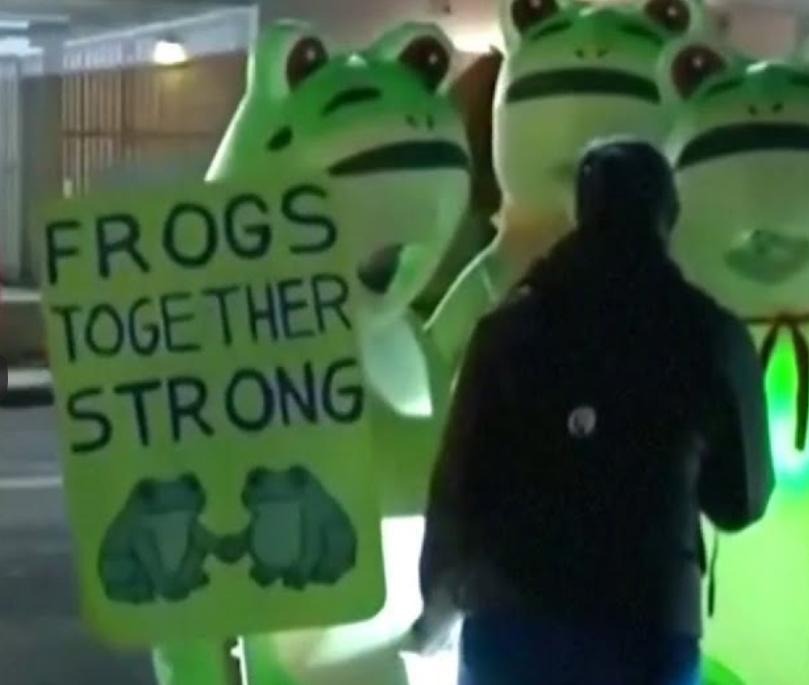
This meme takes on the style of fascist propaganda by replacing national symbols with animals and a collective promise of strength. The text "FROGS TOGETHER STRONG" mimics aggressive political rhetoric used to enforce unity, but instead of rallying people around a nation, it is trying to unite frogs through cartoon imagery.
detailed-analysis (gemma3_27b-it-q8_0)
Okay, let's break down this image from an anti-fascist perspective, utilizing the requested theoretical frameworks where applicable. This is a fascinating and layered meme.
Visual Description
The image shows a person from behind wearing a large, cartoonish frog head. They are holding a sign that reads "FROGS TOGETHER STRONG." The sign also depicts two smaller cartoon frogs. The setting appears to be a public space, possibly a convention or protest due to the lighting and visible signs in the background. The person is wearing dark clothing. The overall aesthetic is deliberately silly and somewhat absurd.
Foucauldian Genealogical Discourse Analysis
This image functions as an intervention within a specific discursive field – the internet's appropriation of the "Pepe the Frog" meme by the alt-right and far-right movements. Foucault would be interested in how this symbol became imbued with meaning. Originally a harmless webcomic character, Pepe was co-opted and transformed, through online usage, into a symbol of hate, often associated with white supremacy, anti-Semitism, and broader fascist ideologies.
The meme reclaims that symbol, but importantly, distorts it. It's no longer about individual, “ironic” expressions of bigotry. It’s a deliberate effort to neutralize the power of the symbol by reducing it to an intentionally ludicrous state. The oversized, cartoonish frog head and the simplistic slogan disrupt the "serious" political weight the alt-right attempted to bestow upon Pepe. It’s a genealogical operation, in that it traces the evolution of the symbol and then attempts to rewrite its history, undermining the power structures that leveraged it. This "froggification" can be seen as a counter-discourse, attempting to dismantle the association of the frog with hateful ideologies through saturation and mockery.
Critical Theory
From a critical theory lens (drawing heavily from the Frankfurt School), this meme speaks to the broader strategies of resistance to the “culture industry”. The alt-right’s appropriation of Pepe was a form of cultural hijacking—taking something innocent and repurposing it to spread harmful ideologies. This response actively disrupts that process. The meme demonstrates an understanding of how symbols operate as vehicles for ideology.
More broadly, the meme is critical of the very seriousness of right-wing politics. The absurdity of "Frogs Together Strong" suggests a rejection of the pseudo-intellectual, pseudo-philosophical justifications offered by far-right groups. It’s a refusal to engage on their terms, instead opting for ridicule as a form of resistance. This is a rejection of the “instrumental rationality” that Critical Theorists like Horkheimer and Adorno argued was central to fascism.
Marxist Conflict Theory
While seemingly apolitical on the surface, the meme embodies a class consciousness. The alt-right often positions itself as a reaction to "political correctness" and a defense of traditional hierarchies. The meme, in its absurdity, challenges those hierarchies. It's a symbolic disruption of the power dynamics the alt-right seeks to uphold.
Moreover, the meme’s viral spread through online spaces indicates a grassroots movement, a “counter-hegemonic” force challenging the dominant narratives perpetuated by right-wing media and institutions. The "frogs" represent a collective identity resisting a perceived enemy. It can be read as a performative demonstration of solidarity and the creation of a new, oppositional culture. The meme functions as a gesture that reclaims agency in a digital space dominated by the forces of capitalist exploitation and reactionary politics.
Postmodernism
The meme's embrace of irony, pastiche, and self-awareness aligns with postmodern sensibilities. The very concept of a group identifying as "Frogs Together Strong" is inherently anti-essentialist. It rejects the idea of fixed identities and embraces the fluidity of meaning.
The meme plays with the signifier ("frog") while deliberately deconstructing its former, hateful signified. It’s a demonstration of the postmodern assertion that meaning is not inherent in objects or symbols, but is socially constructed. By appropriating and re-contextualizing Pepe, the meme undermines the alt-right’s attempt to fix its meaning as a symbol of hate. The meme showcases how meaning can be disrupted and subverted through playful and ironic manipulation.
Queer Feminist Intersectional Analysis (Applicable, but nuanced)
This is where the analysis gets more complex. The appropriation of Pepe has strong ties to online misogyny and harassment (often directed towards women and marginalized genders within gaming communities, a space where Pepe originated and proliferated). The meme, while reclaiming the symbol, doesn't directly address this history.
However, the very act of reclaiming something used to harass and marginalize can be seen as a queer act of resistance. It's an attempt to transform a symbol of hate into something harmless, potentially empowering. The absurdity and silliness could also be read as a rejection of the hyper-masculinity often associated with far-right ideologies.
Further, the collective identity ("Frogs Together Strong") potentially embodies the spirit of coalition building essential to intersectional activism. While the specificity of this connection is limited, the meme speaks to the broader need for solidarity across different marginalized groups.
In conclusion, this meme is not simply a joke. It’s a sophisticated, multi-layered intervention in a complex political landscape. It leverages irony, absurdity, and a deep understanding of how symbols function to challenge and disrupt the forces of fascism and hate. It is a digital act of resistance, a reclamation of a hijacked symbol, and a demonstration of the power of collective action.
simple-description (llama3.2-vision_11b)
The meme features a cartoon frog with a smug expression, holding a sign that reads "Frogs together strong". This image is likely a satirical take on the "Frog" meme, which originated on social media to represent a group of people united in their anti-fascist or left-wing politics. The image pokes fun at the idea of a group of frogs being "strong" together, implying that even a group of frogs can be powerful and united in their anti-fascist or left-wing politics.