First Seen
2026-04-02T05:22:32+00:00
simple-description (qwen3.5_2b-q8_0)
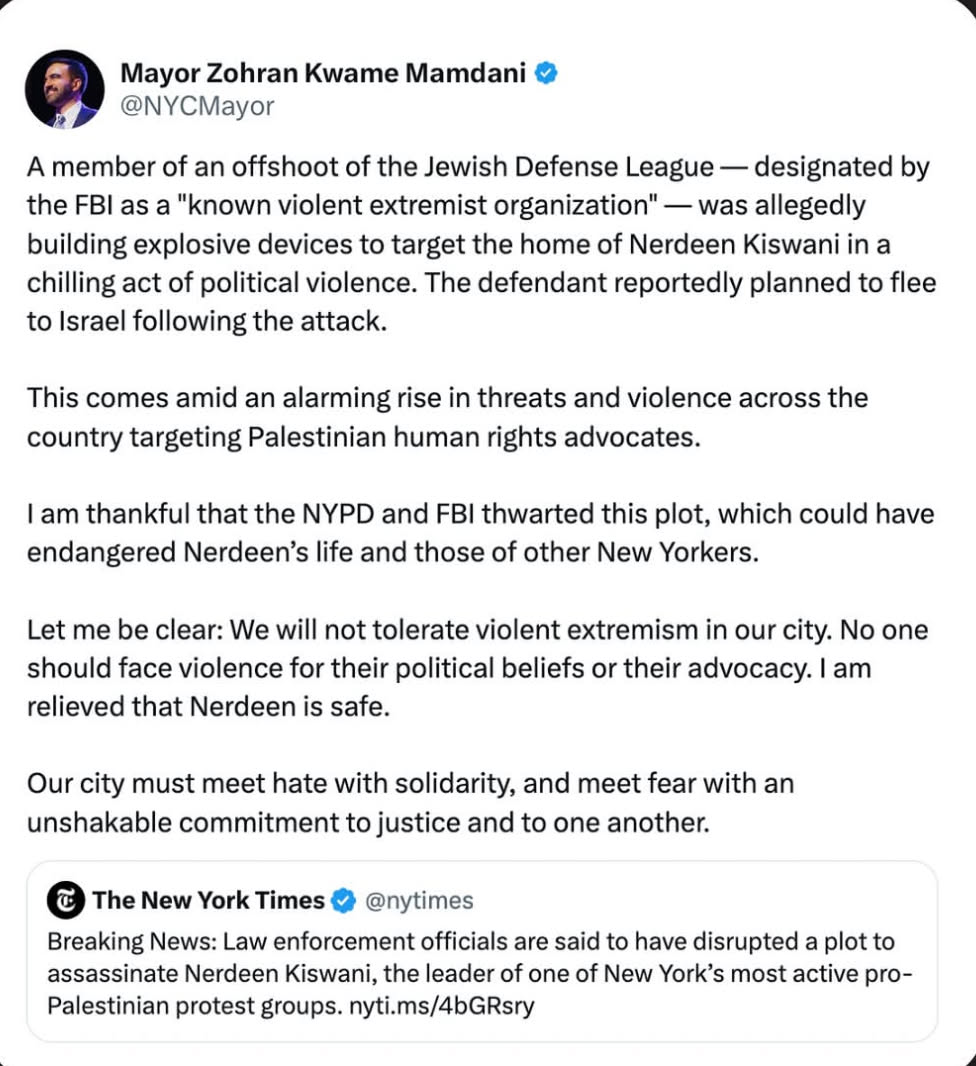
This image depicts a government crackdown on an extremist group targeting Palestinian activists, reinforcing the anti-fascist narrative of protecting minorities. Specifically, Mayor Mamdani and The New York Times report that law enforcement successfully stopped a plot to assassinate Nerdeen Kiswani, demonstrating a state commitment to justice over violence toward vulnerable populations.
detailed-analysis (gemma3_27b-it-q8_0)
Okay, let's analyze this social media post (from NYC Mayor Eric Adams, with a retweeted New York Times article) through the lens of Anti-Fascism, and explore relevant theoretical frameworks where applicable. It’s important to note that Anti-Fascism isn’t a single rigid ideology but a broad movement united by opposition to fascism and related ideologies.
Understanding the Core: Anti-Fascist Perspective
From an Anti-Fascist perspective, this post represents a direct confrontation with, and disruption of, a fascist-adjacent threat. The key components triggering an Anti-Fascist response are:
- Targeted Political Violence: The attempted bombing of Nerdeen Kiswani’s home isn't just a crime; it's a strategic act of intimidation aimed at silencing Palestinian advocacy. Anti-Fascists see such tactics as core to the fascist playbook: using violence or the threat of violence to suppress dissent and maintain hierarchies.
- The Perpetrator's Affiliation: The connection to a “Jewish Defense League” offshoot, designated by the FBI as a “known violent extremist organization,” is crucial. While the phrase “Jewish Defense League” is complex (see below in the Genealogical Discourse section), Anti-Fascists recognize that extremist groups, regardless of professed identity, can embody fascist tendencies when they resort to violence and authoritarian tactics. The focus isn’t on the identity of the perpetrators, but their actions and the ideology driving those actions.
- Escalating Threats: The post accurately flags the wider context of a “rise in threats and violence…targeting Palestinian human rights advocates.” This pattern is interpreted as part of a broader authoritarian trend, seeking to suppress pro-Palestinian activism which is often viewed as a challenge to power structures supportive of Israel.
- Solidarity and Resistance: The Mayor's call for “solidarity” and “justice” is seen as a positive step, even if potentially limited given his position. For Anti-Fascists, resisting these threats requires not just law enforcement action, but also community organizing, mutual aid, and direct action to protect targeted individuals and movements.
Visual Description
The post features a screenshot of a tweet from NYC Mayor Eric Adams. It includes his profile picture and a link to a New York Times breaking news article. The image isn't inherently symbolic, but the text within the tweet and the linked article convey a sense of urgency and danger. The visual presentation is standard for a political statement on social media.
Foucauldian Genealogical Discourse Analysis
A Foucauldian approach would analyze the discourse surrounding the Jewish Defense League (JDL) and its offshoots, and how power operates through the labeling of "extremism."
- The Construction of "Extremism": The term "extremist" isn’t neutral. It's a category created through power dynamics, often used to delegitimize certain political positions. Examining how the JDL came to be labeled "violent extremist" by the FBI reveals a history of surveillance, repression, and the exercise of state power.
- The JDL’s Historical Context: The JDL emerged in the 1960s and 70s, initially with aims of defending Jewish people against antisemitism, but quickly adopted increasingly militant and violent tactics. Its ideology blended elements of nationalism, religious fundamentalism, and revanchism. Tracing its genealogy (its historical development) shows how it drew upon pre-existing discourses of victimhood, national identity, and the justification of violence in self-defense.
- The Production of the "Enemy": The JDL’s rhetoric often focused on demonizing perceived enemies, including Palestinian activists and those deemed "enemies of Israel." This process of "othering" is crucial to understanding how violence is justified and normalized.
- Discourse and Power: The Mayor's statement, and the New York Times article, contribute to the ongoing discourse around extremism. The way they frame the event—focusing on the threat to a specific individual and the disruption of a plot—reinforces the narrative of the state protecting its citizens from dangerous elements.
Critical Theory
From a Critical Theory perspective, this event reveals the inherent contradictions within liberal democratic systems.
- The Illusion of Neutrality: The state (represented by the NYPD and FBI) is presented as an impartial protector of all citizens. However, Critical Theory would point out that the state is inherently biased and serves the interests of dominant groups. The fact that Palestinian advocates are disproportionately targeted suggests that the state is not neutral in the Israeli-Palestinian conflict.
- Ideology and Repression: The attempted attack on Kiswani, and the broader pattern of threats against Palestinian activists, can be seen as a form of ideological repression – attempts to suppress dissenting voices and maintain the status quo.
- Critique of Legal Frameworks: The reliance on law enforcement intervention, while seemingly positive, can also be seen as a way to manage and contain dissent rather than addressing the root causes of the problem. The focus on individual perpetrators obscures the systemic issues that contribute to extremism.
- The Role of Media: The New York Times article, while reporting the event, could be analyzed for how it frames the issue and what narratives it reinforces. Does it contextualize the threat within the broader political landscape? Does it offer a critical perspective on the role of the state?
Marxist Conflict Theory
A Marxist analysis views this event as a manifestation of class struggle and the inherent contradictions of capitalism.
- Imperialism and Colonialism: The Israeli-Palestinian conflict is deeply rooted in the history of colonialism and imperialism. Palestinian advocacy is often seen as a challenge to the power structures that perpetuate these systems. The attack on Kiswani can be seen as an attempt to suppress that challenge.
- The Role of the State: The state, in a Marxist view, serves the interests of the ruling class. Its response to the threat will be shaped by those interests. While condemning the violence, the state may also seek to control and monitor Palestinian activism.
- Ideological Control: The discourse surrounding "extremism" and "terrorism" can be used to justify state repression and maintain the dominance of capitalist ideology.
- Class Divisions within Jewish Community: Examining the JDL's social base can reveal underlying class dynamics. While antisemitism is a serious issue, the JDL's ideology often appeals to certain segments of the Jewish community who feel alienated or marginalized by mainstream society.
Postmodernism
A Postmodern perspective would deconstruct the categories and narratives at play.
- Deconstructing "Extremism": The term "extremism" is inherently unstable and lacks a fixed meaning. It's a socially constructed category that is used to define and control "otherness."
- The Fragmentation of Identity: The JDL's identity is complex and fragmented, blending religious, national, and political elements. There is no single, coherent "JDL" ideology.
- The Instability of Truth: The narratives surrounding the event—the Mayor's statement, the New York Times article—are not objective representations of reality but rather constructed interpretations.
- The Power of Discourse: Postmodernism emphasizes the power of language to shape our understanding of the world. The way the event is framed—the choice of words, the emphasis on certain details—influences how we perceive it.
Queer Feminist Intersectional Analysis
While not immediately central, an intersectional lens can illuminate the layers of vulnerability.
- Interlocking Systems of Oppression: This attack operates within interlocking systems of oppression—Islamophobia, racism, anti-Palestinianism, and potentially, depending on Kiswani’s other identities, homophobia, transphobia, etc.
- Silencing Marginalized Voices: The targeting of a Palestinian advocate, particularly a woman, reinforces the silencing of marginalized voices. Women of color are often subjected to greater levels of violence and intimidation.
- Critique of State Violence: An intersectional feminist perspective would critique the state's reliance on law enforcement intervention as a solution, recognizing that the state is often complicit in perpetuating systems of oppression.
In conclusion: This event, viewed through an Anti-Fascist lens, is a serious escalation of targeted political violence. The theoretical frameworks above help us understand the context, power dynamics, and ideological underpinnings of this threat, and the complexities of responding to it effectively. It's a call to vigilance, solidarity, and a commitment to dismantling the structures that enable such violence.
simple-description (llama3.2-vision_11b)
The meme is a tweet from New York City's mayor, responding to the offshoot of the Jewish Defense League (JDL) who is known to be an extremist group. The JDL member was trying to kill an Israeli- American woman, who was in the US to protest Israel’s actions in Palestine. The tweet is in response to the JDL member’s actions, and the mayor’s response is to thank the FBI for their help in stopping the JDL member.