First Seen
2026-04-20T00:23:52+00:00
simple-description (qwen3.5_2b-q8_0)
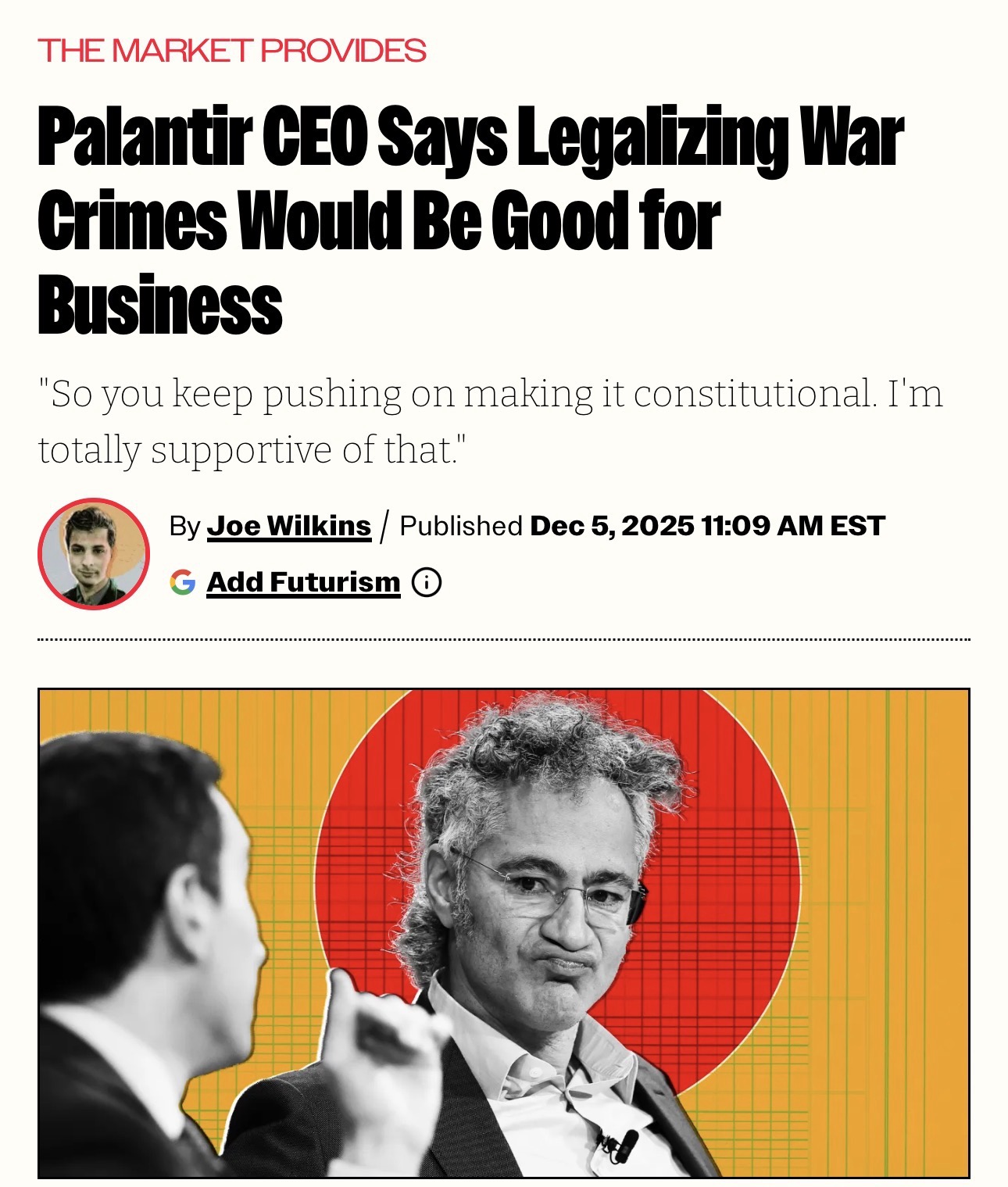
This satirical image portrays Alex Karp, the CEO of Palantir, appearing smugly behind a graphic background as if explaining a concept to an interviewer. The text quotes him jokingly claiming that forcing businesses to support constitutionalizing war crimes would be "good for business." From an anti-fascist viewpoint, this mocks the absolute power over corporations held by totalitarian leaders who prioritize regime stability above all else, demanding that companies remain silent or compliant while their leaders dictate what political topics are acceptable.
detailed-analysis (gemma3_27b-it-q8_0)
Okay, here's an analysis of the image/meme from an anti-fascist perspective, broken down into relevant theoretical frameworks. I'll include only the sections that genuinely apply. Given the content, a significant portion will focus on Critical Theory and Marxist Conflict Theory. I'll also include a section on Foucauldian analysis, as it's helpful in understanding power dynamics.
Visual Description
The image shows Alex Karp, CEO of Palantir Technologies, speaking at a conference or event. He's shown in a dynamic pose, mid-sentence, with intense eye contact. Behind him is a large, red circular backdrop overlaid on a grid. A person with a suit can be seen on the left side of the image, in profile. The text headline reads "Palantir CEO Says Legalizing War Crimes Would Be Good for Business," with a quote, "So you keep pushing on making it constitutional. I’m totally supportive of that." The article is by Joe Wilkins and published on December 5, 2025.
The red circle immediately evokes imagery associated with warnings, danger, or, historically, fascist iconography. The grid backdrop suggests a system, control, and potentially, surveillance (fitting given Palantir's core business). Karp’s enthusiastic expression juxtaposed with the appalling content of his quote is jarring and disturbing. It highlights the callousness and prioritization of profit over ethics.
Foucauldian Genealogical Discourse Analysis
From a Foucauldian perspective, this meme reveals the ways in which power/knowledge constructs norms around warfare and capitalism. The quote isn't just a statement; it's a demonstration of how discourses related to security, national interest, and economic growth can normalize, even demand, the acceptance of violence and atrocity.
Karp’s statement attempts to reposition ‘war crimes’ from a category of unethical, illegal actions to a matter of legal definition – a matter of “constitutionality”. This is a key Foucauldian tactic: to redefine the boundaries of what is acceptable by reshaping the discourses surrounding it. By pushing for its "constitutionality," Karp seeks to legitimize and normalize these acts through the framework of law and order, effectively erasing the moral boundaries that condemn them.
The genealogy would trace how notions of “acceptable losses” or "collateral damage" have evolved within military and business discourse, creating a context where such statements are even conceivable. Palantir's existence itself is predicated on this – on providing the technological tools that facilitate modern warfare and, inevitably, the potential for its atrocities. The company's work in surveillance and data analysis produces the knowledge that allows these acts to occur and be rationalized.
Critical Theory
This image is a powerful illustration of the central tenets of Critical Theory. It explicitly demonstrates how power structures (in this case, concentrated in corporations like Palantir and within political elites) utilize ideology to maintain their dominance.
The quote represents a blatant example of the instrumentalization of reason. Karp isn’t concerned with morality or justice; he's applying a purely rational, utilitarian calculation: legalizing war crimes benefits his business. This is a distortion of reason, turning it into a tool for oppression and profit.
This also reveals the culture industry at work. The fact that this statement was made publicly in a forum (a conference) and then reported on suggests a deliberate normalization of these dangerous ideas. The media's reporting, even if critical, contributes to the circulation of this discourse, allowing it to enter the public sphere.
The meme further exemplifies the critical theory concept of reification – the process by which social relations become treated as natural, objective things, obscuring the power dynamics that created them. The idea that “business” inherently requires or benefits from the legitimization of war crimes is presented as a given, rather than a socially constructed outcome of a specific economic and political system.
Marxist Conflict Theory
From a Marxist perspective, this meme reveals the inherent contradictions of late-stage capitalism. The pursuit of profit, a defining characteristic of the capitalist mode of production, is shown to actively necessitate and encourage the embrace of barbarism.
Palantir, as a company specializing in data analytics and surveillance technologies for governments and military contractors, directly benefits from the expansion of military power and the perpetuation of conflict. Karp’s statement is an expression of class interest: his economic well-being is directly tied to the continuation of a system that relies on violence and exploitation.
The desire to "legalize war crimes" underscores the need for capital to overcome any obstacles – including ethical and legal constraints – that impede its accumulation. The state, in a Marxist framework, is seen as an instrument of class rule, and Karp’s appeal to “constitutionality” suggests a desire to utilize the legal system to protect and advance the interests of the capitalist class.
The meme exposes the fundamental conflict between the interests of the working class (who bear the brunt of war and its consequences) and the interests of the capitalist class (who profit from it). It highlights how capitalism inherently generates conflict and violence as a means of expansion and control.
In summary, the meme is not simply a shocking statement; it’s a concentrated expression of the dangerous convergence of corporate power, militarism, and the erosion of ethical boundaries. From an anti-fascist perspective, it serves as a warning about the normalization of violence and the insidious ways in which capitalism can incentivize and legitimize even the most horrific acts. It is a call to recognize the connections between economic exploitation and political oppression, and to actively resist the forces that seek to benefit from both.
simple-description (llama3.2-vision_11b)
The meme features a screenshot of an article from "THE MARKET PROVIDES" with the title "Palantir CEO Says Legalizing War Crimes Would Be Good for Business." The article's author, Joe Wilkins, quotes Palantir CEO Alex Kassovitz as saying, "So you keep pushing on making it constitutional. I'm totally supportive of that." The quote is followed by the text "By Joe Wilkins / Published Dec 5, 2025 11:09 AM EST" and a link to add to Google's "Futurism" section. The article's background is white, with the title and author's name in black, and the quote in gray. The image of Kassovitz is in black and white, with a red circle behind him. The image is overlaid with a yellow and green grid pattern, and a black border surrounds the entire image. The meme is likely intended to be humorous or satirical, as it appears to be making a statement about the ethics of war crimes and the role of corporations in society. The use of a palantir (a fictional device that can see into the future) as the title of the article and the use of a red circle behind Kassovitz's image may be intended to add to the irony or satiric nature of the article. Overall, the meme is likely meant to be thought-provoking and to encourage readers to think critically about the role of corporations in society and the ethics of war crimes.