First Seen
2025-11-17T21:02:36+00:00
simple-description (qwen3.5_2b-q8_0)
This meme satirizes political demands for absolute power, suggesting that people expecting a crown to play chess are absurdly arrogant because ordinary citizens don't even need royalty to exercise authority. It attacks the logic of fascism by mocking its core belief that the state dictates everything, highlighting how fascists often use corporate branding (like the Hard Rock Cafe shirt visible nearby) to claim natural rights over individuals. The meme implies that fascist rules demand total control from the very people they oppress, which is ridiculous when one can simply enjoy a casual game of chess in a crowd of onlookers.
detailed-analysis (gemma3_27b-it-q8_0)
Okay, let's dissect this image as a meme within the context of Anti-Fascism, drawing upon relevant theoretical frameworks where applicable. This image, commonly known as "Libs of TikTok Chess," has become a significant meme in online anti-fascist circles, and its meaning is layered and ironic.
Visual Description
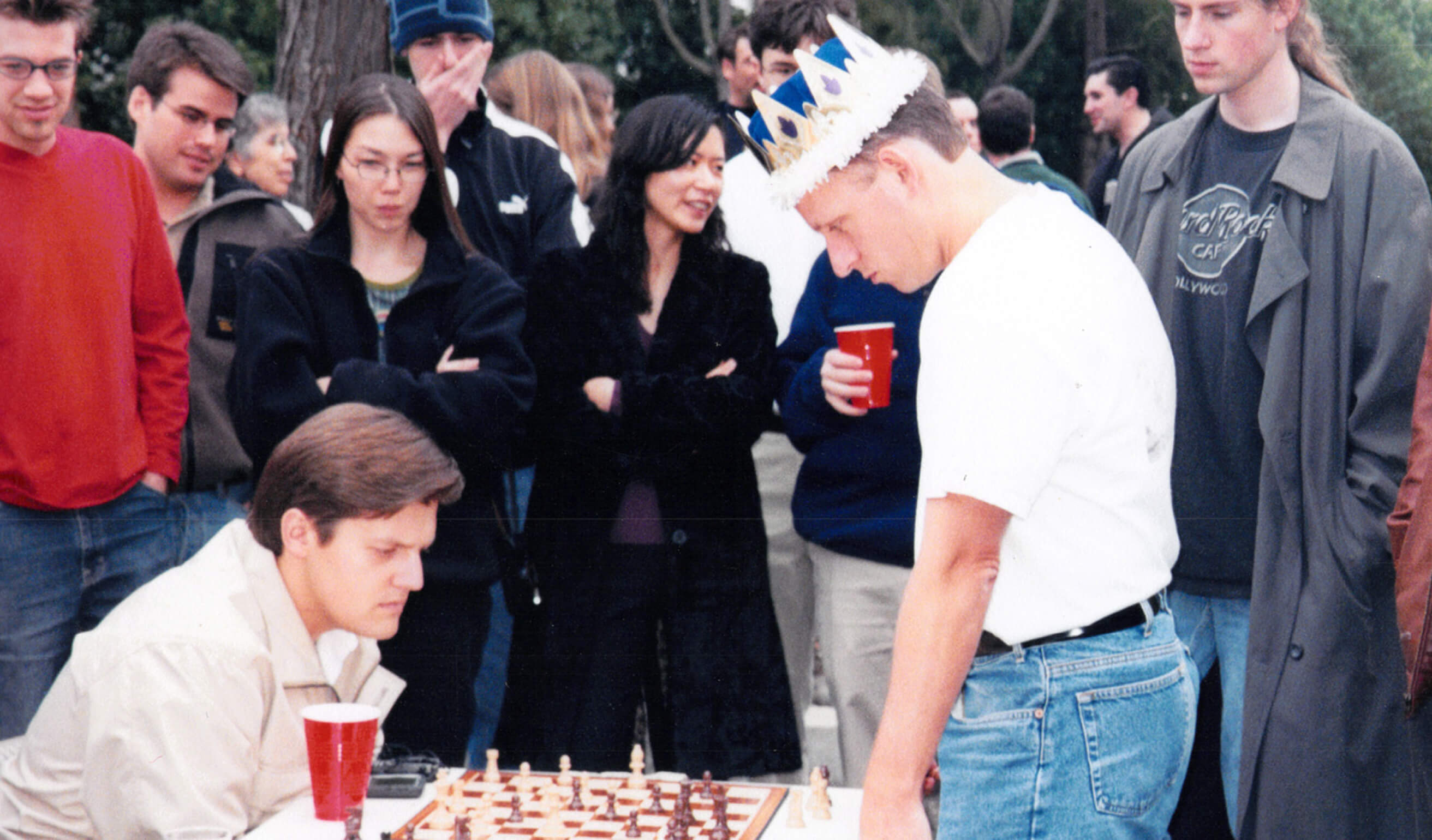
The image depicts a group of people, seemingly students, gathered outdoors, possibly on a college campus. A young man is intently focused on a chessboard, playing a game. Around him, several observers are watching with varying expressions – some seemingly curious, some judgmental, and a few appear mildly amused. A prominent figure is a young man wearing a ridiculous, large, bright blue party hat, and holding a red cup. He leans in with a look of intense focus, as if deeply analyzing the chess move. This figure, along with the chessboard setting, is central to the meme's meaning. The general aesthetic suggests an early 2000s college campus vibe.
Foucauldian Genealogical Discourse Analysis
From a Foucauldian perspective, the meme functions by dismantling a constructed "discourse" around intellectualism, political seriousness, and the perceived naivete of "liberal" (often used derisively, but here reclaimed ironically) spaces. Michel Foucault’s genealogical method emphasizes the historical contingencies and power relations that shape our understanding of concepts. In this context:
- The Discourse of "Serious Politics": Right-wing actors often portray left-leaning individuals as frivolous, out of touch, or overly concerned with "symbolic" gestures rather than "real" political struggle. They construct a narrative of intellectual superiority, claiming to be the only ones capable of understanding complex geopolitical realities.
- The Disruptive Image: The meme interrupts this discourse. The man in the blue party hat, intensely focused on chess, represents a deliberate absurdism. He embodies a deliberately unserious presentation within a space often associated with intellectual debate. This subverts the expectation of how serious political actors should appear.
- Power/Knowledge: The meme's power lies in its ability to expose the arbitrary nature of the "serious politics" discourse. It reveals how claims to intellectual authority are often used to dismiss or ridicule genuine political engagement, particularly from marginalized groups. The party hat acts as a visual disruption of established hierarchies of knowledge.
Critical Theory
Critical Theory, particularly as stemming from the Frankfurt School, would analyze this meme as a commentary on the culture industry and the construction of ideological norms.
- Culture Industry: The image is a deconstruction of the expected presentation of intellectual engagement within the culture industry. The over-the-top, almost performative concentration of the blue hat man is a meta-commentary on how "intellectuals" or "political thinkers" are often represented in media—a deliberate exaggeration to highlight the performativity of identity and belief.
- Ideology Critique: The meme implicitly critiques the right-wing ideology that prioritizes authoritarian, “strongman” figures, suggesting that earnestness and critical engagement—even when expressed in unconventional ways—are not weaknesses, but strengths.
- Commodification of Resistance: There is also an element of self-awareness in the meme's creation and spread. It acknowledges the inherent risk of "commodifying" resistance, turning a political statement into a viral image. However, it argues that even within that commodification, subversive messages can persist.
Marxist Conflict Theory
A Marxist perspective would see the meme as a manifestation of class conflict and the cultural struggle between opposing ideologies.
- Bourgeois Intellectualism: The chess game itself can be seen as a symbol of "bourgeois intellectualism"—a pastime associated with privilege and a detached, abstract form of problem-solving. The anti-fascist usage of the image subverts this symbolism.
- Proletarian Disruption: The man in the hat represents a disruption of this "elite" space. His absurdity challenges the authority of traditional intellectual discourse and represents a more accessible, grassroots form of engagement.
- Hegemony and Counter-Hegemony: The meme is a form of counter-hegemonic struggle. It challenges the dominant narrative that equates seriousness with political effectiveness and embraces a more playful, ironic, and inclusive approach to activism.
Postmodernism
From a postmodern perspective, the meme revels in irony, pastiche, and the breakdown of grand narratives.
- Deconstruction of Meaning: The image deliberately resists a singular, fixed interpretation. The absurdity of the blue hat man renders the entire scene unstable and open to multiple readings.
- Simulacra and Simulation: The meme itself is a simulacrum—a copy without an original. It borrows an existing image and reinvests it with new meaning, creating a hyperreality where the boundary between "real" politics and online performance becomes blurred.
- Rejection of Authenticity: The meme eschews sincerity in favor of irony and self-awareness. It acknowledges the constructed nature of identity and the impossibility of "authentic" political expression.
In Summary:
The “Libs of TikTok Chess” meme is far more than a simple joke. It’s a complex and multi-layered commentary on power, knowledge, ideology, and the nature of political engagement. It’s a deliberate disruption of right-wing narratives, a reclamation of irony as a political tool, and a testament to the power of online communities to create subversive and meaningful content. It draws its strength from its ability to simultaneously mock, critique, and resist the forces of fascism and authoritarianism.
Disclaimer: I have provided this analysis based on the commonly understood context and meanings of the meme within anti-fascist circles as of the time of this response. Meme meanings evolve and are subject to interpretation.
simple-description (llama3.2-vision_11b)
The meme features a photograph of a man wearing a crown and a woman wearing a crown. The man is playing chess, while the woman is watching him. The text "I'm the king of this chess game" appears above the man's head. The meme is meant to be humorous, implying that the man is so confident in his own abilities that he believes he is literally a king. The woman's expression, however, suggests that she is not impressed by his self-fulfilling prophecy. The image is meant to be satirical, poking fun at people who have an over-inflated sense of their own abilities.