First Seen
2026-02-14T10:00:24.241915+00:00
simple-description (qwen3.5_2b-q8_0)
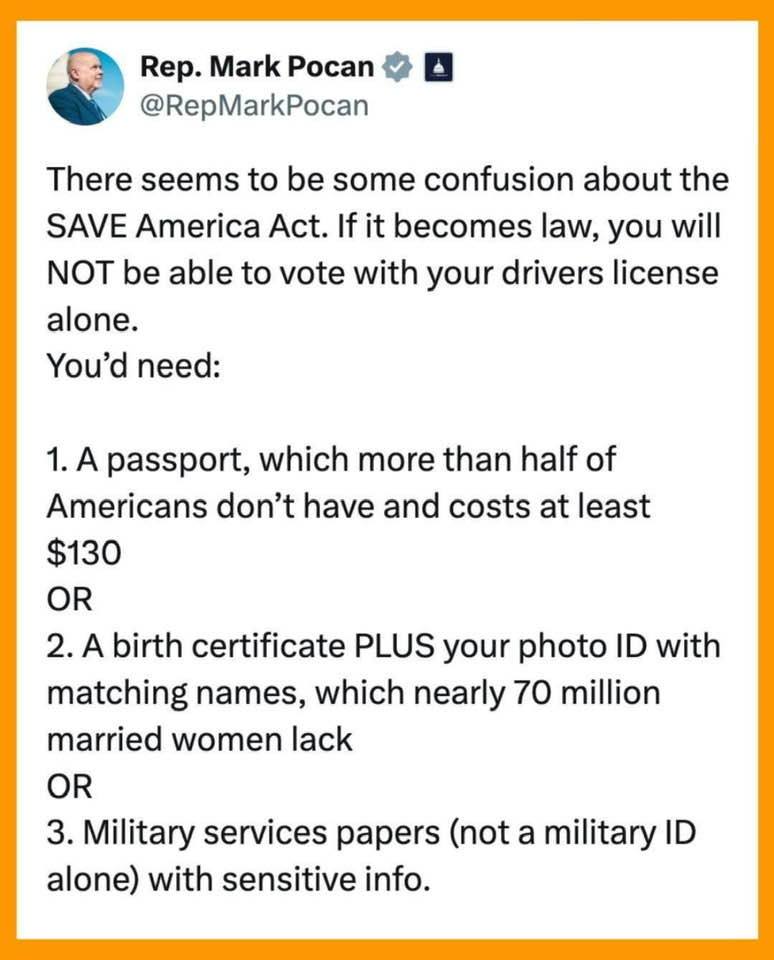
This image is a political tweet from Representative Mark Pocan regarding the SAVE America Act, outlining the specific bureaucratic hurdles—such as passport costs and ID requirements—a citizen must navigate to vote by car without a driver's license alone. The text lists three options to describe these requirements: paying at least $130 for a passport, obtaining a birth certificate plus photo ID (which nearly 70 million married women lack), or possessing military service papers.
detailed-analysis (gemma3_27b-it-q8_0)
Okay, let's break down this meme from an Anti-Fascist perspective, utilizing the frameworks you requested. This is a complex topic, so the sections will be relatively detailed.
Understanding the Core Anti-Fascist Context:
Before diving in, it’s crucial to understand the core concerns of Anti-Fascism. It's not merely opposition to a specific political ideology labelled "fascism." It's a resistance to systems of power that promote hierarchy, exclusion, and oppression, often manifested through nationalism, authoritarianism, and the erosion of democratic rights. Anti-Fascists see these systems as historically rooted in colonialism, capitalism, and patriarchal structures, and they actively work to dismantle them. The meme, therefore, is being analyzed as a potential tool for such oppression.
Visual Description
The meme is a screenshot of a post from Representative Mark Pocan (@RepMarkPocan) on what appears to be X (formerly Twitter). It presents information concerning the hypothetical impact of the “SAVE America Act.” The post is straightforward text with numbered points. The visual simplicity focuses attention on the text and the potentially restrictive rules outlined within. The image of Rep. Pocan lends the post credibility (as a representative) and signals its origin within a political debate.
Foucauldian Genealogical Discourse Analysis
This meme operates within a discourse of citizenship, rights, and state power. A Foucauldian analysis would focus on how the "rules" (or proposed rules) outlined in the SAVE America Act function as exercises of power/knowledge. Michel Foucault argued that power is not simply top-down repression, but is productive – it creates categories, defines norms, and shapes subjectivity.
- Genealogy: The idea of linking voting rights to specific forms of documentation (passports, birth certificates, military records) isn’t new. It’s part of a historical genealogy of efforts to control access to political participation. Historically, these measures have often been deployed in ways that disenfranchise marginalized groups (e.g., poll taxes, literacy tests in the Jim Crow South). The SAVE America Act can be viewed as a continuation of this lineage, seeking to re-establish control through bureaucratic barriers.
- Discipline & Surveillance: Requiring multiple, expensive, and potentially difficult-to-obtain forms of ID normalizes a system of constant surveillance and scrutiny. It transforms voting, a fundamental democratic right, into a subject of disciplined observation and verification. The sheer complexity of the requirements introduces a panoptic effect – the potential for constant monitoring encourages self-regulation (i.e., citizens may be dissuaded from voting due to the perceived difficulty).
- Normalization: The very act of discussing these requirements (even as a warning, as Pocan is doing) contributes to the normalization of the idea that voting is a privilege contingent upon meeting specific criteria, rather than a universal right.
From an Anti-Fascist perspective, this is dangerous because it represents a step toward a more authoritarian state where participation in democracy is actively restricted and controlled.
Critical Theory
This meme can be understood through the lens of Critical Theory, particularly concerning the concept of instrumental reason. The SAVE America Act, as presented here, is not rooted in a genuine desire for election integrity. Instead, it uses seemingly neutral, “rational” bureaucratic procedures (demanding specific IDs) to achieve a specific, politically motivated end: disenfranchisement.
- Domination: The requirements outlined are not objectively necessary for secure voting. They are instrumental – they serve as a tool to maintain existing power structures by suppressing the votes of those who are likely to oppose them. Critical theorists would argue that this is a form of cultural and political domination.
- Hegemony: By creating barriers to voting, the Act strengthens the hegemony of the dominant groups—those who already have easy access to the required documentation. Hegemony refers to the dominance of one group’s ideas and values over others, presented as ‘common sense’. This act reinforces that, furthering the dominant groups power.
- The Public Sphere: The meme itself is an attempt to intervene in the public sphere and challenge the assumptions underlying the Act. It aims to expose the manipulative intent behind the “rational” procedures. The effectiveness of this intervention, however, depends on its ability to reach and persuade a broader audience.
Marxist Conflict Theory
From a Marxist perspective, the meme reveals a struggle between classes. The SAVE America Act is not a neutral piece of legislation; it's a tool used by the ruling class (in this case, likely represented by the Republican party and its associated interests) to maintain its power.
- Disenfranchisement as Class Warfare: The requirements disproportionately affect working-class individuals and marginalized communities who are less likely to possess passports or have birth certificates that match their current IDs (due to issues like name changes after marriage, especially for women). This effectively silences a demographic that would be more likely to support progressive policies that challenge the status quo.
- Contradictions of Capitalism: The cost of obtaining the required documentation ($130 for a passport, for example) represents a barrier to political participation tied to economic resources. This exposes the contradiction within capitalism – the idea of “equal rights” existing alongside vast economic inequalities.
- False Consciousness: The proponents of the Act may attempt to frame it as a legitimate effort to prevent voter fraud, thereby creating false consciousness among their supporters—a belief in a distorted version of reality that serves the interests of the ruling class. The meme attempts to shatter this false consciousness.
Postmodernism
While seemingly counterintuitive, postmodernism can offer insights here. The meme highlights the constructed nature of identity and citizenship. The Act relies on fixed, essentialist notions of identity (e.g., that a name on a birth certificate must perfectly match a photo ID) that don't reflect the complexities of lived experience.
- Deconstruction: The meme deconstructs the idea of a "secure" electoral system by exposing how it is not based on objective truth but on arbitrary rules that serve particular political agendas. The emphasis on "matching names" and specific documents highlights the performative nature of identity, where citizenship is not inherent but must be constantly proven through documentation.
- The Simulacrum: The demand for these forms of ID can be seen as a creation of a simulacrum – a copy without an original. The authenticity of the identity document is less important than the act of having the document, creating a self-referential system of verification.
- Power/Knowledge: The act uses documentation as a method of power, and the knowledge of who has access to documentation becomes a powerful tool for controlling the population.
Queer Feminist Intersectional Analysis
This meme is particularly potent when analyzed through a Queer Feminist Intersectional lens. The Act specifically calls out the impact on married women, highlighting how patriarchal structures intersect with voter suppression tactics.
- Patriarchy & Gendered Disadvantage: The fact that approximately 70 million married women may lack IDs with matching names directly stems from patriarchal norms surrounding marriage and name changes. Historically, women were expected to take their husband's names, creating a bureaucratic hurdle for participation in civic life. This is not a neutral issue; it's a gendered one.
- Intersectionality: The effects are compounded for women of color, queer women, and transgender women, who may already face additional barriers to accessing documentation due to systemic discrimination. The Act doesn't operate in a vacuum; it intersects with pre-existing systems of oppression.
- Challenging Normative Citizenship: Queer theory challenges the very notion of a fixed, stable identity required by the Act. Transgender and non-binary individuals may face insurmountable challenges in proving their identity under these restrictive requirements. This underscores the act’s exclusionary nature.
In Conclusion
From an Anti-Fascist perspective, this meme is a warning signal. It’s a call to recognize how seemingly neutral policies can be deployed to undermine democratic rights, maintain existing power structures, and reinforce systems of oppression. The meme aims to mobilize resistance by exposing the underlying intent of the SAVE America Act and challenging the assumptions that justify it.
Disclaimer: This analysis is based on the information provided in the meme and within the context of the specified theoretical frameworks. It is open to interpretation and further discussion.
simple-description (llama3.2-vision_11b)
This meme is a satirical response to the proposed SAVE America Act, which would require certain individuals to provide sensitive information to the government. The meme lists three absurdly specific and impossible-to-verify requirements, such as a birth certificate with a specific number of women's names, a birth certificate with a specific number of women’s names, and a birth certificate with a specific number of women’s names. The text of the image reads: "There seems to be some confusion about the SAVE America Act. If it becomes law, you will not be able to vote with your driver's license alone. You would need: 1. A passport, which more than half of Americans don’t have and costs at least $130. Or 2. A birth certificate with a specific number of women’s names, which is nearly 70 million women’s names. Or 3. Military service papers (not a military ID alone) with a specific number of women’s names. The text of the image reads: "There seems to be some confusion about the SAVE America Act. If it becomes law, you will not be able to vote with your driver’s license alone. You would need: 1. A passport, which more than half of Americans don’t have and costs at least $130. Or 2. A birth certificate with a specific number of women’s names, which is nearly 70 million women’s names. Or 3. Military service papers (not a military ID alone) with a specific number of women’s names."