First Seen
2026-02-13T21:38:13.861551+00:00
simple-description (qwen3.5_2b-q8_0)
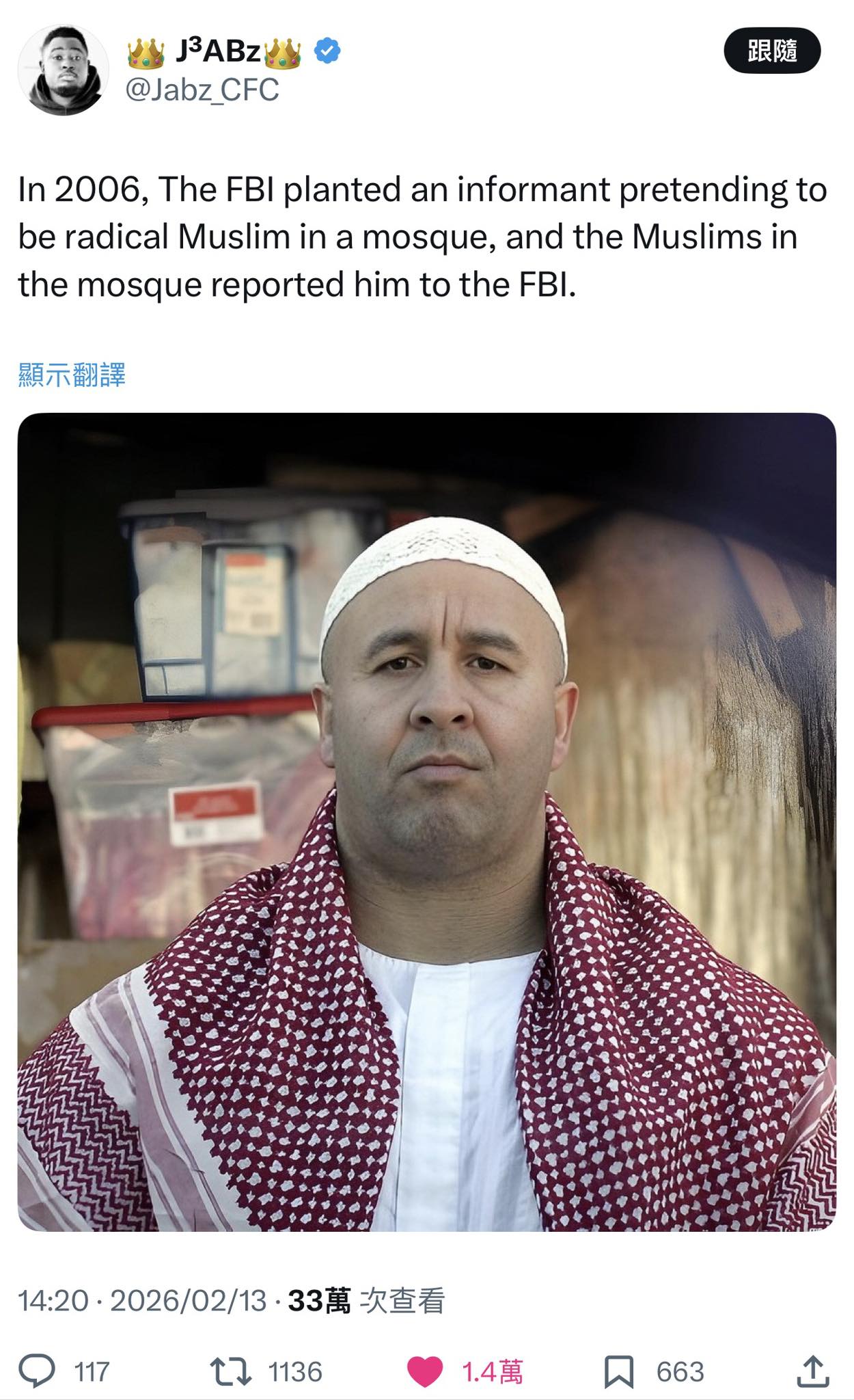
The image displays a man in traditional Islamic attire with text stating that the FBI planted an informant pretending to be a radical Muslim in a mosque to incite violence. From an anti-fascist perspective, this illustrates how state authorities can employ "false flag" tactics to fabricate security threats and divide religious minorities, thereby undermining their own social cohesion and identity through targeted surveillance and disinformation.
detailed-analysis (gemma3_27b-it-q8_0)
Okay, let's break down this meme from an Anti-Fascist perspective, utilizing relevant theoretical frameworks where applicable.
Please Note: The meme relies on a specific historical event (FBI infiltration of mosques post 9/11), and its impact is deeply rooted in real-world consequences for Muslim communities. This analysis seeks to unpack that within the broader context of anti-fascism.
Visual Description
The image features a close-up portrait of a man wearing a kufi (a traditional Muslim cap) and a shemagh (a traditional Arab headdress). His expression is relatively neutral, but a degree of guardedness is present. The background suggests a modest, possibly urban, environment - a shopfront or alleyway. The image quality is relatively simple, suggestive of a still from surveillance or documentation.
Foucauldian Genealogical Discourse Analysis
This meme powerfully engages with Foucauldian concepts of power, surveillance, and the construction of the “Other.”
- Discourse of Terrorism: The historical context (the FBI's post-9/11 actions) is critical. The “War on Terror” produced a discourse around radical Islam, framing certain religious practices and communities as inherently suspect. The FBI’s actions directly constituted this discourse through the very act of attempting to manufacture "radicalization."
- Power/Knowledge: Foucault argued that power and knowledge are inextricably linked. The FBI possessed the power to define what constituted a threat, and in doing so, created the knowledge (even if fabricated) to justify its surveillance and intervention.
- Panopticism: The act of planting an informant evokes the panoptic model. While the Muslims in the mosque might not have known precisely who was an informant, the possibility of surveillance created a chilling effect, altering behavior and self-regulation. It fostered an atmosphere of distrust and suspicion within the community.
- Genealogy: This event is not isolated. It’s part of a longer history of state surveillance targeting marginalized communities, often justified by narratives of national security and the threat of “subversion."
Critical Theory
This meme points directly to the central concerns of Critical Theory: the critique of power structures and the exposure of ideologies that maintain domination.
- Instrumental Reason: The FBI's actions exemplify "instrumental reason" – focusing solely on the efficiency of achieving a political goal (preventing terrorism) without ethical considerations or acknowledging the broader impact on civil liberties and community trust.
- Ideology and False Consciousness: The narrative that Muslim communities are breeding grounds for terrorism is an ideology that serves to justify state repression. This meme challenges that ideology by revealing the deliberate manipulation involved in its construction.
- The Culture Industry: (Though less direct) One could argue the construction of the ‘radical Muslim’ through state action is part of a wider project of the ‘culture industry’ constructing cultural enemies to justify the maintenance of existing power relations.
Marxist Conflict Theory
While not the primary lens, elements of Marxist Conflict Theory are relevant.
- State as an Instrument of Class Rule: The FBI's actions can be viewed as the state acting in the interests of dominant classes by suppressing dissent and potential challenges to the status quo. Fear-mongering around terrorism distracts from economic inequalities and other systemic issues.
- Internal Colonialism: The surveillance and infiltration of Muslim communities can be seen as a form of “internal colonialism” – the oppression of a minority group within a nation-state, mirroring the dynamics of traditional colonialism.
Postmodernism
Postmodernism is less directly applicable, but can contribute to understanding the meme.
- Deconstruction of Grand Narratives: The meme disrupts the "grand narrative" of the "War on Terror" by exposing the fabricated nature of some of its underlying assumptions.
- Simulacra and Simulation: The informant pretending to be radical challenges the notion of a “real” radical – it's a simulation of a threat, blurring the lines between reality and representation.
Anti-Fascist Framing and Implications
From an Anti-Fascist perspective, this meme is significant because:
- It reveals the State's role in manufacturing enemies: Fascism relies on creating and demonizing “others” to consolidate power. This meme highlights how the state actively creates those enemies through surveillance, infiltration, and disinformation.
- It exposes the targeting of marginalized communities: Muslim communities have been disproportionately affected by state repression in the name of national security. Anti-Fascists advocate for solidarity with these communities and oppose all forms of discrimination and surveillance.
- It challenges dominant narratives: The meme disrupts the simplistic portrayal of “radical Islam” as an inherent threat, exposing the political motivations behind its construction.
- It is a form of resistance: Sharing and discussing this meme is a way of challenging state power, raising awareness about historical abuses, and fostering critical consciousness.
In essence, this meme is a powerful indictment of state overreach, a critique of the ideology that fuels it, and a call for vigilance against all forms of oppression. It is a reminder that anti-fascist work requires not only confronting overt displays of hatred but also dismantling the systems and narratives that enable them.
simple-description (llama3.2-vision_11b)
The meme is a photo of a man with a serious expression, wearing a white shirt and a red and white scarf, with a caption that reads: "In 2006, The FBI planted an informant pretending to be a radical Muslim in a mosque, and the Muslims in the mosque reported him to the FBI." The meme is likely commenting on the FBI's use of informants in the 2006 ... more context needed. The image is likely a photo of a man who is not a Muslim, and is not part of a mosque. The meme is likely making a point about the FBI's use of informants in the 2006 ... more context needed.