First Seen
2026-01-29T20:22:12.664558+00:00
simple-description (qwen3.5_2b-q8_0)
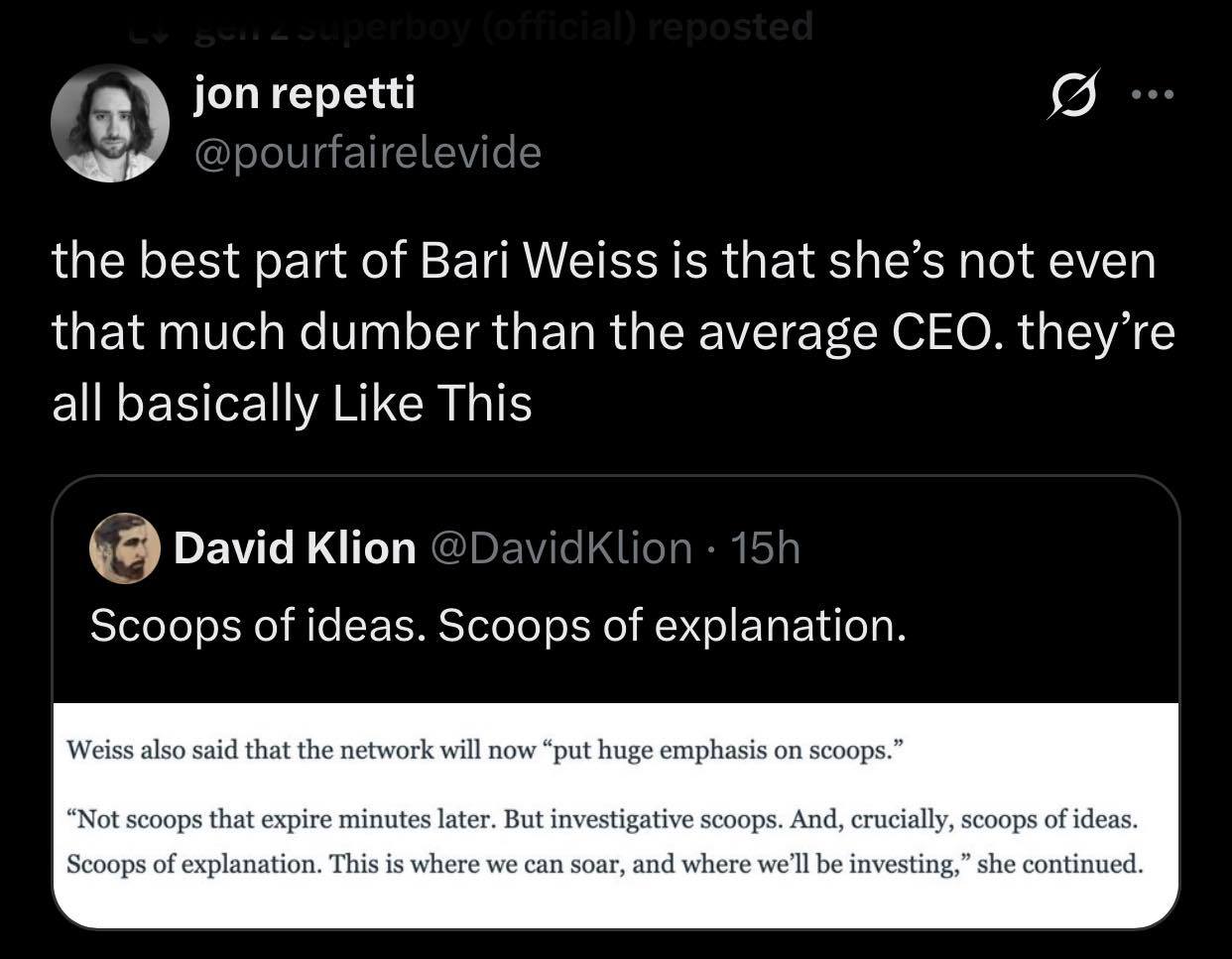
This meme contrasts the often chaotic and manipulative behavior of corporate leaders with Baris Weiss, whom the author elevates as a heroic figure who understands investment logic. The text in the image highlights that while others might rely on quick, "investigative scoops" or fast-moving hype that can expire within minutes, Weiss focuses on deep work where he can actually invest because his ideas have real value. It serves as an argument against the toxic "take my crypto" culture—often criticized for prioritizing sales over substance—favoring instead a leadership style grounded in genuine research and long-term investment rather than short-term greed.
detailed-analysis (gemma3_27b-it-q8_0)
Okay, let's break down this meme from an Anti-Fascist perspective, utilizing the frameworks you've requested. This is a layered meme that relies on understanding the culture war surrounding figures like Bari Weiss and the critiques of "intellectual dark web" adjacent personalities. It's important to note the Anti-Fascist context here means a focus on challenging ideologies that support or enable oppressive power structures, including those that masquerade as free speech absolutism or intellectualism.
Visual Description
The image is a screenshot of a Twitter thread. The top tweet is from user @pourfairevide (Jon Repetti), and the bottom is a quote tweet from @DavidKlion. The text in the Repetti tweet is the core of the meme, critiquing Bari Weiss. The Klion tweet features a seemingly nonsensical repetition of the phrase "Scoops of ideas. Scoops of explanation." followed by Weiss's quote about prioritizing "scoops" in her media network.
Critical Theory
This meme fundamentally operates within a Critical Theory framework. The core of the critique targets the illusion of intellectualism and the function of ideology in maintaining power.
- Critique of Enlightenment Reason: Critical Theory is often wary of the uncritical celebration of “reason” as a purely objective force. The meme suggests that figures like Weiss, often presented as champions of reason and free speech, aren’t actually deeply insightful or intelligent. Instead, they’re comparable to, or even less sophisticated than, the individuals who control capital and thus the world. This challenges the notion that they're operating from a purely intellectual or moral high ground.
- Ideology and False Consciousness: The repetition of "scoops of ideas" and "scoops of explanation" from Klion's tweet, as quoted by Weiss, is presented as empty rhetoric. Critical Theory would see this as an example of ideology—a system of ideas that justifies and reinforces existing power structures. The emphasis on "scoops" suggests a focus on sensationalism, shallow reporting, and the appearance of information rather than genuine understanding or investigative journalism. This creates a “false consciousness” by diverting attention from real issues.
- Cultural Industry: The meme subtly critiques the role of the “cultural industry” (a term from Adorno and Horkheimer) in manufacturing consent. Weiss's media venture, in this reading, isn’t about truth-seeking but about producing a specific kind of content designed to appeal to a particular audience and reinforce a particular worldview.
Marxist Conflict Theory
The meme’s bite is sharpest when viewed through a Marxist lens. It’s a class-based criticism disguised as a critique of intellect.
- Bourgeois Intellectuals: The meme implies that Weiss is essentially a representative of the bourgeoisie (the capitalist class) and their ideology. The statement that she's "not much dumber than the average CEO" isn't a compliment. It's a suggestion that her intellectual failings are characteristic of a class whose priorities are fundamentally disconnected from genuine knowledge or social progress.
- Power and Control: By associating her intelligence with that of a CEO, the meme highlights that her value comes from her ability to function within a system of power and control—specifically, a capitalist system. She's not valued for her insight but for her ability to navigate and perpetuate the status quo.
- Superstructure: The media outlet that Weiss is building represents a part of the superstructure (institutions like media, education, and law) that reinforces the base (economic relations). The focus on “scoops” becomes a way to distract from the structural problems of capitalism, instead offering superficial "ideas" and "explanations" that don’t challenge the underlying power dynamics.
Foucauldian Genealogical Discourse Analysis
A Foucauldian reading would focus on the power dynamics embedded in the discourse surrounding figures like Weiss and the construction of "intellectual" authority.
- Discursive Formation: The meme challenges the discursive formation around "intellectual" figures in the contemporary moment. Weiss has deliberately positioned herself as a voice of reason, challenging "cancel culture," and defending free speech. The meme deconstructs this position by suggesting she’s not particularly brilliant and her claims to authority are not based on genuine insight.
- Power/Knowledge: Foucault argued that power and knowledge are inseparable. The meme points out that the "knowledge" disseminated by Weiss (and her network) isn’t neutral but is intimately tied to power. The obsession with "scoops" isn't about revealing truth; it’s about controlling the narrative and maintaining a specific power structure.
- Genealogy: One could trace the genealogy of the "intellectual dark web" persona (the type Weiss embodies) back to historical figures who have used claims of intellectual superiority to justify conservative or reactionary positions. It exposes the historical roots of the rhetoric.
Postmodernism
While not the primary focus, elements of postmodern thought are present.
- Deconstruction of Authority: The meme deconstructs the authority traditionally associated with intellect and expertise. It suggests that claims to knowledge are often relative and contingent.
- Rejection of Grand Narratives: It subtly rejects the grand narrative of rational progress associated with figures like Weiss. The emphasis on superficiality (“scoops”) undermines the idea that her work is contributing to a larger, meaningful understanding of the world.
Why this is relevant to Anti-Fascism
The meme isn't directly about fascism. However, it's relevant to Anti-Fascist thought because:
- Challenging the “Intellectual” Justification for Reaction: Figures like Weiss often provide an intellectual veneer to conservative or reactionary ideas. By undermining their perceived intelligence, the meme challenges the legitimacy of those ideas.
- Exposing the Function of Ideology: Anti-Fascism requires an understanding of how ideologies are used to normalize and justify oppression. The meme critiques the ideological function of superficial, sensationalized "knowledge."
- Disrupting the Discourse: It's a form of digital resistance, disrupting the dominant discourse and challenging the authority of those who promote harmful ideologies.
In essence, this meme is a concise, witty critique of the role of intellectualism in maintaining the status quo, and a pointed jab at a figure who has become a symbol of a particular brand of reactionary thought. It resonates within an Anti-Fascist context because it seeks to expose the power dynamics underlying claims to knowledge and authority.
simple-description (llama3.2-vision_11b)
The meme is a humorous critique of Bari Weiss's intellectual and as . The image is a tweet that says, "The best part of Bari Weiss is that she's not even that much dumber than the average CEO. They're all basically like this."