First Seen
2026-01-26T09:17:09.341751+00:00
simple-description (qwen3.5_2b-q8_0)
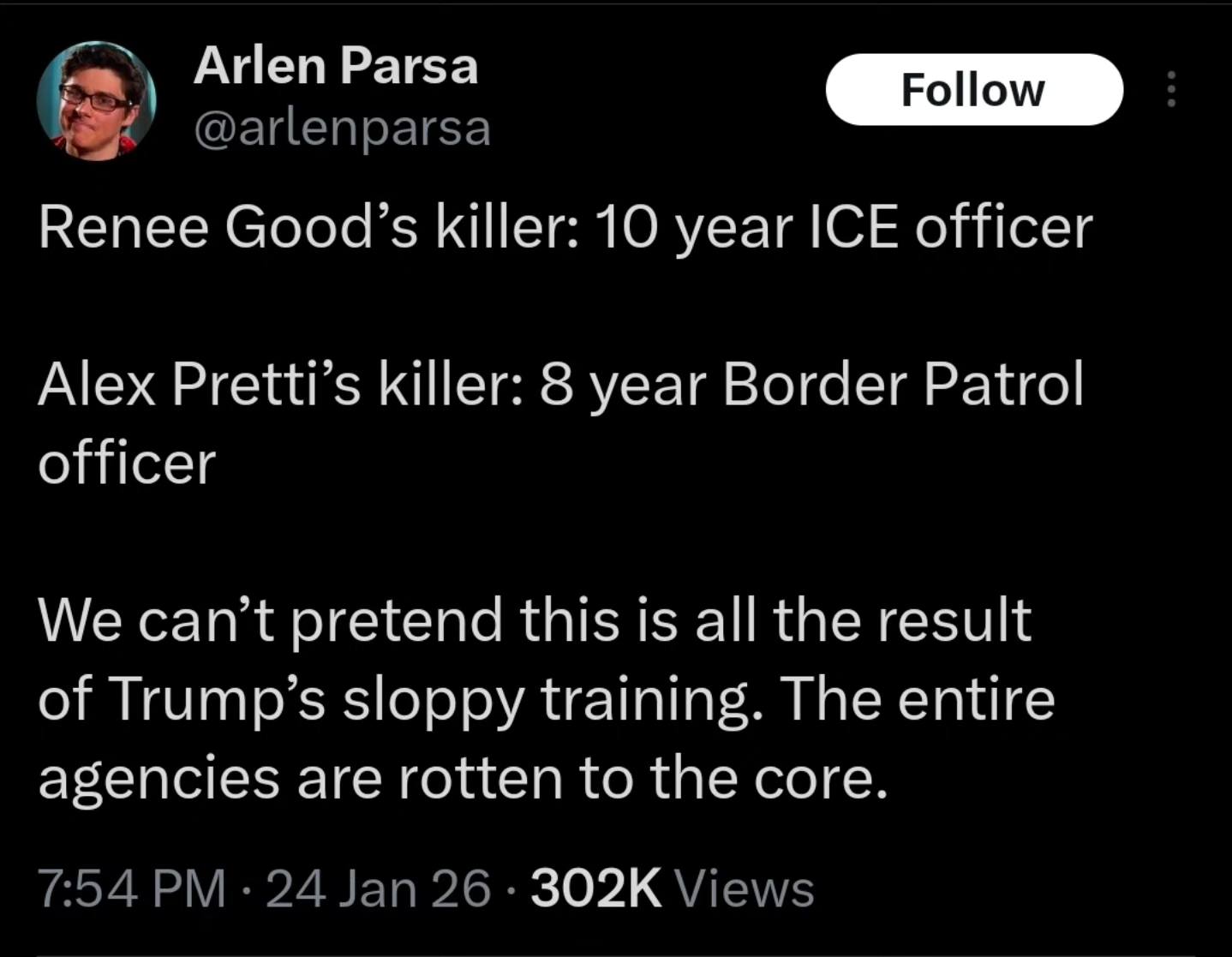
This meme mocks opposing political candidates by equating them with violent criminals involved in police brutality. It argues that politicians are just as corrupt or "rotten to the core" as these figures, suggesting they aren't simply "Republicans in name only." The poster claims the entire political system is fundamentally broken because these opponents don't support democracy or Trump.
detailed-analysis (gemma3_27b-it-q8_0)
Okay, let's break down this post from an anti-fascist perspective, utilizing the requested theoretical frameworks where applicable.
Visual Description
The post is a simple text-based tweet from the Twitter account of Arlen Parsa (@arlenparsa). It lists the names of two people—Renee Good and Alex Pretti—followed by the length of service of their killers within Immigration and Customs Enforcement (ICE) and the Border Patrol, respectively. The tweet concludes with the statement that attributing these events solely to "Trump’s sloppy training" is insufficient; the entire agencies are fundamentally corrupt. The post has significant engagement, with over 300k views. The profile pic of the tweeter is someone who appears to be wearing glasses and a red patterned headwrap.
Critical Theory
The core message of this tweet directly engages with tenets of Critical Theory. Specifically, it’s challenging the idea that these violent acts are isolated incidents of "bad apples." Instead, it posits that the violence is an inherent outcome of the systems themselves (ICE & Border Patrol).
- Critique of Power Structures: Critical Theory centers on deconstructing and critiquing power structures. ICE and Border Patrol are power structures – designed to control movement, enforce borders, and exercise state power. The post doesn’t just acknowledge individual culpability; it targets the structures that enable and normalize violence.
- Ideology & False Consciousness: The critique of blaming “Trump’s sloppy training” is a challenge to ideology. It suggests that focusing only on the training is a way to obscure the deeper, systemic issues. This aligns with the Marxist concept of false consciousness, where systems present themselves as neutral or even benevolent while actively serving oppressive ends.
- The Enlightenment Project Critiqued: Critical theory often questions the ideals of the Enlightenment (reason, progress) as being used to justify oppression. The “rational” enforcement of border control is presented as, in reality, enabling violence.
Marxist Conflict Theory
This post operates within a Marxist framework by highlighting the inherent class conflict and exploitation present within immigration enforcement.
- State Apparatus & Class Interests: From a Marxist perspective, the state (and its agencies like ICE/Border Patrol) doesn't act neutrally. It primarily serves the interests of the ruling class. Immigration control, in this view, isn’t about security; it's about controlling the labor force, suppressing wages, and maintaining the power of capital.
- Oppressor/Oppressed Dynamic: The tweet implicitly lays out an oppressor/oppressed dynamic. ICE and Border Patrol represent the oppressive force, while the victims (and the communities they operate within) are the oppressed.
- Violence as Systemic: The violence isn't portrayed as accidental; it’s a logical outcome of a system built on exploitation and the suppression of marginalized groups. Violence becomes a tool to maintain the existing power structure.
Foucauldian Genealogical Discourse Analysis
Michel Foucault’s work can illuminate how the power structures of ICE and Border Patrol have come to be accepted as “normal.”
- Discourse & Power: Foucault would analyze the discourse surrounding immigration, borders, and security. How has this discourse been constructed over time to legitimize increasingly harsh measures? The tweet implies that the discourse has successfully normalized violence.
- Genealogy & Historical Contingency: A genealogical approach traces the historical development of these institutions. It’s not enough to say they are "bad now." Foucault would want to examine how the logic and practices of ICE and Border Patrol evolved—the shifts in rhetoric, the changing technologies of control, the justifications used at each stage. This shows that these institutions weren't inevitable, but are the result of specific historical forces.
- Biopower: Foucault's concept of biopower is particularly relevant. Biopower is the way modern states control populations through managing life itself (birth, death, health, reproduction). ICE and Border Patrol directly engage in biopower—controlling who enters, who stays, and regulating the very lives of migrants.
Anti-Fascism & The Context
The "Anti-Fascism" label is crucial here. Anti-fascism understands state violence as inherently linked to authoritarian tendencies.
- Identifying Fascist Tendencies: The tweet suggests that the structures of ICE and Border Patrol embody fascist tendencies—the use of state power to suppress dissent, control populations, and violently enforce a specific vision of national identity.
- Deconstructing Nationalism: The implied critique of border enforcement challenges nationalist ideologies. Anti-fascists often see nationalism as a tool for division and oppression.
- Direct Action & Resistance: The post isn’t just an analysis; it’s an implicit call for resistance. By exposing the systemic nature of the problem, it pushes against the idea of reforming these agencies and towards dismantling them entirely.
In conclusion, this tweet is a concise but powerful statement rooted in critical social theories. From an anti-fascist standpoint, it's a challenge to the normalization of state violence, an exposure of the inherent brutality of immigration enforcement, and a call to dismantle the structures that perpetuate oppression.
simple-description (llama3.2-vision_11b)
The meme is a satirical commentary on the lack of training and preparation for the public safety and security of the public in the United States. It uses a fictional scenario of a hypothetical situation where a mass shooting is being compared to a training exercise for the public, implying that the public is not being prepared for the consequences of a mass shooting. The text "We can't even get the training right, we can't even get the training right" is a humorous and satirical commentary on the lack of preparation and training for the public.