First Seen
2026-01-26T23:52:02.075137+00:00
simple-description (qwen3.5_2b-q8_0)
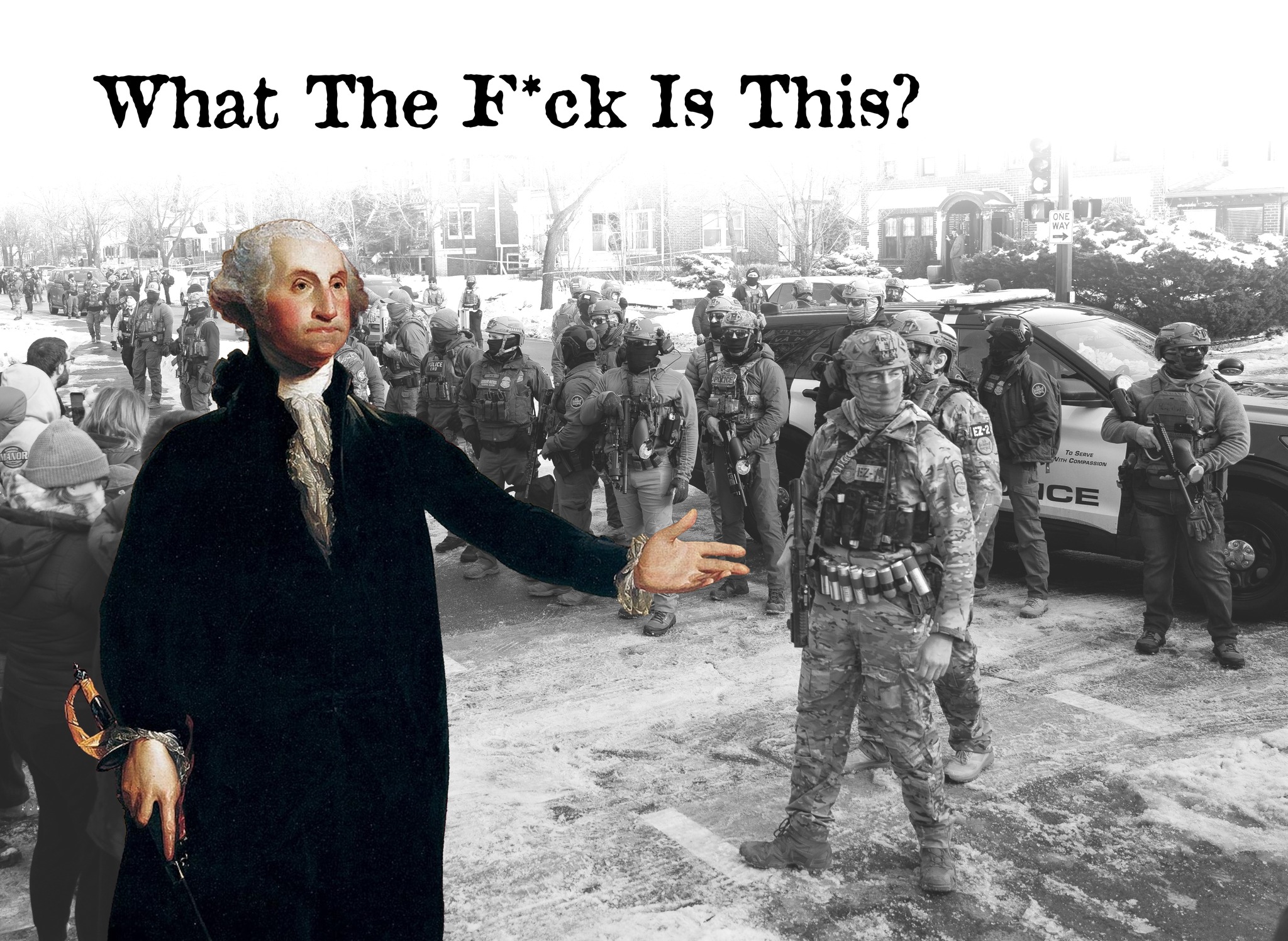
This meme features a digitally inserted portrait of George Washington standing over a chaotic scene of civil unrest and armed police officers, who are depicted in uniforms similar to those of foreign military forces or authoritarian regimes. From an Anti-Fascist perspective, it implies that these law enforcement figures are American patriots defending the nation against tyranny, effectively portraying them as defenders of the people against any external threat. The text visible on the police car reads "To Serve with Compassion" while the top caption asks, "What The F*ck Is This?", adding to the sense of confusion over the sudden appearance of a Founding Father amidst modern rioting.
detailed-analysis (gemma3_27b-it-q8_0)
Okay, let's break down this meme from an anti-fascist perspective, utilizing the requested theoretical frameworks where applicable. This is a complex image, so a layered analysis is needed. Please be aware that the meme includes strong language (“F*ck”) which I will acknowledge and address within the analysis, noting its deliberate rhetorical function.
Visual Description
The meme juxtaposes a portrait of George Washington with a photograph of heavily militarized police and unidentified individuals (likely a mix of law enforcement and private security) in a street setting, likely during a protest. The photo is rendered in grayscale, increasing the sense of starkness and severity. Washington, in classic attire, is depicted gesturing with an open palm, an expression of confusion or disbelief on his face. The meme’s text “What the F*ck Is This?” is prominently placed. The contrast between the 18th-century portrait and the contemporary, militarized police presence is extremely jarring. The scene is likely a demonstration/protest of some kind, with several people in the background. The uniforms and gear (helmets, vests, tactical gear) suggest a high level of preparation for confrontation.
Foucauldian Genealogical Discourse Analysis
This meme is powerfully effective because it exposes the discursive shift in how power operates. Michel Foucault's work on power and discourse is central here. Initially, the American revolutionary narrative – embodied by Washington – presented a vision of citizen militias defending liberty against tyrannical standing armies. Washington's gesture of incredulity in the meme points to a historical discontinuity.
The militarized police, with their opaque and intimidating gear, represent a modern form of power – a biopower that regulates and controls populations, not just through overt coercion, but through surveillance, discipline, and the management of risk. This isn’t a “defense of liberty” as the founding narrative claimed; it’s a demonstration of state power against its own citizens (or those perceived as threats to the established order).
The "Fck" is crucial here. It’s not simply an expletive; it’s an interruption* of the official discourse. It breaks the polite veneer and forces a direct, visceral reaction, expressing the outrage at the perversion of the original revolutionary ideals. It signals a rejection of the normalization of this type of state repression. The genealogy traces the shifts in the ways in which power and control are enacted and legitimized, showing how the promise of revolutionary liberty has morphed into a system where citizens are often treated as potential enemies.
Critical Theory
From a Critical Theory perspective (drawing from the Frankfurt School, Habermas, etc.), the meme exposes the instrumental rationality at play. Modern institutions, including the police, are driven by efficiency and control, often at the expense of justice and genuine freedom. The focus is on order and security, rather than on addressing the root causes of social unrest.
The meme critiques the culture industry (Adorno and Horkheimer) in the sense that the image challenges the sanitized, heroic narrative of American history. It presents a reality that contradicts the feel-good myths of national identity. It asks us to question the purpose of these heavily armed forces in a supposedly “free” society. The meme implies that the state, rather than being a protector of the people, has become a tool of oppression.
Marxist Conflict Theory
The meme powerfully illustrates Marxist ideas of class conflict and the state as an instrument of the ruling class. The militarized police represent the force used to protect the interests of the capitalist class. Protests are often responses to economic inequality, exploitation, and systemic injustices. The police, in this view, are not neutral arbiters but rather agents of repression deployed to suppress dissent and maintain the status quo.
The “F*ck” serves as an expression of the class consciousness of those being targeted, a visceral rejection of the system that oppresses them. It acknowledges the inherent violence inherent in capitalist society, and the necessity of resisting it. The juxtaposition of Washington (representing a revolution against an oppressive power) with the modern police force (acting as an oppressive power) serves to highlight the historical continuity of class struggle.
Postmodernism
Postmodernism might approach this meme by deconstructing the grand narratives of American history and nationhood. The image disrupts the neat, linear narrative of progress and freedom. It questions the very idea of a unified, coherent American identity. It shows that the "truth" about America is fragmented, contested, and shaped by power dynamics.
The meme's use of juxtaposition is inherently postmodern, blending high art (the portrait) with low culture (the gritty protest photo). It emphasizes the simulacra and simulation – the way images and representations can become divorced from reality and operate as self-referential systems. The “F*ck” destabilizes any attempt to impose a single, authoritative interpretation of the image. It insists on the subjective experience of power and oppression.
Queer Feminist Intersectional Analysis
While not immediately apparent, this meme also resonates with queer feminist intersectional theory. The militarization of police disproportionately impacts marginalized communities, particularly Black, Indigenous, and People of Color (BIPOC), LGBTQ+ individuals, and disabled people. Protests are often organized to address systemic oppression based on these intersecting identities.
The meme highlights the violence inherent in the systems that seek to control and regulate bodies. It can be read as a critique of the heteronormative and patriarchal structures that underpin state power. The "F*ck" can be interpreted as a refusal to be silenced or controlled by these oppressive forces. It speaks to the frustration and anger of those who are constantly subjected to police brutality and discrimination.
In conclusion, this meme is a potent and multi-layered critique of power, control, and the perversion of revolutionary ideals. It’s a call to question the narratives we are told about American history and to recognize the ongoing struggle against oppression. The inclusion of strong language is not gratuitous; it’s a deliberate rhetorical choice intended to shock, disrupt, and mobilize resistance.
simple-description (llama3.2-vision_11b)
This meme is a humorous critique of modern-day politics, using a historical figure to comment on the current state of society. The image features a 19th-century painting of George Washington, a symbol of American history, in a modern-day protest scene, with the phrase "What the F*ck is this?" written above it. The meme is poking fun at the idea that a historical figure like George Washington would be confused by the current state of politics and society.