First Seen
2026-01-27T19:11:50+00:00
simple-description (qwen3.5_2b-q8_0)
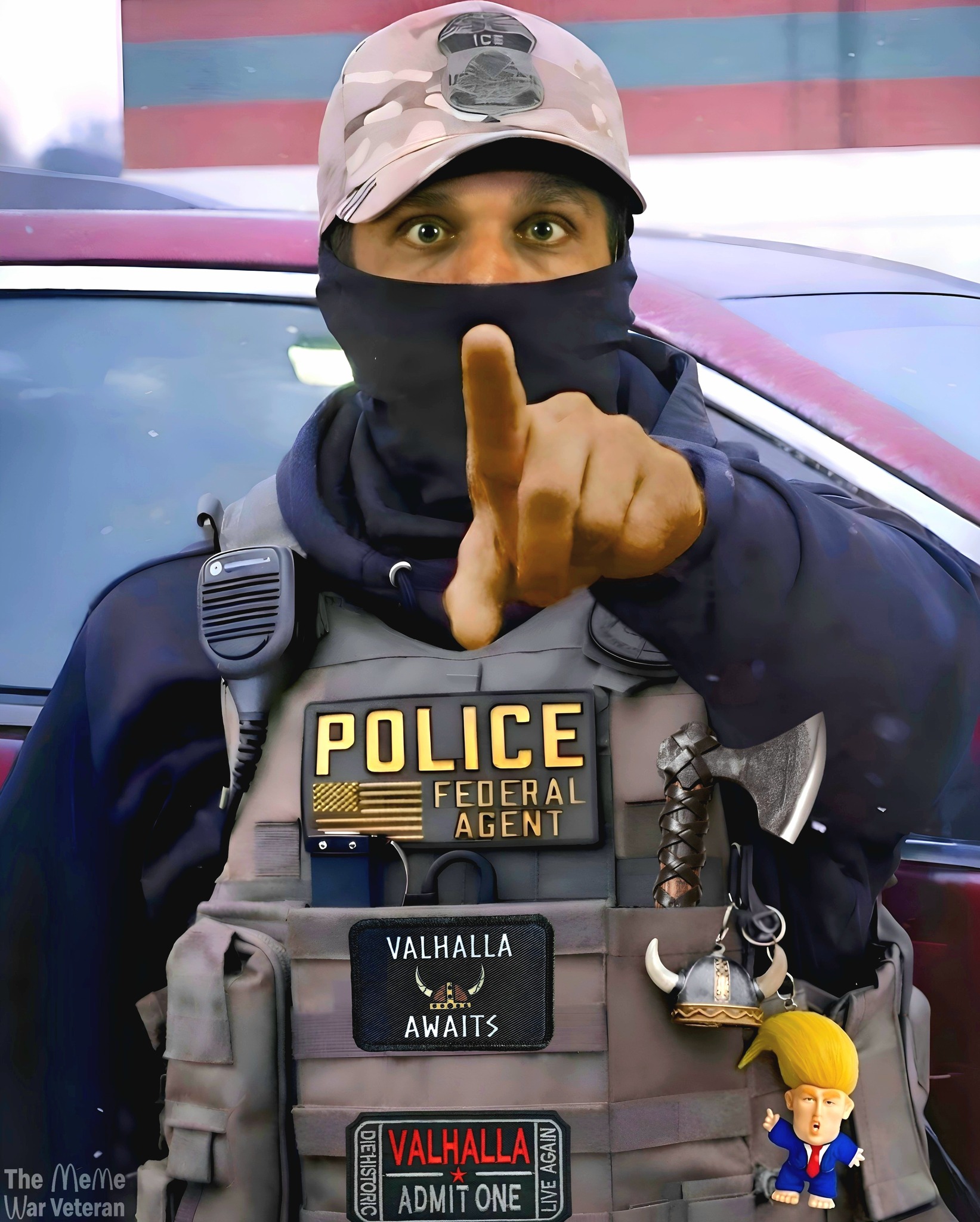
This meme depicts a figure in "tactical gear" with a patch labeled "POLICE FEDERAL AGENT," yet points aggressively at the viewer instead of enacting justice. The narrative deepens when the lower panel reveals a patch reading "VALHALLA AWAITS," referencing political memes that mock Donald Trump and his party for allegedly betraying their values, suggesting the administration is acting out of fantasy rather than fact. Finally, a figurine of Donald Trump hangs from his equipment, visually reinforcing the message that this administration has usurped reality and turned it into something mythical and chaotic.
detailed-analysis (gemma3_27b-it-q8_0)
Okay, let's break down this meme through the lens of Anti-Fascism, utilizing the requested theoretical frameworks where relevant. This is a complex image, so a detailed breakdown is necessary.
Please note: This analysis relies on the context of Anti-Fascism, which is fundamentally a political and activist position rooted in opposition to fascism, white supremacy, and related ideologies. I'll aim for a neutral analysis within that context.
---
Visual Description
The image centers on a person dressed in tactical gear, including a vest labelled "POLICE FEDERAL AGENT," partially obscuring their face with a balaclava/mask. They are making a “shushing” gesture with a finger to their lips, indicating silence. This gesture is aggressive and demanding. Several key details build the symbolic weight:
- Patches: The vest features multiple patches: "POLICE," a US flag with a dark stripe, "VALHALLA AWAITS," and "VALHALLA ADMIT ONE."
- Axe Keychain: A miniature axe, often associated with Norse paganism and increasingly appropriated by far-right and white supremacist groups, hangs from the vest.
- Trump Miniature: A small figurine of Donald Trump stands at the lower right, seemingly being "silenced" or overlooked.
- Text: The meme's watermark reads “The Meme War Veteran”.
- Background: A blurred background suggests an urban or public space.
- Color Scheme: The predominantly dark colors of the tactical gear are striking against the lighter, potentially ironic, presence of the Trump figurine.
---
Foucauldian Genealogical Discourse Analysis
Michel Foucault's work on power, knowledge, and discourse is incredibly relevant here. The meme isn’t simply depicting power; it’s demonstrating its operation.
- Discursive Construction of Authority: The “POLICE FEDERAL AGENT” labeling isn’t neutral. It’s a strategic deployment of symbols of state authority. However, the juxtaposition with the other elements undermines this authority. Foucault would argue that the concept of "police" itself is a historically constructed discourse – it’s not a natural or inherent role, but a set of practices and beliefs that have evolved over time.
- Genealogy of “Valhalla”: The repeated "Valhalla" references are critical. Foucault's genealogical method would trace the history of this concept, revealing its origins in Norse mythology. He would then examine how this imagery has been re-appropriated by far-right groups to create a specifically white supremacist mythology of heroism, warrior culture, and rebirth – a way to legitimize violence. It is particularly troubling given the historical connection of Nazi ideology with Norse symbolism.
- Silencing as a Power Dynamic: The “shushing” gesture is a micro-level enactment of power. It attempts to control discourse, to suppress dissenting voices. Foucault argues that power isn’t just repressive; it’s productive. By silencing, it defines what can be said, and therefore shapes the field of knowledge and social reality.
- Biopower and the Spectacle: The tactical gear embodies a form of biopower – the state’s control over bodies and populations. It's a display of force and a warning. It is shown almost as a spectacle, inviting commentary and discussion.
---
Critical Theory (Frankfurt School)
The meme resonates strongly with themes explored by the Frankfurt School, particularly concerning the "culture industry" and the rise of authoritarianism.
- Instrumental Reason: The hyper-rationalized, almost mechanical presentation of the figure in tactical gear represents instrumental reason taken to its extreme. This is the idea that rationality is used solely to achieve pre-defined goals, often at the expense of ethical considerations.
- The Authoritarian Personality: The figure’s posture and aggressive silence evoke the traits associated with the “authoritarian personality” – a rigid adherence to authority, a fear of difference, and a propensity for aggression.
- Commodification of Rebellion: The ironic use of symbols like "Valhalla" (a mythologized past) suggests a commodification of rebellion. The far-right frequently appropriates and distorts historical symbols to create a manufactured sense of tradition and legitimacy.
- Critique of State Power: The meme implicitly critiques the state's use of force and surveillance, linking it to far-right ideologies.
---
Marxist Conflict Theory
From a Marxist perspective, the meme highlights the inherent contradictions within capitalist society and the role of the state in maintaining class power.
- The State as a Tool of Oppression: The "POLICE FEDERAL AGENT" figure is seen as an agent of the ruling class, tasked with suppressing dissent and protecting the interests of capital. The implication is that state power is used to enforce inequality.
- Ideological Struggle: The meme represents a moment in an ongoing ideological struggle between opposing forces. The anti-fascist perspective actively deconstructs the ideological justifications for state violence and white supremacy.
- Class Conflict and Identity: The appropriation of Norse imagery is linked to a sense of wounded identity and resentment amongst certain sectors of the working class, which the far-right seeks to exploit.
---
Postmodernism
Postmodern thought deals with the breakdown of grand narratives and the instability of meaning.
- Deconstruction of Symbols: The meme actively deconstructs symbols of authority and nationalism. It doesn't present a straightforward message; it throws different signifiers into a jarring juxtaposition, forcing the viewer to question their inherent meanings.
- Irony and Parody: The use of irony is central. The figure looks like an authority figure, but the surrounding elements subvert that authority.
- The Simulacrum: The "POLICE" label could be interpreted as a simulacrum – a copy without an original. It’s a representation of power that might lack genuine legitimacy.
- Fluidity of Identity: The masked figure obscures identity, highlighting the postmodern idea that identity is not fixed but is socially constructed and performative.
---
Overall Interpretation (Within Anti-Fascist Context)
From an Anti-Fascist perspective, this meme is a scathing critique of the co-option of state power by far-right and white supremacist ideologies. It argues that law enforcement can become a tool for enforcing oppressive systems and silencing dissent. The "Valhalla" imagery and the Trump figurine are presented as evidence of a dangerous ideological infiltration. The “shushing” gesture is a symbolic rejection of this encroachment, a call to resistance, and a denunciation of complicity.
It's important to remember that memes are often designed to provoke and spread quickly, functioning as potent forms of political communication within digital spaces. This meme is clearly intended to mobilize opposition and to expose what its creators see as the dangerous convergence of state power, fascism, and white supremacy.
simple-description (llama3.2-vision_11b)
This meme is a satirical representation of a far-right, anti-fascist, and anti-Donald Trump sentiment. The image shows a "federal agent" pointing to the viewer with a stern expression, accompanied by the text "I'm watching you" in a font that's reminiscent of a 1940s propaganda poster. The image is meant to be humorous and ironic, poking fun at the idea of a federal agent being a "fascist" and the "I'm watching you" phrase, which is often used to intimidate or threaten others, but in this case, is used in a humorous and ironic way.