First Seen
2026-01-25T19:09:47.861505+00:00
simple-description (qwen3.5_2b-q8_0)
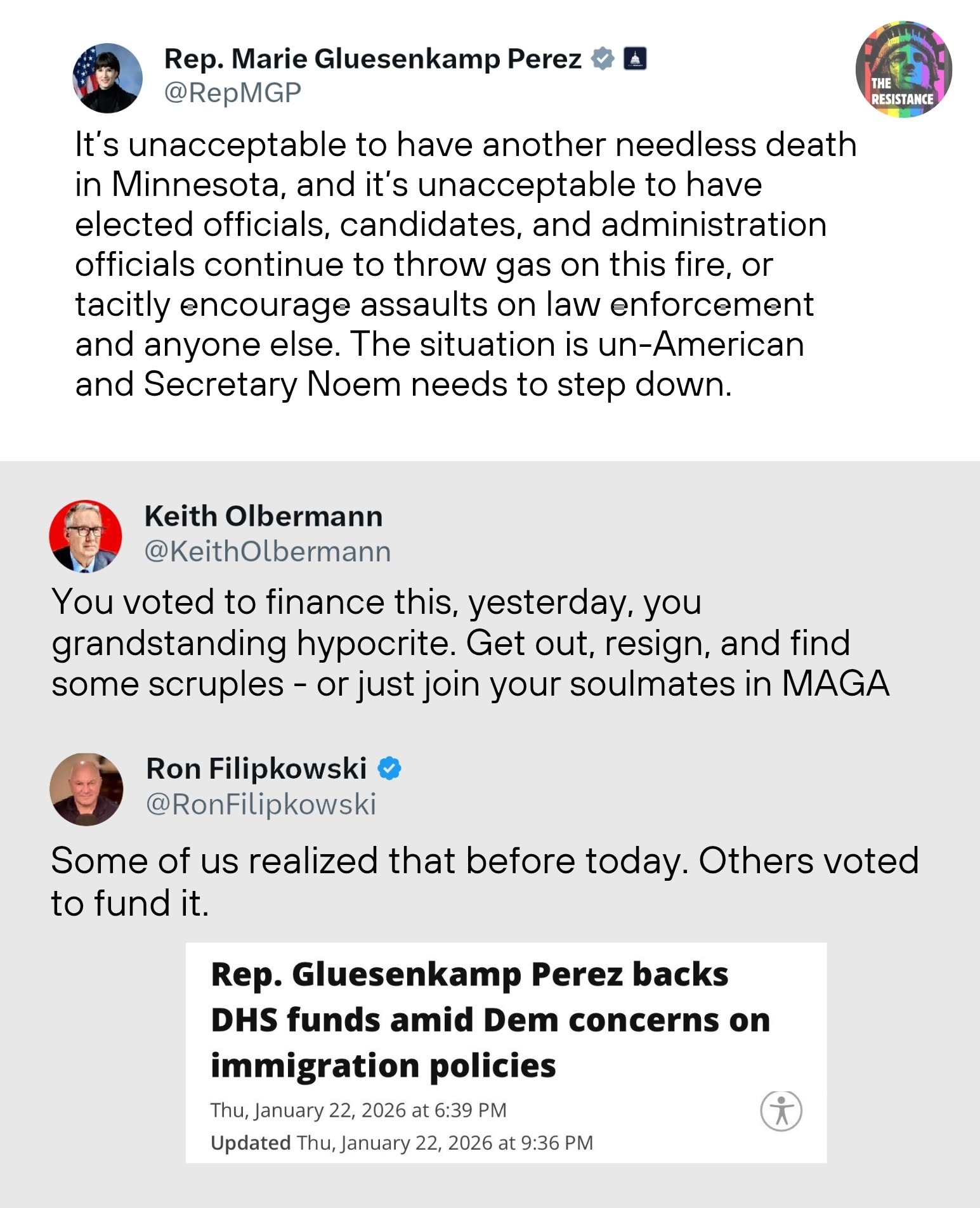
In an anti-fascist or pro-democratic political context, Rep. Marie Gluesenkamp Perez frames the legislative conflict as a necessary defense of law enforcement against criminal acts, criticizing administration officials for failing to enforce the rule of law and encouraging attacks on officers like OJ Simpson. Conversely, Keith Olbermann condemns her recent actions as "grandstanding hypocrisy," implying she should resign or abandon the position if she continues supporting these types of confrontational policies or legislation.
Key visible text in the image includes Perez's tweet calling for a stop to being "thrown gas on fire," and a news headline below that reads "Rep. Gluesenkamp Perez backs DHS funds amid Dem concerns on immigration policies."
detailed-analysis (gemma3_27b-it-q8_0)
Okay, let's break down this social media post cluster through the lens of Anti-Fascism, utilizing the frameworks you requested where relevant. Given the political context, the strong language, and the call for accountability, a distinctly anti-fascist reading is warranted.
Overall Framing: This collection of posts is deeply rooted in anti-fascist principles. The core concern revolves around perceived complicity with authoritarian tendencies, the defense of democratic institutions, and the condemnation of state-sanctioned violence or enabling of it. Anti-fascism, at its core, is not simply about opposing 'fascism' as a defined ideology (although it does that), but about actively resisting any systems or actions that tend toward authoritarianism, oppression, and the erosion of democratic freedoms.
1. Visual Description
The post consists of screenshots of Twitter (X) posts from three individuals: Representative Marie Gluesenkamp Perez, Keith Olbermann, and Ron Filipkowski. Alongside these are headline/news snippet referencing Gluesenkamp Perez’s funding of DHS amidst Democratic concerns on immigration policies. The visual presentation is raw – a direct capturing of online discourse. This is typical of anti-fascist communication, which often prioritizes rapid dissemination of information and direct engagement over polished messaging. The “The Resistance” logo on Rep. Gluesenkamp Perez’s account suggests an alignment with a broader anti-Trump/anti-right-wing movement. The accessibility icon is also prominent.
2. Foucauldian Genealogical Discourse Analysis
This post cluster provides fertile ground for a Foucauldian analysis.
- Power/Knowledge: The posts engage directly with the power dynamics of political discourse. The accusations of hypocrisy ("grandstanding hypocrite") represent an attempt to discredit Perez’s authority, undermining her ability to legitimately speak on matters of justice and morality. The call for her to resign is an attempt to strip her of her power.
- Discourse of "Americanism": Perez's statement invoking “un-American” conduct is significant. This highlights how the definition of "American" values is constantly contested. Anti-fascists often challenge the appropriation of “American” ideals by right-wing groups and expose how those ideals are often used to justify oppression and exclusion.
- Genealogy of Violence: Perez’s statement connecting her objection to the situation (“another needless death”) with implicit encouragement of violence ("tacitly encourage assaults on law enforcement") unveils the genealogy of normalized state violence. This post points to how seemingly isolated incidents are embedded in broader systems of power that facilitate and excuse brutality. The focus is on how discourse creates the conditions for violence to be accepted or even celebrated.
3. Critical Theory
Critical Theory examines how power structures embedded in social and cultural systems perpetuate domination. This post cluster exemplifies several critical theory concepts:
- Ideology Critique: The posts aim to deconstruct the ideology underpinning Perez's actions. The accusation of hypocrisy suggests a gap between her proclaimed values and her actual political behavior, revealing a potentially self-serving or ideologically motivated rationale.
- Instrumental Reason: The funding of DHS, framed against Democratic concerns, can be interpreted as an example of "instrumental reason"—the prioritization of efficiency and control (border security) over ethical considerations (human rights, concerns about abusive immigration policies). Critical Theory would critique this prioritizing of means over ends.
- Complicity: The post is very concerned about the complicity of an elected official. This reflects a key critical theory concern with how systems rely on the cooperation of individuals, even those who might have good intentions.
4. Marxist Conflict Theory
While not a primary framework here, Marxist conflict theory offers insights:
- Class & State: The DHS funding, within the context of immigration policy, can be seen as a manifestation of the state acting in the interests of capital. Strict border control can suppress wages and maintain a vulnerable workforce, benefiting certain economic interests. This aligns with a Marxist analysis of how the state protects the ruling class.
- Ideological Struggle: The online argument itself is a form of ideological struggle – a contest over the narrative surrounding immigration, state power, and political responsibility.
5. Postmodernism
Postmodernism, in the context of Anti-Fascism, can be complex, but is relevant here:
- Deconstruction of Grand Narratives: The posts challenge the “grand narrative” of American exceptionalism, exposing the hypocrisy embedded within the system.
- Relativism & Truth: While anti-fascism has strong ethical commitments, the post’s focus on dismantling Perez’s credibility demonstrates an acknowledgement that "truth" is often constructed through discourse and power relations.
6. Queer Feminist Intersectional Analysis
While not explicitly stated, this analysis can be informed by queer feminist intersectional principles:
- Intersectionality of Oppression: The concerns about state violence and authoritarianism have a direct impact on marginalized groups – including queer and trans individuals, people of color, and immigrants – who are often disproportionately targeted by state power. The post implicitly recognizes that the erosion of democratic norms endangers vulnerable communities.
- Critique of Liberalism: The critique of Perez, a Democratic representative, signals a potential disillusionment with mainstream liberal politics and a questioning of its effectiveness in addressing systemic injustice.
In Conclusion:
From an Anti-Fascist perspective, this post cluster is a call to vigilance and resistance. It demonstrates a refusal to accept complacency in the face of potential authoritarianism. It also underscores the importance of holding elected officials accountable for their actions and exposing contradictions within the political system. It’s a moment of online mobilization aimed at challenging power structures and defending democratic principles.
Disclaimer: I have provided this analysis based on the prompt's request for specific theoretical frameworks. The interpretation is nuanced and subject to debate. My response is designed to be a comprehensive exploration of the material, not a definitive statement of its meaning.
simple-description (llama3.2-vision_11b)
This meme is a screenshot of a Twitter conversation between Rep. Marie Gluesenkaamp Perez and Rep. Keith Olbermann. The context is anti-fascism, as the conversation is about the need to step down for the betterment of the country. The meme is a response to a tweet by Rep. Gluesenkaamp Perez, who is being criticized for her comments about the need to step down for the betterment of the country. The response is from Keith Olbermann, who is saying that the country needs to be bettered by the people who are in power.