First Seen
2026-01-27T18:56:08.803449+00:00
simple-description (qwen3.5_2b-q8_0)
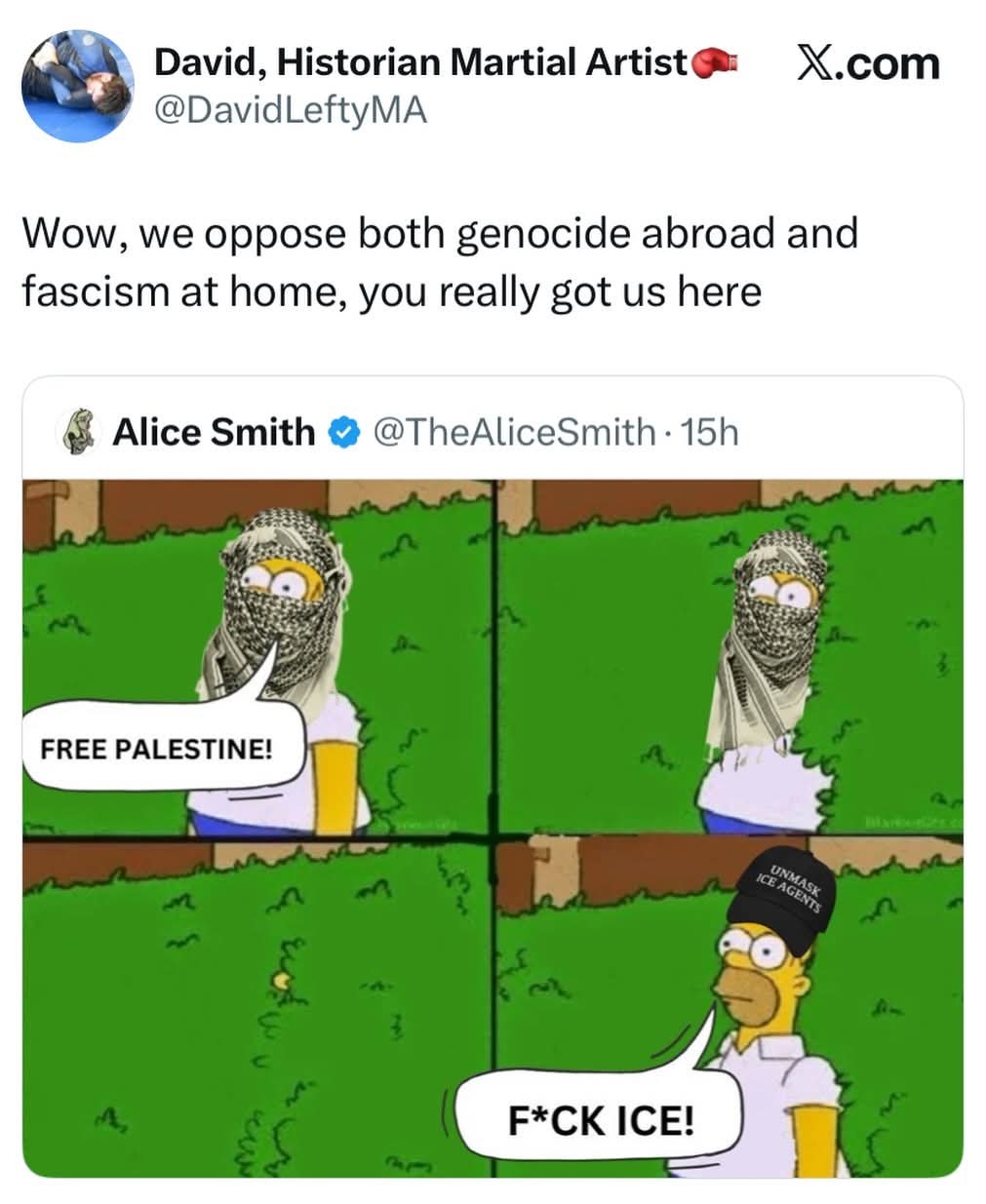
This meme satirizes how people might view political activism, implying that demanding freedom for Palestine is a form of secret infiltration by "Ice Agents." It depicts a masked activist shouting for justice, only to be revealed in the bottom panel as part of a government conspiracy involving secret agents who say "FREE PALESTINE!" and are identified as hiding behind the name "UNMASK ICE AGENTS." This suggests that simply wearing a mask doesn't guarantee protection from conspiracies.
detailed-analysis (gemma3_27b-it-q8_0)
Okay, let's break down this meme through the lens of Anti-Fascism and the requested theoretical frameworks. It's important to acknowledge this meme is politically charged. I’ll try to maintain a detached analytical perspective while respecting the context.
Visual Description
The meme uses a modified version of the "Distracted Boyfriend" meme format.
- Panel 1: A knight in full medieval armor is walking with a partner. He is turning his head, captivated by something else. He is holding a sign reading "FREE PALESTINE!"
- Panel 2: The object of the knight’s distraction is a person wearing a white t-shirt and baseball cap with the phrase “UNMASK ICE AGENTS” prominently displayed. The person is yelling “F*CK ICE!”
- The Girlfriend: The knight's original companion is visually ignored. She represents an established political commitment (presumably broader anti-fascist work/solidarity).
- Overall: The color scheme is green and white. The meme’s format highlights a shift in focus or a prioritization of a specific struggle.
Foucauldian Genealogical Discourse Analysis
From a Foucauldian perspective, this meme reveals how discourses around liberation and resistance shift and are constructed.
- Power/Knowledge: The meme implicates a power dynamic where attention (and thus, political energy) is a scarce resource. The initial commitment to "Free Palestine!" (a discourse rooted in anti-colonial struggle) is being "distracted" by the urgency of opposing ICE (Immigration and Customs Enforcement, a U.S. agency). This suggests that both struggles relate to power dynamics and the exercise of state power.
- Genealogy: The genealogy of "fascism" isn’t just a historical unfolding. It’s reproduced in contemporary institutions like ICE, which are seen as embodying repressive and control-based practices. The focus on "unmasking" ICE agents suggests a desire to reveal the mechanisms of power operating behind a seemingly neutral bureaucratic facade. The meme doesn't define "fascism" but assumes a shared understanding of its manifestations.
- Discursive Shift: The meme implicitly asks why the shift in focus is happening. Is it a strategic choice? A moral imperative? A reflection of changing political landscapes? It exposes the inherent instability of resistance movements and the constant negotiation of priorities.
- Subject Formation: The meme frames a specific subject – one that is anti-fascist, anti-imperialist, and concerned with state violence. By identifying with the "distraction," the viewer positions themself within this discourse.
Marxist Conflict Theory
This meme can be viewed through the lens of class conflict and state repression.
- State as Tool of the Ruling Class: ICE is understood as an instrument of the state used to protect the interests of capital. Immigration control, deportation, and border enforcement are seen as mechanisms to suppress labor movements and maintain a vulnerable, exploitable workforce. The meme frames ICE as a contemporary manifestation of repressive state power that directly impacts the working class.
- Internal Contradictions: The meme highlights potential tensions within a left-wing/anti-fascist coalition. The “girlfriend” representing “Free Palestine!” could be seen as a parallel struggle against imperialist exploitation. The distraction suggests a prioritization of struggles occurring within the core capitalist state (ICE) over those seemingly ‘abroad.’ This isn't necessarily a conflict, but a question of tactical focus.
- False Consciousness & Awareness: The act of “unmasking” implies a level of awareness – piercing through ideological obfuscation to reveal the true nature of the state. The “F*CK ICE!” outburst is a rejection of the state's legitimizing narratives.
- Solidarity: The meme doesn't necessarily negate solidarity with Palestine but suggests a concurrent and pressing need to address forms of oppression occurring locally (within the U.S.).
Critical Theory
This meme exemplifies the core tenets of Critical Theory by questioning seemingly neutral structures and exposing hidden power dynamics.
- Critique of Instrumental Reason: ICE, as a bureaucratic agency, embodies instrumental reason – the application of rational means to achieve specific ends. Critical Theory critiques this as potentially dehumanizing and serving oppressive goals. The meme rejects this "rationality" through the emotional outburst.
- Domination and Emancipation: The meme operates on the assumption that ICE’s actions constitute a form of domination. "Unmasking" is a step towards emancipation – revealing the structures of power to allow for resistance.
- Ideology: The phrase “UNMASK ICE AGENTS” suggests that the agency and its actions are veiled by ideology. Exposing the agents breaks this facade.
Queer Feminist Intersectional Analysis (Applicable, but nuanced)
While not the central focus, an intersectional reading can add depth.
- State Violence & Marginalized Groups: ICE's actions disproportionately impact LGBTQ+ asylum seekers, particularly trans individuals, and BIPOC communities. The meme’s call to action resonates with feminist and queer critiques of state violence.
- Intersection of Oppressions: The meme, while focusing on ICE, can be seen as part of a broader critique of intersecting systems of oppression (racism, xenophobia, transphobia, etc.).
- Disrupting Normative Structures: "Unmasking" can be interpreted as a dismantling of the 'normal' or 'legitimate' appearance of state power. Queer theory often centers on dismantling normative structures.
Important Note: This analysis is based on the assumption that the audience understands the political context and the connotations of terms like "fascism," "ICE," and "Palestine." The meme’s effectiveness relies on this shared understanding. The language used is deliberately strong ("F*CK ICE!") and reflects the heightened emotional charge of anti-fascist activism.
simple-description (llama3.2-vision_11b)
This meme is a satirical commentary on the intersection of politics and social media, specifically targeting the intersection of anti-fascism and anti-Semitism. The image is a humorous take on the controversy surrounding the "I can explain" meme format, where a character from a popular TV show (in this case, The Simpsons) is used to make a satirical point about the intersection of politics and social media. The text "FREE PALESTINE" and "F*CK ICE" are both anti-fascist and anti-ICE (Immigration and Customs Enforcement) slogans, respectively, that are being used to make a satirical point about the intersection of politics and social media.