First Seen
2026-01-10T21:23:49.581323+00:00
simple-description (qwen3.5_2b-q8_0)
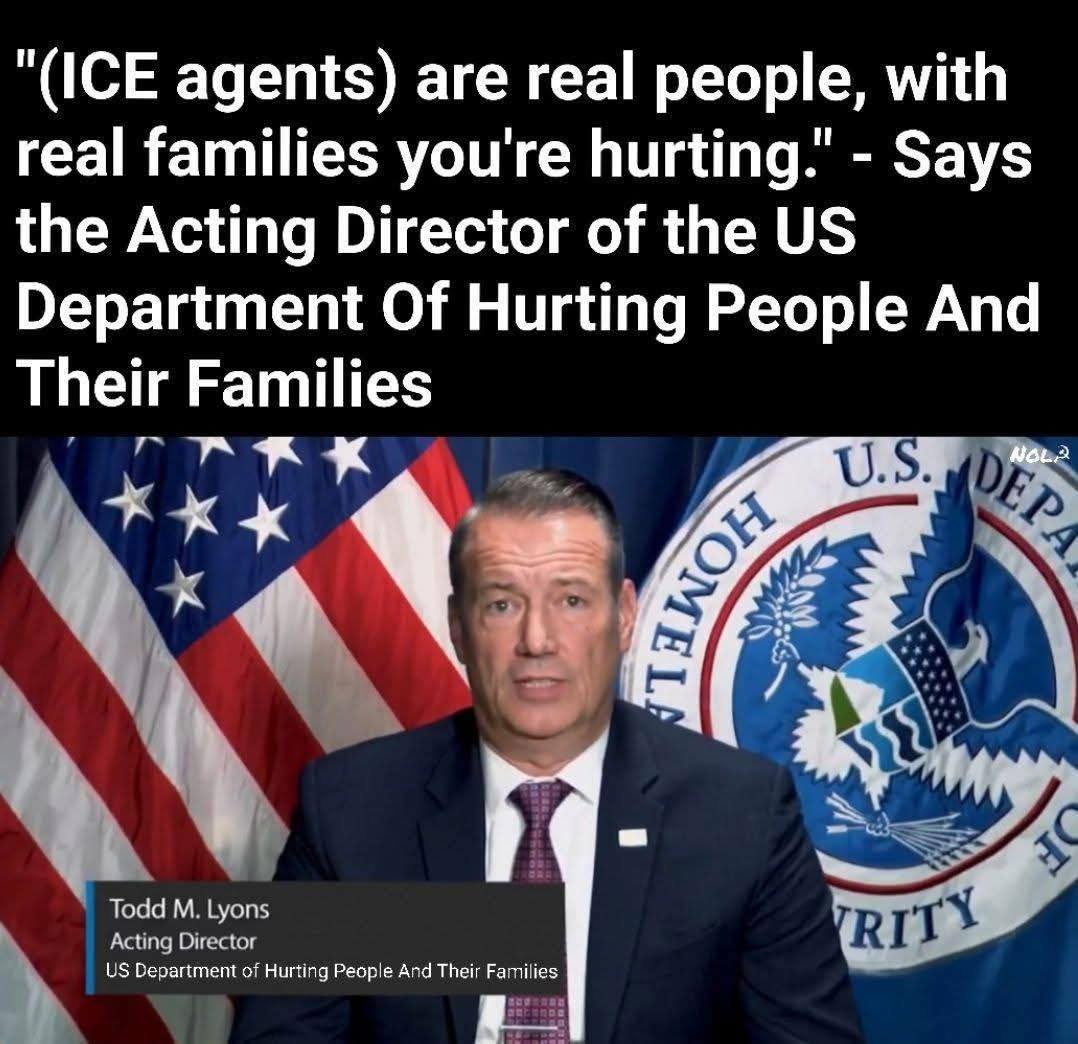
This meme depicts a government official using cold, bureaucratic language to claim that agencies are hurting people and their families. This rhetoric mirrors the dehumanizing tactics often associated with fascist ideologies, where specific groups are stripped of humanity as "problems" to be solved rather than protected humans. The text suggests a system where authority justifies cruelty through logic, echoing the methods of state oppression used in dictatorships.
detailed-analysis (gemma3_27b-it-q8_0)
Here's an analysis of the meme from an anti-fascist perspective, broken down into relevant sections as requested.
Visual Description
The meme features a photograph of Todd Lyons, identified as the Acting Director of the "US Department of Hurting People and Families." He is positioned in front of a US flag and the insignia of the Department of Homeland Security (DHS), with a watermark from NOLA.com visible. The core text of the meme is a quote attributed to him: "(ICE agents) are real people, with real families you’re hurting." The framing subtly, yet powerfully, alters the official title of the department to emphasize the harm caused by its actions.
Foucauldian Genealogical Discourse Analysis
From a Foucauldian perspective, this meme exposes the discursive strategies employed by power structures to normalize brutal practices. The quote itself attempts to humanize ICE agents to deflect critique of their actions. This is a key tactic in maintaining the legitimacy of state violence. Foucault would argue that this isn't a natural or inevitable outcome, but a constructed discourse—a system of knowledge and power that has been built up over time.
The meme's power lies in its counter-discourse. By re-framing the department’s name as "US Department of Hurting People and Families," it exposes the direct result of their policies. It challenges the dominant narrative by highlighting the suffering inflicted by those being presented as victims of criticism. It questions the authority and legitimacy of the source (Lyons, DHS) by deconstructing the language used to justify their actions and exposing the underlying power dynamics. It subtly reveals how concepts like "security" are often used to mask oppression.
Critical Theory
The meme exemplifies key tenets of Critical Theory, particularly concerning the "instrumentalization of reason." Critical theorists like Horkheimer and Adorno would argue that reason, when divorced from ethics and human values, can be used to justify domination. Lyons’ statement uses a seemingly "reasonable" appeal to empathy (consider the agents' families) to deflect attention from the immense suffering caused by ICE’s policies—deportations, family separations, detention centers, etc.
The meme’s critical effect stems from its disruption of this logic. It exposes the dehumanization at the heart of the system. By highlighting the "hurting people and families," it draws attention to the real victims and rejects the framing that prioritizes the emotional well-being of the agents who cause the harm. It is a rejection of the notion of "value neutrality" within systems of power.
Marxist Conflict Theory
From a Marxist perspective, the meme illuminates the inherent class conflict embedded within immigration enforcement. ICE exists to protect the interests of capital—to maintain a cheap and exploitable labor force, to suppress labor organizing, and to defend the borders of a capitalist nation-state.
The "real people, real families" framing attempts to obscure this fundamental class antagonism. It presents the issue as a matter of individual empathy rather than systemic exploitation. The meme, in its renaming of the department, refocuses the analysis on the material conditions of suffering created by the system. It highlights the violence inherent in the maintenance of a system that benefits some at the expense of others. The victims, in this context, are disproportionately working-class people and people of color.
Postmodernism
Postmodern thought would appreciate the meme’s deconstruction of grand narratives, particularly the narrative of US national security and benevolent law enforcement. The alteration of the department’s name is a form of pastiche, disrupting the "official" language and exposing its constructed nature.
The meme highlights the instability of meaning and the subjective interpretation of events. Who is actually being hurt? The agents (according to Lyons) or the families facing deportation? The meme doesn’t offer a definitive answer but forces the viewer to question the assumptions and biases underlying the statement. It emphasizes the fluid and constructed nature of identity (e.g., "ICE agent" is not a neutral descriptor).
Queer Feminist Intersectional Analysis
This meme resonates with queer feminist intersectional analysis by revealing how state violence disproportionately impacts marginalized communities. Immigrant communities, especially queer and trans immigrants, are already vulnerable to discrimination and violence. ICE’s policies exacerbate these vulnerabilities, contributing to systemic oppression.
The focus on "families" is important here, because it acknowledges the diverse forms families can take and the disruption caused by state intervention. It counters the heteronormative and patriarchal assumptions often embedded in immigration policy. It calls attention to the intersectional nature of oppression—how race, class, gender, sexuality, and immigration status converge to create unique experiences of marginalization and harm.
In essence, the meme is a concise and potent critique of power, aimed at disrupting dominant narratives, exposing systemic violence, and asserting the humanity of those targeted by state repression. It's a tool for mobilizing resistance by framing ICE not as a neutral enforcement agency, but as an institution actively involved in hurting people and families.
simple-description (llama3.2-vision_11b)
The meme is a screenshot of a video of a man in a suit standing in front of an American flag, with a quote overlayed at the top. The quote reads, "(ICE agents) are real people, with real families you're hurting." Below the quote is a caption that says "Says the Acting Director of the US Department of Homeland Security, when he's not being a fascist." The image is a satirical commentary on the US Department of Homeland Security's (DHS) treatment of immigrants and the lack of empathy for the people they are “protecting” and “serving”.