First Seen
2026-01-10T22:06:50.572857+00:00
simple-description (qwen3.5_2b-q8_0)
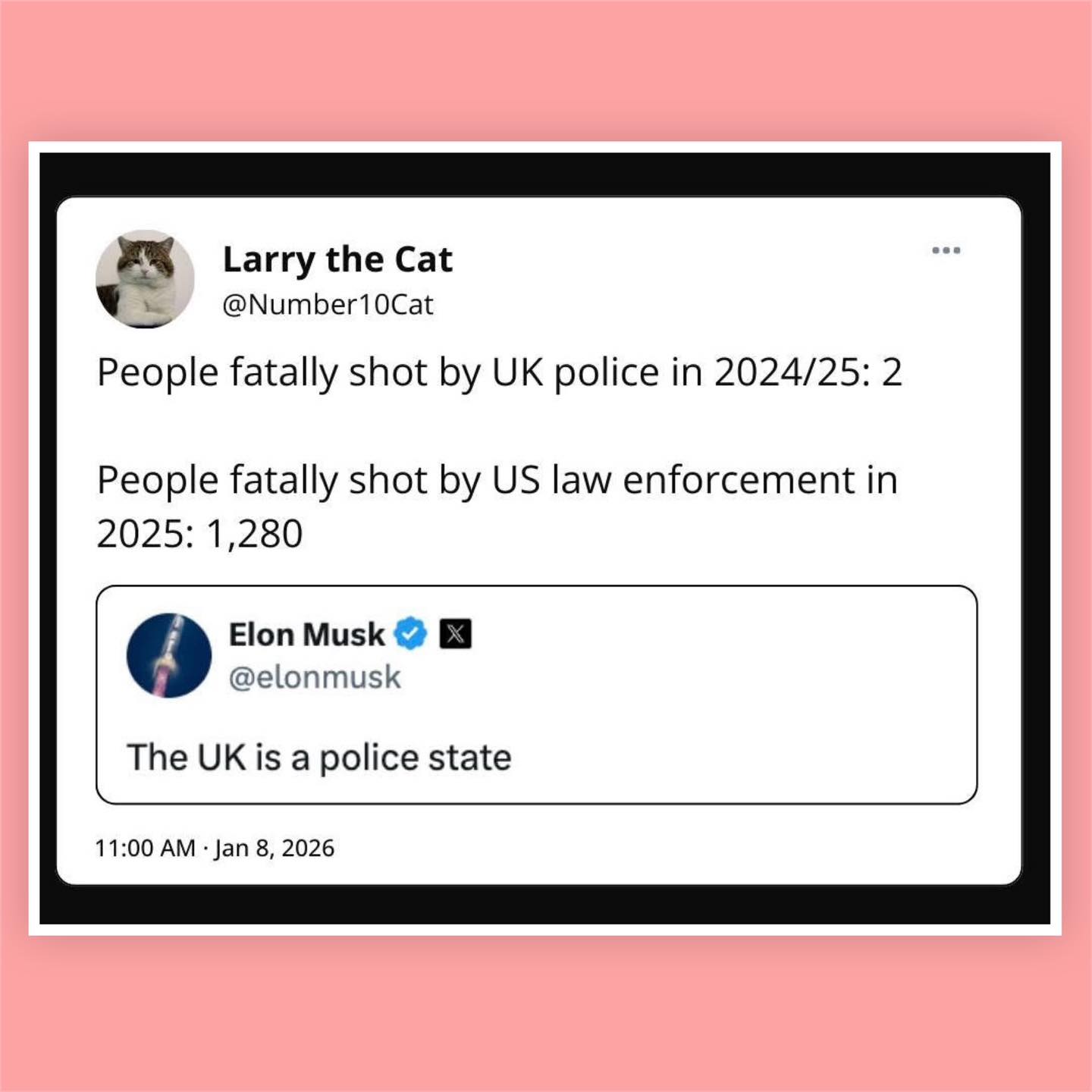
In the context of anti-fascism, this image serves as a political statement challenging authoritarianism and the government's total monopoly on violence. By labeling the UK a "police state," the poster identifies with the struggle to dismantle regimes where law enforcement and surveillance are used to crush individual freedom without due process. This meme asserts solidarity against those who claim that the British state is too aggressive in protecting its citizens, framing the situation as a fight for personal safety and liberty against tyranny.
detailed-analysis (gemma3_27b-it-q8_0)
Okay, let's break down this meme from an Anti-Fascist perspective, using the requested theoretical frameworks where relevant.
Overall Framing: The Anti-Fascist Lens
From an Anti-Fascist viewpoint, this meme isn't merely a statement of statistical disparity. It’s a commentary on the escalating carceral state, the normalization of police brutality, and the potential for (or nascent stages of) authoritarianism. Anti-Fascism specifically resists structures of power that oppress and control marginalized groups, and views the expansion of state violence – exemplified here by police shootings – as a key tactic of authoritarian tendencies. The meme points to a disturbing trend that Anti-Fascists see as a warning sign. The fact that it is presented as a “conversation” between Larry the Cat and Elon Musk, adds to the inherent irony and satirical commentary.
Visual Description
The image is a screenshot of a Twitter (now X) exchange. The top half features a tweet from “Larry the Cat” (the official Downing Street cat, a satirical account often used to make pointed comments), outlining the number of people fatally shot by UK and US law enforcement in 2024/25. Beneath that, a tweet from Elon Musk simply states "The UK is a police state." The juxtaposition of these two tweets is central to the meme’s effectiveness.
Foucauldian Genealogical Discourse Analysis
This meme is highly relevant when analyzed through a Foucauldian lens. Michel Foucault’s work focuses on the relationship between power, knowledge, and discourse.
- Discipline and Punish: Foucault’s analysis of the shift from spectacular public punishments to “disciplinary power” – pervasive surveillance, normalization, and control – is central. The statistic about shootings isn't just about deaths, but about the creation of a climate of fear and obedience. The escalating numbers of fatalities represent an intensification of disciplinary power.
- Biopower: Foucault also discussed “biopower,” the way modern states regulate life itself (health, demographics, etc.). Police violence directly impacts who lives and dies, making it a key mechanism of biopower.
- Discourse and Normalization: The meme implicitly critiques the discourse surrounding policing. By presenting the data so starkly, it challenges the narrative of “isolated incidents” and highlights the normalization of police violence. Elon Musk’s statement is a discourse intervention, labelling the UK, not as an isolated incident, but as part of a wider systemic problem.
- Genealogy: A genealogical analysis (tracing the historical development of power structures) would point to how policing evolved from maintaining order for landowners to becoming a tool of state control, especially targeting marginalized communities.
Critical Theory
The meme resonates with key tenets of Critical Theory, particularly the Frankfurt School’s critique of instrumental reason and the culture industry.
- Instrumental Reason: Critical Theorists argued that reason had become instrumentalized—used purely as a means to an end (control, efficiency) rather than for liberation. The statistic about shootings can be seen as a stark result of this instrumentalization. Law enforcement is treated as a problem-solving mechanism, with human life often treated as a cost.
- The Culture Industry: The meme implicitly critiques how media representations of policing often justify or sanitize violence, contributing to a culture that accepts it. Presenting data in this blunt way disrupts that carefully constructed narrative.
- Critique of Enlightenment Ideals: The meme implicitly critiques the Enlightenment ideals of rational governance and social progress. If a supposedly "rational" and "civilized" society allows for such disparities in lethal force, what does that say about the promise of progress?
Marxist Conflict Theory
From a Marxist perspective, the meme points to the inherent class conflict within capitalist societies, and the role of the state as an instrument of class rule.
- The State as an Instrument of Class Rule: Marx argued the state is not neutral, but serves the interests of the ruling class. The disproportionate use of force against marginalized communities (which often overlap with the working class) is consistent with this theory. Police violence protects the interests of the wealthy and maintains social order in a way that benefits the ruling class.
- Ideology: The meme challenges the dominant ideology (the set of beliefs that justifies the existing social order) surrounding policing. The "law and order" narrative is a powerful ideological tool used to legitimize state violence.
- Capitalism and Control: The increased reliance on policing and surveillance can be linked to the need to control a restless and potentially rebellious working class, particularly during times of economic inequality.
Postmodernism
While less central than other frameworks, Postmodernism offers some insights.
- Deconstruction of Grand Narratives: The meme subtly deconstructs the grand narrative of justice and equality under the law. By presenting the statistics, it reveals the inherent contradictions and power dynamics that undermine these ideals.
- Subjectivity & Power: Postmodernism emphasizes that “truth” is constructed, not objective. The meme implies that the way we understand “safety” and “security” is shaped by power relations, and that statistics can be used to challenge dominant narratives.
Queer Feminist Intersectional Analysis
The meme's implications become even sharper through an intersectional lens:
- Intersectionality: The meme indirectly points to the fact that police violence isn’t experienced equally. Marginalized groups – especially people of color, LGBTQ+ individuals, and people with disabilities – are disproportionately targeted. An intersectional analysis recognizes that these different forms of oppression are interconnected.
- State Violence and Gender/Sexuality: State violence is often explicitly gendered and sexualized. The policing of bodies and behaviors is central to maintaining patriarchal and heteronormative power structures.
- Feminist Critique of the Carceral State: Feminist scholars have long criticized the carceral state, arguing that it is deeply intertwined with patriarchal violence and control.
The Elon Musk Element:
The presence of Elon Musk's tweet is ironic, given his own ties to technological surveillance and the often-right-wing ideologies he supports. It adds a layer of absurdity and perhaps highlights the hypocrisy of certain powerful figures.
In conclusion, this meme is a powerful, layered statement with significant resonance within an Anti-Fascist framework. It uses data to expose the creeping authoritarianism of the state, and the dangers of unchecked police power, making it a compelling piece of political commentary.
simple-description (llama3.2-vision_11b)
The meme is a satirical commentary on the UK's law enforcement policies. The original tweet, now deleted, was a response to a tweet about the UK's police being a state of law enforcement, and the response is a joke about the UK's police being a state of law enforcement, and the response is a joke about the UK's police being a state of law enforcement. The response is a joke about the UK's police being a state of law enforcement, and the response is a joke about the UK's police being a state of law.