First Seen
2026-01-06T18:05:53.581030+00:00
simple-description (qwen3.5_2b-q8_0)
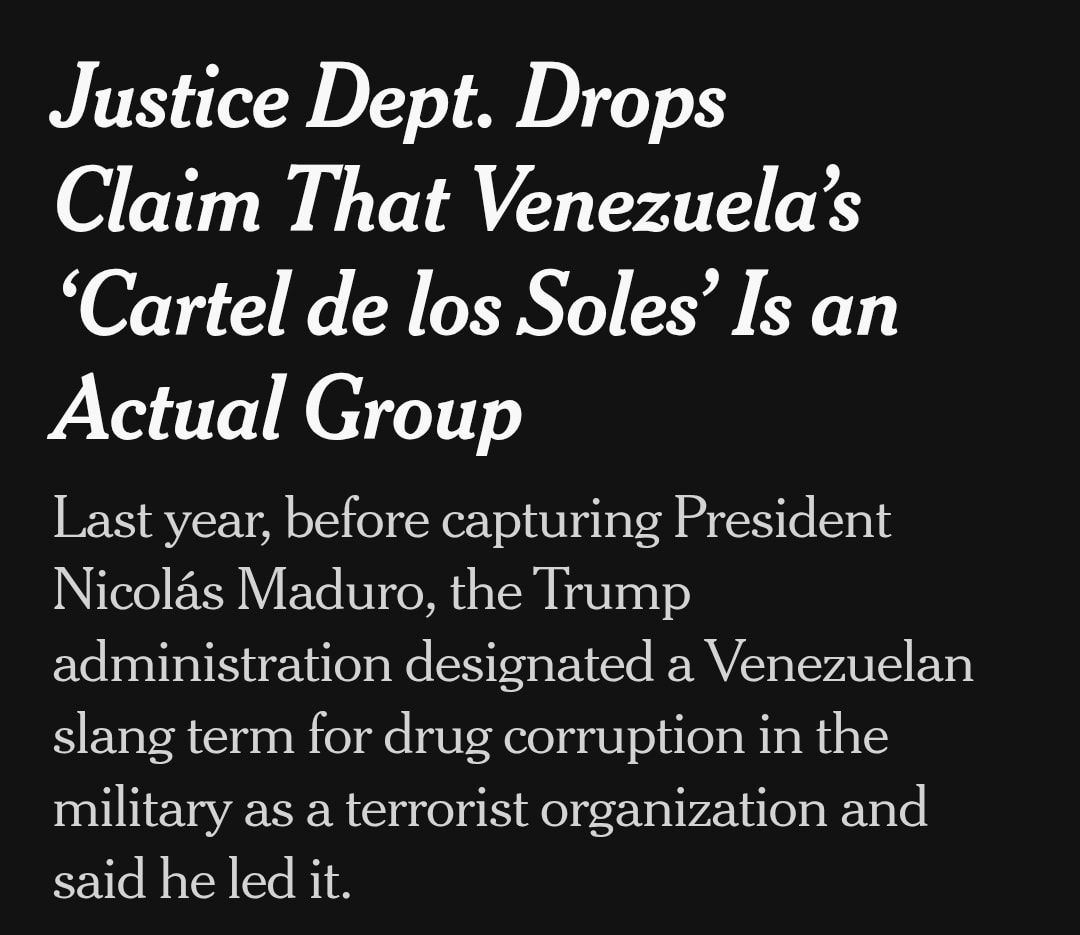
This meme is a political satire about Nicolás Maduro and the "Cartel de los Soles" (The King’s Cartel), referencing a specific historical organization associated with military dictatorships that had fascist-style regimes for drug trafficking. The text notes that the Justice Department suddenly declared this gang a terrorist organization just before capturing the leader, implying they are dismantling a real-world criminal entity labeled as belonging to an authoritarian regime. By treating them as an "actual group" in a new light, it mocks the rigidity of political definitions regarding state-sponsored crime.
detailed-analysis (gemma3_27b-it-q8_0)
Okay, let's break down this text snippet from an anti-fascist perspective, utilizing the requested theoretical frameworks where applicable. It's important to note that while this looks like a meme format, it's presented as news text. I'll treat it as such, analyzing the implications a meme would make in using this information.
Visual Description
The visual is simple: a text block on a dark background. This aesthetic choice is common in sharing quick news updates, particularly on social media where clarity and quick consumption are important. The stark contrast emphasizes the headline, which is presented in a large, attention-grabbing font. While it lacks an image, the boldness of the text aims to visually convey a sense of urgency and importance.
Foucauldian Genealogical Discourse Analysis
This situation is ripe for a Foucauldian reading. Michel Foucault's work on power/knowledge is central here.
- Discourse & Power: The designation of "Cartel de los Soles" as a terrorist organization isn't about objective truth; it's a discursive act. It’s a way of constructing a narrative about Venezuela, specifically under Maduro, that positions it as an enemy. This isn't about “discovering” a real, pre-existing terrorist group. It’s creating a "truth" through pronouncements from state power (the US Justice Department) and building a discourse around that truth.
- Genealogy & Historical Context: Foucault’s genealogical method wants us to look at the history of how this designation came about. Why this term? Why now? The text points to this coming before any attempt to capture Maduro, suggesting the "terrorist" designation isn’t a consequence of actions, but a preemptive justification for intervention. It’s a historical construction to legitimize potential actions. The usage of a Venezuelan slang term, in particular, is interesting. It suggests an attempt to penetrate Venezuelan language and culture to re-contextualize it through a US power dynamic.
- Power/Knowledge Nexus: The Justice Department's claim isn’t simply an assertion of fact; it becomes a source of knowledge. It influences how media reports, politicians speak, and the public understands the situation. It’s a classic example of power producing knowledge, and then using that knowledge to reinforce its power. The anti-fascist perspective sees this as a tactic to demonize a political opponent and create the conditions for further imperialist actions.
Critical Theory
From a Critical Theory lens, notably the Frankfurt School, this event reveals the manipulation of reason and the ideology underpinning US foreign policy.
- Instrumental Reason: The "terrorism" label serves an instrumental purpose - to justify political and potentially military intervention in Venezuela. It’s not about genuine concern for security, but about advancing geopolitical interests.
- Ideology: The framing of Maduro and his government as terrorists reinforces a narrative of “rogue states” and the US as the defender of democracy and freedom. This is an ideology that obscures the real motivations behind US actions: resource control (Venezuela has vast oil reserves) and maintaining regional hegemony.
- Culture Industry: The dissemination of this narrative through the media is part of the “culture industry” – the way capitalist systems produce and distribute ideologies that maintain the status quo. The repeated association of Maduro with terrorism aims to shape public opinion and normalize interventionist policies.
Marxist Conflict Theory
This scenario is a clear example of class conflict playing out on an international scale.
- Imperialism: The US interventionist approach, justified by the "terrorism" narrative, is a manifestation of imperialism—the exploitation of one country by another for economic gain. Venezuela’s oil wealth is a key factor here.
- Bourgeois State: The US Justice Department acts as an instrument of the ruling class, protecting their economic interests abroad. The "terrorism" label is a tool to undermine a government that challenges those interests.
- False Consciousness: The dissemination of the "terrorism" narrative can contribute to “false consciousness” among the US public, leading them to support policies that ultimately benefit the capitalist class at the expense of Venezuelan sovereignty and the Venezuelan working class.
Postmodernism
A postmodern reading would focus on the deconstruction of truth claims and the instability of meaning.
- Simulacra and Simulation: The "Cartel de los Soles" as a terrorist organization could be seen as a simulacrum – a copy without an original. It is a constructed reality, a representation of a threat that may or may not accurately reflect the actual situation. The designation becomes more real than any actual substance it represents.
- Deconstruction of Grand Narratives: The narrative of the "war on terror" is a “grand narrative” that has been used to justify numerous interventions. Postmodernism encourages us to deconstruct these narratives and expose their underlying power dynamics. The claim about "Cartel de los Soles" challenges the universal claim of the "war on terror", suggesting it's applied selectively and politically.
- Subjectivity of Truth: Postmodernism would emphasize that "truth" is not objective but is always constructed within a specific context and from a particular perspective. The US Justice Department's claim is simply one interpretation of events, not an absolute truth.
In essence, an anti-fascist analysis of this text sees it as a calculated effort by the US government to demonize a political opponent, justify intervention, and protect its economic interests in Venezuela. The use of the "terrorism" label is a manipulative tactic that relies on ideological constructs, power dynamics, and the control of information.
simple-description (llama3.2-vision_11b)
The meme is a satirical image that compares the Trump administration's use of the term "Cartel de los Soles" (Cartel of the Sun) to describe a group of Venezuelan military officers who were involved in a 2015-2016 [...] to the Trump administration's use of the term "Cartel de los Soles" to describe a group of Venezuelan military officers who were involved in a 2015-2016 [...] The image is likely to be humorous and satirical, using the term "Cartel de los Soles" to describe a group of [...] The image is likely to be humorous and satirical, using the term "Cartel de los Soles" to describe a group of [...]