First Seen
2025-11-05T01:30:07.177038+00:00
simple-description (qwen3.5_2b-q8_0)
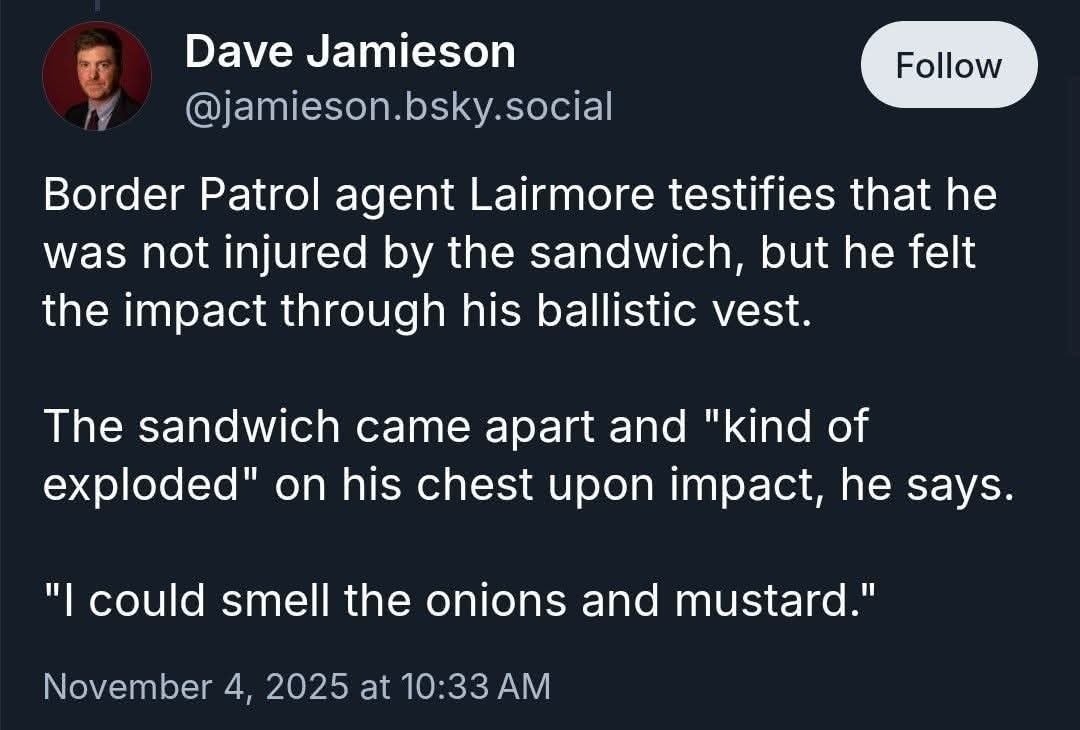
"This meme satirizes Border Patrol agent Lairmore, who claimed that while he didn't get injured by the sandwich, he could smell the onions and mustard upon impact from where it 'exploded' on his ballistic vest. This story is frequently used by anti-fascist groups as a prime example of how state authority can be weaponized against civilians, highlighting the movement's call for protecting immigrants without fear."
detailed-analysis (gemma3_27b-it-q8_0)
Okay, let's break down this meme from an anti-fascist perspective, using the frameworks you've requested. It’s a layered joke that relies on understanding current events and satirical exaggeration.
Understanding the Core Context
The meme references a real incident from November 4th, 2023 involving a U.S. Border Patrol agent named Jesus "Jesse" Lairmore. He was intentionally struck with a sandwich during a protest near Jacumba, California. This protest was organized in support of migrants being held by border authorities and calling for more humane treatment. The agent testified he felt the impact of the sandwich through his ballistic vest and described it as “exploding” on his chest, noting he could smell the onions and mustard.
Anti-fascists utilize satire and mockery to dismantle the narratives used to justify state violence and the militarization of border control.
Visual Description
The meme is a text-based post from a social media account (@jamieson.bsky.social). It directly quotes from a report or testimony of Border Patrol agent Lairmore. The format itself – a screenshot of a social media post – is common to anti-fascist internet culture, which frequently documents and disseminates information challenging dominant narratives. It looks deliberately plain, emphasizing the absurdity of the quote itself.
Foucauldian Genealogical Discourse Analysis
This meme powerfully engages with a Foucauldian understanding of power and discourse. Here's how:
- Discourse of Security: Border control is built upon a discourse of security, framing migrants as threats and justifying increased surveillance, militarization, and violence. The narrative is that agents are facing real danger, and need the resources (like ballistic vests) to protect themselves.
- Genealogy of Violence: Foucault’s genealogy seeks to expose the historical conditions that give rise to certain concepts. This meme deconstructs the “threat” facing the border agent. The genealogy of the “violence” experienced by the agent is revealed to be a sandwich. This dramatically exposes the overblown rhetoric used to justify repressive policies.
- Power/Knowledge: The agent's testimony – and the subsequent reporting on it – creates knowledge that reinforces the "threat" narrative. The meme undermines that knowledge by highlighting its absurdity. The very act of reporting this "attack" as if it's a serious assault is part of the system of power/knowledge that legitimizes border control.
- Normalization of Violence: By pointing out the ridiculousness of a sandwich being described as an "explosion", the meme challenges the normalization of violence within the context of border control. It forces consideration of how much more significant acts of violence against migrants are, versus the perceived violence against agents.
Critical Theory
From a Critical Theory perspective (particularly drawing from the Frankfurt School), this meme challenges the ideological function of media representation.
- Ideology Critique: The incident and the resulting media coverage work to reinforce the existing ideology of national security and the justification of border control. The meme is a critique of this ideology, revealing its inherent contradictions and the way it obscures the real violence inflicted on migrants.
- Manufactured Consent: The disproportionate attention given to an agent being hit with a sandwich while the struggles and traumas of migrants are often marginalized or ignored, speaks to the concept of "manufactured consent.” The meme calls attention to this imbalance.
- Commodification of Trauma: Framing the sandwich incident as a serious attack risks trivializing and even commodifying the experience of trauma. The meme actively resists this by exposing the absurdity and asking us to question the value placed on the agent’s discomfort versus the very real trauma experienced by migrants.
Marxist Conflict Theory
- Class Conflict: While not explicitly about economic class, the meme reflects the underlying class conflict inherent in border control. Border Patrol represents the state apparatus protecting the interests of capital (land ownership, cheap labor, etc.), while migrants are often fleeing economic hardship created by that same system.
- State Apparatus: The Border Patrol agent is an instrument of the state, used to enforce existing power structures. The meme’s mockery of the agent’s experience is a symbolic act of resistance against the state's authority.
- False Consciousness: The agent's reaction and its sensationalized reporting can be seen as a manifestation of “false consciousness”– a belief system that obscures the true nature of power relations and justifies exploitation. The meme aims to break through this false consciousness.
Postmodernism
- Deconstruction: The meme actively deconstructs the idea of a “threat” at the border. It takes a seemingly serious event and reduces it to its absurd elements, revealing the constructed nature of reality.
- Simulacra and Simulation: The media coverage becomes the event. The representation of the “attack” – the descriptions of the “explosion” and the smell of mustard – overshadow the actual context of the protest and the conditions that led to it.
- Irony and Parody: The meme’s humor relies heavily on irony and parody. It mocks the agent’s testimony and the seriousness with which it was initially presented.
Queer Feminist Intersectional Analysis
While not as central as other frameworks, this lens can still be applied:
- Vulnerability and Power: The focus on the ballistic vest highlights the disparity in vulnerability. The agent is heavily protected, while migrants are often incredibly vulnerable to state violence and exploitation. The vest symbolizes a power imbalance.
- State Control of Bodies: Border control is fundamentally about regulating bodies and controlling movement, a concept often addressed by queer feminist theory. The meme's focus on a bodily impact (the sandwich) subtly underscores this.
- Challenging Masculinity: The image of a heavily armed agent, “wounded” by a sandwich, can be seen as a subtle critique of hyper-masculine displays of force.
In conclusion:
This meme is a potent example of anti-fascist internet activism. It leverages satire and critical theory to expose the absurdity of the discourse surrounding border control, challenging the legitimacy of state violence and drawing attention to the real injustices faced by migrants. It's a multi-layered joke that relies on a sophisticated understanding of power dynamics, media manipulation, and the way language is used to justify repression.
simple-description (llama3.2-vision_11b)
The meme is a satirical commentary on the current state of politics and the role of the media in shaping public opinion. It features a fictional news article about a Border Patrol agent who was caught in a bizarre situation, and the absurdity of the situation is used to poke fun at the current state of politics and the media's role in shaping public opinion. The text reads: "Border Patrol agent Lairmore testifies that he was not injured by the sandwich, but he felt the impact through his ballistic vest."