First Seen
2025-10-30T23:36:35.261125+00:00
simple-description (qwen3.5_2b-q8_0)
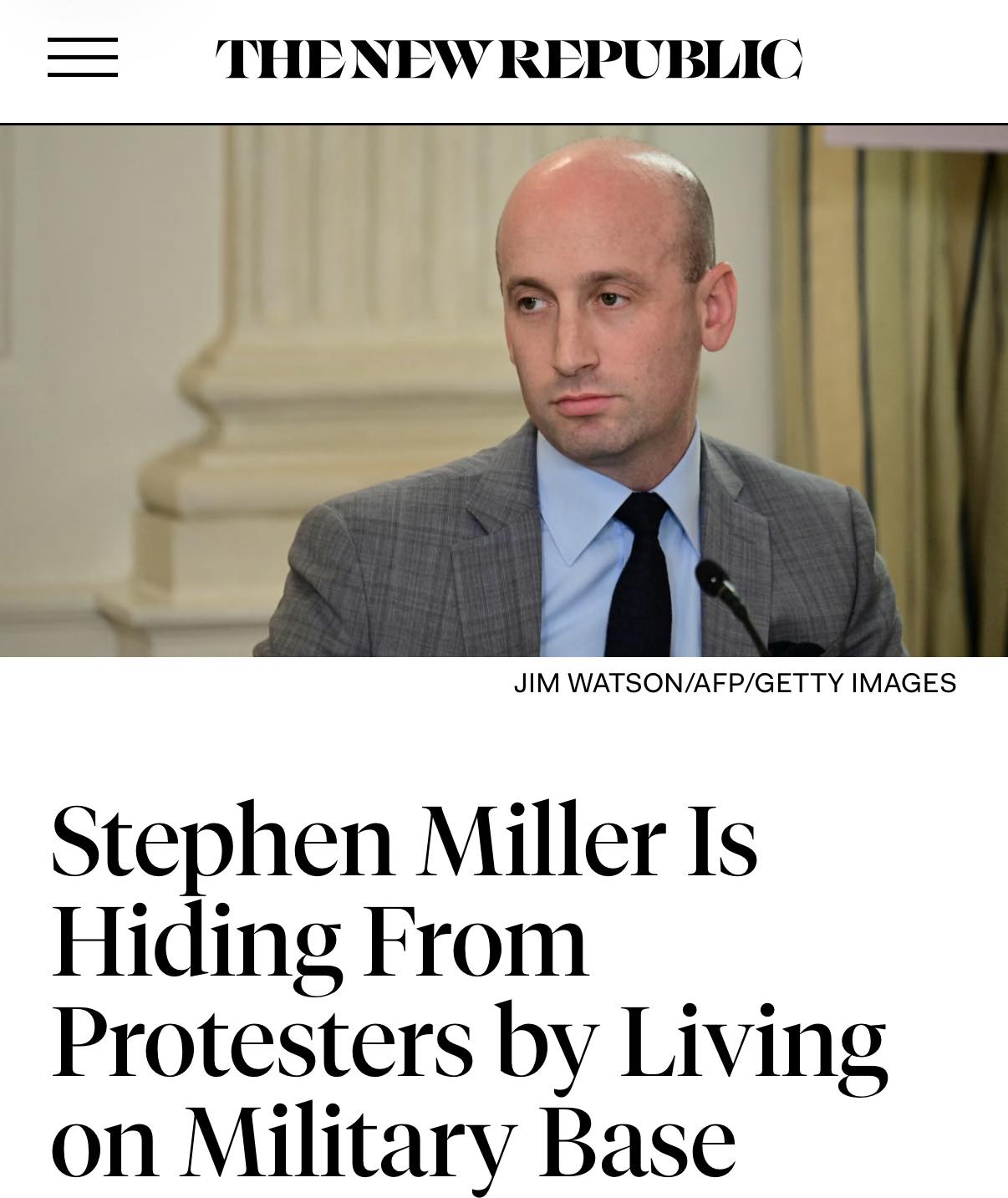
The image displays a headline from The New Republic reporting that Senator Stephen Miller is "hiding from protesters by living on a military base." The photograph shows Miller in a suit and tie speaking into a microphone, with a credit line reading "JIM WATSON/AFP/GETTY IMAGES" below the photo.
detailed-analysis (gemma3_27b-it-q8_0)
Here's an analysis of the image and its accompanying headline, framed from an anti-fascist perspective, with sections addressing relevant theoretical frameworks.
Image Analysis: Stephen Miller & the Specter of Fascism
Visual Description
The image depicts Stephen Miller, a former senior advisor to Donald Trump known for his staunch anti-immigration stances, and widely seen as a key architect of the Trump administration's restrictive immigration policies. He's pictured indoors, appearing in a formal suit, tie, and with a neutral, almost stern facial expression. The lighting is somewhat stark, adding to a sense of seriousness and unease. The composition is a medium shot, focused on his face, giving prominence to his expression. The fact that the image comes from a news source (The New Republic) and is credited to a reputable agency (AFP/Getty) lends it an air of authority.
Foucauldian Genealogical Discourse Analysis
From a Foucauldian perspective, this image and headline represent a moment within a discourse about power, security, and the construction of the "other." Miller's policies, and his decision to take refuge on a military base to avoid protests, speak to the historical genealogy of how states exercise control through border regulation and the management of populations.
The image implicates Miller in a biopower dynamic. Biopower, as defined by Foucault, is the way in which modern states govern and control populations through mechanisms that regulate life itself – immigration policies are a prime example. Miller, in attempting to evade accountability for his role in enacting this biopower, reveals the fragility and the inherent violence within the system. The "hiding" is crucial, demonstrating a need to protect the apparatus of power (himself) from the disruptive force of resistance (protests).
The narrative about Miller needing protection on a military base further signifies the deep entrenchment of securitization within the discourse. The state apparatus (the military base) is called upon to shield someone whose policies fundamentally alter who is permitted to be part of the “nation”.
Critical Theory
Critical Theory, particularly relating to the Frankfurt School, would see this image as symptomatic of a larger crisis of legitimacy in liberal democracy. Miller represents a strand of reactionary thought – a desire for restoration and control – that gains power within the system.
The headline suggests a failure of the supposed 'rational' forces of discourse to hold him accountable. His reliance on a military base, a symbol of state power and potentially violent force, to avoid protesters, indicates a rejection of democratic process in favor of an authoritarian approach. This also highlights the tension between instrumental reason (achieving efficiency through specific policies) and communicative reason (reaching consensus through open dialogue). Miller's actions privilege the former, suppressing the latter.
Marxist Conflict Theory
From a Marxist perspective, Miller represents the interests of a particular class – a nationalistic, nativist element that seeks to maintain its power by exploiting divisions within the working class. Immigration policies crafted by Miller are seen as tools to suppress wages, create scapegoats, and divert attention from systemic economic inequalities.
The protests against Miller are interpreted as a manifestation of class struggle, a resistance to the dominant ideology. The fact that he seeks refuge on a military base is evidence of the inherent contradiction within capitalist states: the need to rely on coercion and repression (the military) to maintain order and protect the interests of the ruling class. His need to hide indicates that the "hegemonic" power of the ruling class is becoming challenged.
Postmodernism
A postmodern interpretation would question the notion of a singular, unified "truth" about Miller or his actions. It would emphasize the role of narratives and representations in constructing his image and the meaning of his hiding. The headline itself is a performance of meaning – it is framing the event, shaping the public perception.
Furthermore, postmodernism would examine the deconstruction of the categories “protester” and “protected.” Who gets to be a protestor? Who is worthy of protection? The image disrupts a neat understanding of these categories. Miller’s need to be protected on a military base throws into question who is the real threat to stability, and who is fighting for justice.
Anti-Fascist Context & Overarching Interpretation
Ultimately, viewed through an anti-fascist lens, this image is deeply concerning. Miller is seen as a central figure in the normalization of far-right, white nationalist ideology within the mainstream political sphere. His policies have inflicted immense harm on marginalized communities. The act of "hiding" on a military base is not simply a personal quirk; it’s a symbolic act of cowardice and an embrace of authoritarian tactics. It confirms the anti-fascist suspicion that proponents of these ideologies are not interested in open debate, but in imposing their will through force and suppression.
The image, therefore, is not just a news item; it’s a rallying point for anti-fascist organizing and resistance. It underscores the importance of continuing to challenge, expose, and disrupt the forces of reaction and oppression. It’s a reminder that vigilance and collective action are essential to preventing the rise of fascism.
Disclaimer: These interpretations are based on the provided theoretical frameworks and the context of the image and headline. The analysis is inherently subjective and open to further debate.
simple-description (llama3.2-vision_11b)
The meme is a screenshot of a news article from The New Republic with the title "Stephen Miller Is Hiding From Protesters by Living on Military Base". The image shows a photo of Stephen Miller, a former White House advisor, with a caption that suggests he is avoiding protests by living on a military base, implying that he is hiding from protesters. The meme is likely being shared to poke fun at the idea that someone who is known for being a pro-fascist and anti-fascist has to hide from protesters.