First Seen
2025-10-17T22:04:32.290228+00:00
simple-description (qwen3.5_2b-q8_0)
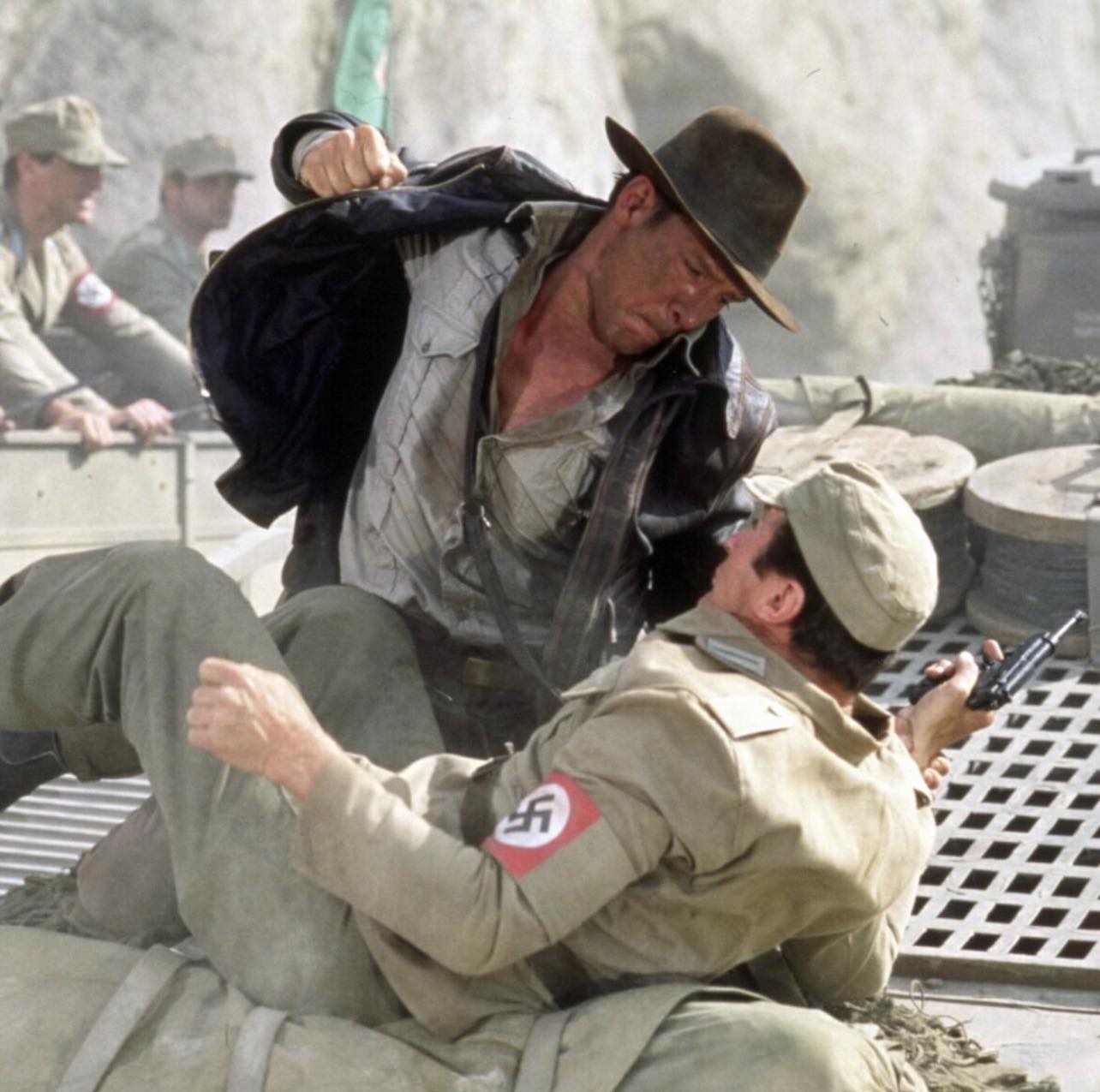
This meme personifies the struggle against fascism by contrasting traditional heroism with totalitarian aggression, showing how courage can dismantle ideological extremism. The scene features Indiana Jones, a symbol of adventure and freedom, physically overpowers a Nazi officer (the symbol of hatred), representing a direct assault on evil. The soldier’s identity is explicitly marked by a red armband featuring a black swastika as the specific text of the enemy he is battling.
detailed-analysis (gemma3_27b-it-q8_0)
Here's an analysis of the image from the provided category (Anti-Fascism), utilizing the requested theoretical frameworks where relevant.
Image Analysis: Indiana Jones and the Anti-Fascist Struggle
Visual Description
The image depicts a scene from Raiders of the Lost Ark (1981). Indiana Jones is physically fighting a Nazi soldier. Jones is wearing his signature fedora and leather jacket and is in the process of delivering a punch to the Nazi’s face. The Nazi soldier is wearing a military uniform prominently displaying the swastika armband. He is in a defensive posture, attempting to shield himself from the blow. The setting appears to be a marketplace or dockside, with other Nazi soldiers visible in the background. The image conveys a sense of direct physical confrontation, with Jones positioned as the active agent and the Nazi as the target of his aggression. The inclusion of the drain below suggests a symbolic “washing away” or disposal of the fascist element.
Foucauldian Genealogical Discourse Analysis
From a Foucauldian perspective, this image is not simply about a good guy fighting a bad guy. It represents a discursive struggle around the construction of “normality” and the legitimacy of power. The Nazi ideology, rooted in concepts of racial purity, national superiority, and authoritarian control, attempted to establish a new “regime of truth.” This regime sought to define who was "normal" and legitimate and who was excluded and deemed “other” (Jews, communists, Roma, homosexuals, etc.).
Indiana Jones, as a representation of Western values and exploration, is actively disrupting this Nazi "regime of truth" through physical force. His action is a rejection of the Nazi’s attempts to define reality and exert control. The very act of physically attacking a Nazi is a performative rejection of the discourse of fascism. The genealogy would trace the historical emergence of both the Nazi ideology and the counter-discourse represented by resistance figures like Jones – how power relations shaped both and how they came to be understood.
Critical Theory
This image is a powerful illustration of the core tenets of Critical Theory, particularly as it relates to the Frankfurt School’s concern with the “culture industry” and the dangers of totalitarianism. The Nazis represent the ultimate expression of instrumental reason turned towards domination – using rationality and organization to implement a horrific ideology.
The image speaks to the concept of "Enlightenment" falling into barbarism. It’s a spectacle of resistance against an oppressive, rationalized system. Jones is a figure embodying Enlightenment values (knowledge, exploration, individual agency) fighting against their perversion by the Nazi regime. The image challenges the viewer to critically examine the social forces that allow ideologies like fascism to take hold and the responsibility individuals have to resist them. It is a reminder that critical thinking and action are necessary to prevent the re-emergence of authoritarianism.
Marxist Conflict Theory
From a Marxist perspective, the image represents a struggle between opposing class interests. While the Nazis presented a nationalist ideology, their power base rested on the support of specific economic classes (industrialists, landowners) who benefited from their control and expansion.
Jones, as a representative of individual agency and, implicitly, a challenge to established hierarchies, can be interpreted as a symbol of resistance from those who are oppressed by the Nazi regime. The fight is not merely ideological but a struggle over material power and control. It embodies the inherent conflict between the ruling class (Nazis) attempting to maintain their dominance and the forces of liberation. The Nazis are seeking to control resources (the Ark in the film), and Jones is obstructing that control.
Postmodernism
A postmodern reading would deconstruct the image's simplistic good-versus-evil narrative. It would question the idea of a single, definitive "truth" about fascism. It might explore the ways in which the film itself constructs the Nazi as the "Other" to reinforce Western, heroic narratives.
The image, through a postmodern lens, is a simulacrum – a representation of a representation. It’s a fictionalized depiction of a real historical evil, raising questions about the authenticity and reliability of historical representation. It challenges the grand narratives about good and evil, questioning the authority of the filmmaker to define those categories. It explores the instability of meaning in representations of power and conflict.
In Conclusion
The image of Indiana Jones fighting the Nazi soldier is a potent symbol within the context of Anti-Fascism. It can be interpreted through various theoretical lenses to reveal the complexities of power, ideology, resistance, and the ongoing struggle against authoritarianism. While the image appears straightforward, it's a loaded symbol that speaks to enduring political and philosophical concerns.
simple-description (llama3.2-vision_11b)
The meme is an image of Indiana Jones fighting a Nazi in the 1984 film "Indiana Jones and the Temple of the 1st 3" (a typo in the original title). The meme is a humorous take on the iconic scene where Indiana Jones is fighting a Nazi, with the Nazi's face being replaced with a swastika, symbolizing the Nazi's ideology of hate and intolerance. The meme is a commentary on the anti-fascist movement, highlighting the need to fight against the ideology of hate and intolerance.