First Seen
2025-10-11T06:59:49.087443+00:00
simple-description (qwen3.5_2b-q8_0)
This meme is a satirical take by Premi Takker, whose account is linked to the T movement's specific narrative that frames mainstream coverage of Israel-Hamas conflicts as an example of "white supremacy." The humor mocks how news outlets treat complex geopolitical tensions like the Israel-Hamas war as mundane business negotiations or "deals," reducing serious international conflict to a trivial logistical setup.
detailed-analysis (gemma3_27b-it-q8_0)
Okay, let's break down this "meme" (it's more of a news update/observation with accompanying screenshots) through the lens of Anti-Fascism, utilizing relevant theoretical frameworks where appropriate. It's important to note the implied critique here is subtle and relies heavily on the existing context of Anti-Fascist thought.
Understanding the Core Anti-Fascist Perspective
Before diving into specific theories, it's crucial to understand that Anti-Fascism, beyond simply opposing literal fascism, is concerned with identifying and challenging power structures that enable or resemble fascist dynamics—authoritarianism, nationalism, militarism, the suppression of dissent, the normalization of violence, and the concentration of power in elite hands. This post suggests a critique of the normalization of figures associated with US foreign policy which has, at times, been implicated in supporting structures that mirror these dynamics.
1. Visual Description
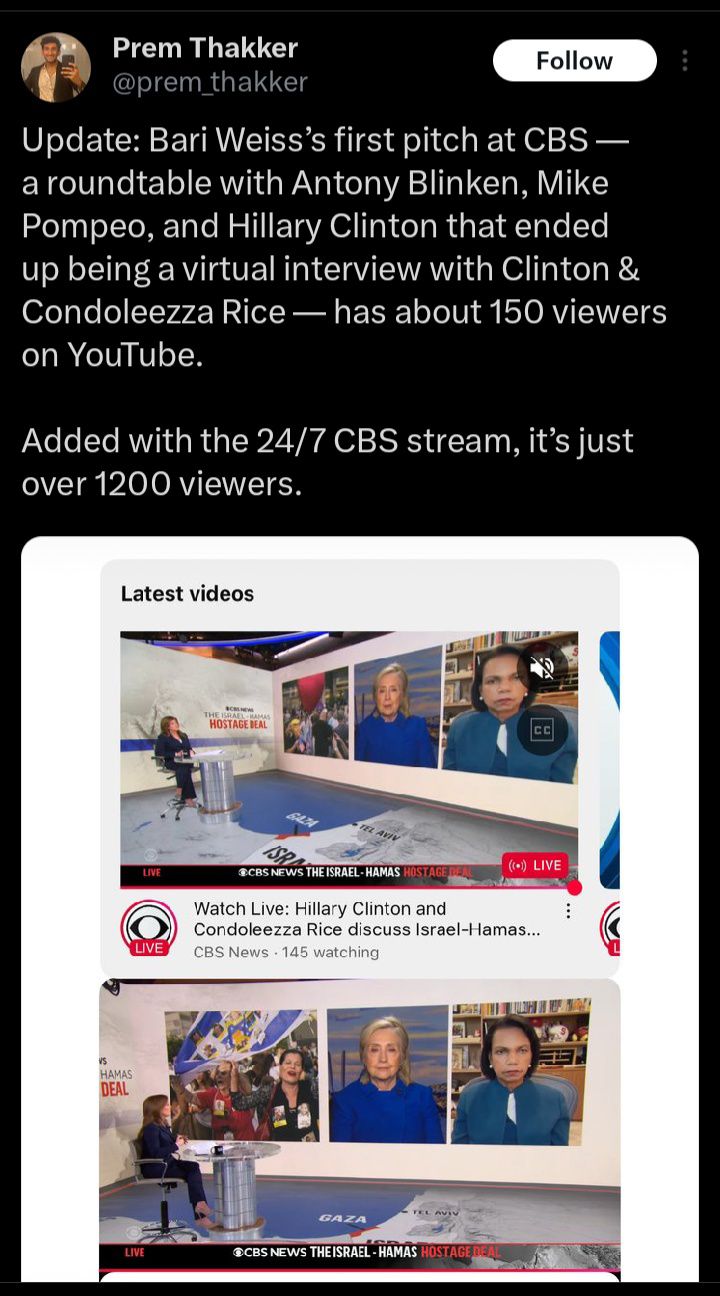
The image consists of three screenshots from a CBS News live stream featuring a roundtable discussion on the Israel-Hamas conflict. The participants visible are Antony Blinken (US Secretary of State), Hillary Clinton (former Secretary of State), and Condoleezza Rice (former Secretary of State and National Security Advisor). The screenshots focus on their faces in a video conferencing setup. The backdrop shows a CBS News graphic related to the “Israel-Hamas Hostage Deal”. Notably, the post points out the extremely low viewership (145-150 viewers, then 1200). This contrast – high-profile figures, a serious geopolitical topic, and a tiny audience – is a significant part of the critique.
2. Foucauldian Genealogical Discourse Analysis
This is where the post gets interesting. Foucault's genealogy examines the historical construction of power/knowledge relations. This image can be read as highlighting a specific discourse surrounding US foreign policy.
- The Expert Panel as Discourse: The very act of gathering these three figures—Clinton, Rice, and Blinken—constructs a particular authority and legitimacy around a discussion of the Israel-Hamas conflict. It suggests that this discourse is owned by established political figures, specifically those connected to the US State Department. This pre-defines who is permitted to speak on the issue, silencing other voices (Palestinian perspectives, grassroots activism, independent journalists, etc.).
- Normalization of Interventionism: All three participants have been key players in US foreign policy decisions involving military intervention, “nation-building,” and support for various regimes in the Middle East. The “roundtable” format normalizes the idea of US intervention and US-led “solutions” to complex international conflicts. This echoes a historical trajectory of US dominance in global affairs and the construction of “expertise” tied to interventionist policies.
- The Spectacle and Absence: The extremely low viewership contrasts sharply with the status of the figures involved. This suggests the spectacle of power is not necessarily captivating or meaningful to the wider public. The lack of engagement could be interpreted as a rejection of the official narratives being presented. It's a visual representation of a disconnect between elite power and public interest.
3. Critical Theory
Critical Theory focuses on how dominant ideologies perpetuate power imbalances.
- Hegemony & Consent: The panel exemplifies how "hegemony" operates – how dominant ideologies become normalized and accepted as "common sense." The inclusion of these figures reinforces the idea that US foreign policy is a rational, well-intentioned force for good, despite its often-controversial outcomes. The low viewership, however, subtly challenges this hegemony.
- Commodification of Discourse: The fact this is streaming on YouTube can be interpreted as the commodification of political discourse. The topic—a brutal conflict—is presented as content for consumption, potentially obscuring the lived realities of those affected.
- The Illusion of Debate: A roundtable format implies a debate, but it’s a debate entirely contained within the boundaries of establishment politics. The range of viewpoints is limited, reinforcing existing power structures.
4. Marxist Conflict Theory
While not a direct application, the post alludes to conflicts of interest and the role of elites.
- Imperialism and Global Capitalism: The figures involved have consistently supported policies that benefit US economic and geopolitical interests, which can be linked to the expansion of global capitalism and imperialist ventures. The discussion of the Israel-Hamas conflict, in this framework, is framed as being inseparable from the broader context of resource control, strategic alliances, and the preservation of US power.
- Class Interests: These figures represent the interests of the ruling class—those who benefit from the existing capitalist system and US dominance.
5. Postmodernism
- Deconstruction of Authority: The juxtaposition of high-profile figures and minimal viewership serves to “deconstruct” the notion of authority. The image questions the inherent validity of their perspectives simply by highlighting their disconnection from broader public engagement.
- Simulacra and Simulation: The curated, mediated nature of the livestream and the “expert” panel could be seen as a "simulacra" – a copy without an original. The discussion may be more about performing a certain narrative than about genuine dialogue or problem-solving.
In summary:
From an Anti-Fascist perspective, this post isn't simply about the individuals involved. It's a subtle critique of the structures of power that enable the continued normalization of interventionist foreign policy, the silencing of dissenting voices, and the disconnect between elite decision-making and public interest. The low viewership is a key element, suggesting a growing public disillusionment with these established power structures. The theoretical frameworks above help unpack the underlying mechanisms at play and illuminate the power dynamics at work.
simple-description (llama3.2-vision_11b)
The meme is a screenshot of a news article with a video of a news anchor discussing the Israeli-Hamas conflict. The article's title reads "Israel-Hamas conflict: A 'war' of words" and the video shows the news anchor discussing the conflict's "war" of words.