First Seen
2025-10-11T07:30:41.218455+00:00
simple-description (qwen3.5_2b-q8_0)
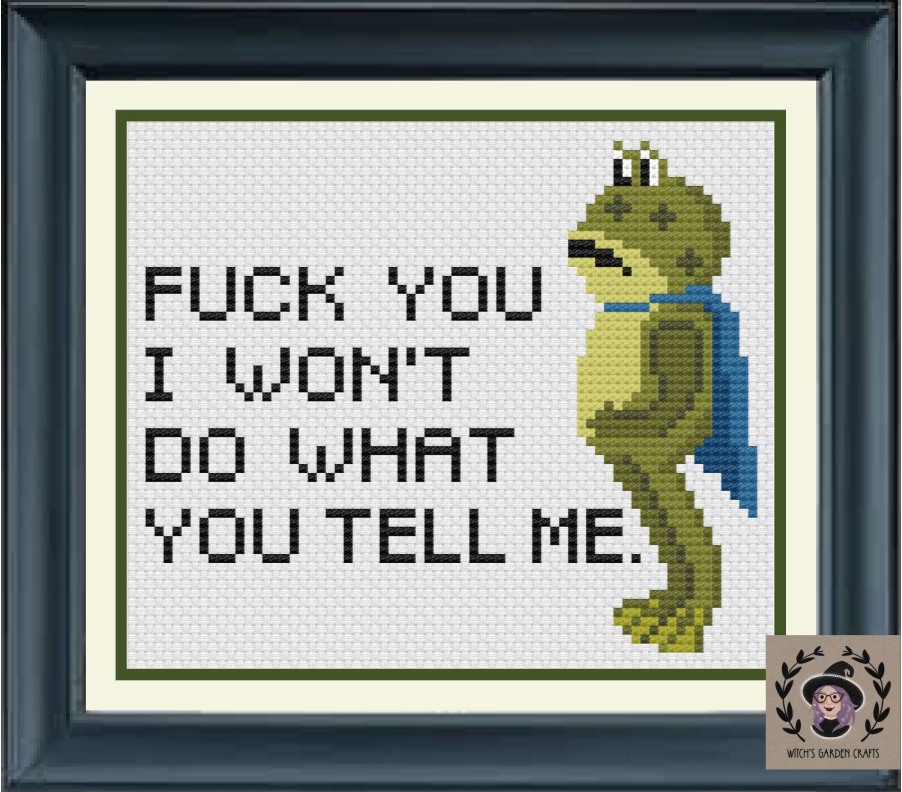
This embroidered artwork features a character with crossed-out eyes and text reading 'FUCK YOU I WON'T DO WHAT YOU TELL ME,' visually conveying a refusal to obey commands. Such a spirit of resistance challenges arbitrary authority, fitting the anti-fascist category's emphasis on opposing tyrannical rule. By refusing to do what you are told, the character embodies the sentiment of fighting for autonomy against unjust orders.
detailed-analysis (gemma3_27b-it-q8_0)
Okay, let's break down this image—a seemingly simple piece of cross-stitch—through the lens of Anti-Fascism and the requested theoretical frameworks.
Visual Description
The image depicts a framed cross-stitch embroidery. The background is a plain off-white. Boldly stitched in black are the words “FUCK YOU I WON'T DO WHAT YOU TELL ME.” To the right of the text is a pixelated image of a green sea dragon. The dragon is wearing a blue cape. The whole piece has a handmade, "crafty" aesthetic, contrasted with the very direct and aggressive language. The creator’s logo, “Witch’s Garden Crafts,” appears at the bottom right corner of the image. This juxtaposition of craft and rebellion is significant.
Foucauldian Genealogical Discourse Analysis
This image is deeply resonant with Foucault’s work on power and discourse. The statement, "FUCK YOU I WON'T DO WHAT YOU TELL ME," is a direct rejection of power dynamics and the imposition of norms. Foucault argued that power isn’t simply top-down oppression, but is productive—it creates the subjects it controls through discourses (systems of thought, language, and practice).
The "you" in this statement represents not just an individual, but the entire apparatus of oppressive power – the institutions, ideologies, and social expectations that seek to regulate behavior. The cross-stitch, as a traditionally “feminine” craft, itself is a reclamation of a space historically used for creating domestic conformity. By imbuing it with such a defiant message, it challenges the prescribed role of the stitcher.
The sea dragon image serves as a powerful symbol of resistance. Dragons in mythology often represent chaos, independence, and the disruption of established order. The pixelated style is reminiscent of early digital culture, a space that has often been associated with subcultures and challenges to mainstream authority.
In a Foucauldian sense, the statement is a counter-discourse. It's a challenge to the dominant narratives of obedience and conformity, seeking to create a different understanding of agency and autonomy.
Critical Theory
From a Critical Theory perspective, particularly drawing on the Frankfurt School, this image is a form of resistance against the "culture industry." The culture industry, as theorized by Adorno and Horkheimer, produces standardized, commodified cultural forms that reinforce existing power structures.
This cross-stitch actively disrupts that standardization. It’s handmade, explicitly political, and rejects the passive consumption of culture. The crude language, intentionally jarring, is a challenge to the "false consciousness" that Critical Theory identifies—the acceptance of ideologies that serve the ruling class.
The image speaks to the idea of "emancipatory consciousness"—an awareness of oppression and a desire for social change. By boldly declaring its refusal to obey, the image is an attempt to awaken that consciousness in others.
Marxist Conflict Theory
Within a Marxist framework, this image can be interpreted as an expression of class struggle. The "you" represents the bourgeoisie, the ruling class who exert control through economic and ideological means. "Doing what you tell me" represents the exploitation and alienation inherent in capitalist systems.
The act of creating this cross-stitch can be seen as a form of proletarian self-activity. It’s a creative act that doesn’t contribute to capitalist production, but rather expresses a challenge to it. The anti-authoritarian message resonates with the Marxist call for a revolution against oppressive class structures.
The handmade nature of the work also points to a rejection of mass-produced, commodified art, aligning with a critique of capitalist alienation.
Postmodernism
Postmodern thought often questions grand narratives and emphasizes the deconstruction of meaning. This image plays with that in several ways. The crude language is deliberately provocative, rejecting the decorum of polite discourse. The mix of a traditionally "low" art form (cross-stitch) with aggressive political language subverts expectations and challenges the hierarchy of artistic value.
The sea dragon is a playful, fantastical element that resists easy categorization. It’s a rejection of a singular, unified understanding of reality. The pixelated aesthetic can be interpreted as a nod to the fragmentation and simulation that characterize the postmodern condition.
The image is also self-aware and ironic. It acknowledges the absurdity of its own existence—a defiant message embroidered onto a domestic object. This self-reflexivity is a hallmark of postmodern art.
Queer Feminist Intersectional Analysis
This image has strong relevance to Queer Feminist Intersectional analysis. Historically, crafting and needlework have been spaces associated with feminine labor and social control. This image reclaims that space. The assertive language, "FUCK YOU I WON'T DO WHAT YOU TELL ME," is a direct expression of defiance against patriarchal expectations and gender roles.
The intersectional aspect comes into play by recognizing how this resistance to authority intersects with other forms of oppression. The anti-fascist context is crucial here. Fascism inherently relies on controlling and suppressing marginalized groups, including queer and feminist communities. This image thus becomes a statement of solidarity and resistance against all forms of domination.
The sea dragon, as a fantastical, non-normative creature, can be read as a metaphor for queer identity. The image rejects the expectation that individuals conform to dominant norms. The "Witch's Garden Crafts" logo also hints at reclaiming historically demonized feminine power (witchcraft).
In Summary
This simple cross-stitch is far more than just a craft project. It’s a complex political statement that resonates with multiple theoretical frameworks within the realm of Anti-Fascism. It challenges power structures, rejects conformity, and celebrates agency and resistance. It’s a powerful example of how everyday objects can become tools for social and political change.
simple-description (llama3.2-vision_11b)
The meme is a humorous critique of fascist ideologies, using a cartoon frog as a symbol of resistance. The text "I can explain" is often used in a sarcastic or ironic way to respond to a situation where someone is being overly explanatory or pedantic. In this context, the frog is "explaining" the absurdity of fascist ideologies, using the phrase "I can explain" to mock the idea that anyone would need to explain the obvious.