First Seen
2025-10-11T03:52:05.302312+00:00
simple-description (qwen3.5_2b-q8_0)
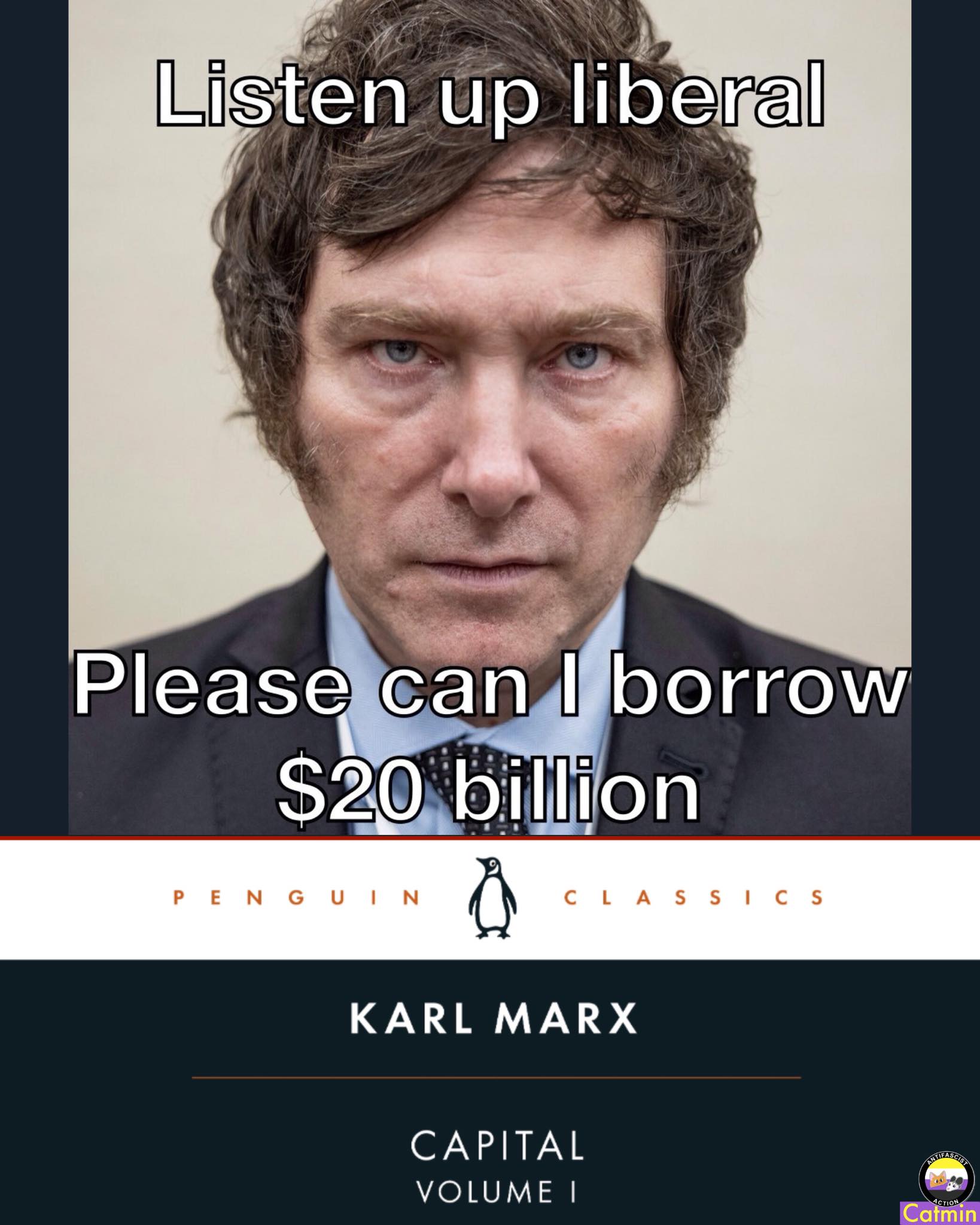
This anti-fascist meme features a man dressed formally, resembling Karl Marx, with a serious demeanor while wearing the cover art for his book Capital. The overlaid text includes 'Listen up liberal', 'Please can I borrow $20 billion', and identifies him as the author of 'Capital Volume 1'. In this context, he is depicted as an authority figure challenging a specific political label, symbolizing resistance against what is labeled as reactionary liberalism in modern meme culture.
detailed-analysis (gemma3_27b-it-q8_0)
Okay, let's break down this meme through the lens of Anti-Fascism, utilizing the requested theoretical frameworks where applicable.
Visual Description
The meme features a close-up image of former Treasury Secretary Steven Mnuchin. He's presented with a stern, demanding expression. Overlaid on the image are two blocks of text. The first, "Listen up liberal," is positioned above his head. The second, “Please can I borrow $20 billion," is below his face. The lower portion of the meme is styled to mimic the cover of a Penguin Classics edition of Karl Marx’s Capital, Volume I. This juxtaposition is crucial to understanding the meme's message.
Marxist Conflict Theory
This is the most immediately relevant lens for analyzing this meme within the Anti-Fascist context. The meme is a direct commentary on class struggle and the parasitic nature of capitalism, and the role that the wealthy class plays in destabilizing systems for their own gain.
- Class Antagonism: The phrase “Listen up liberal” directly casts the "liberal" as a perceived enabler or funder of structures that then benefit Mnuchin. The request for "$20 billion" is a blunt acknowledgement of the need to continually extract wealth from the working class to perpetuate the capitalist system. This is precisely what Marx critiqued – the inherent contradiction between the bourgeoisie (the owning class, exemplified by Mnuchin) and the proletariat (the working class, implied in the target of “liberal”).
- Capital Accumulation: The request for $20 billion embodies the relentless drive for capital accumulation that Marx identified as central to capitalism. It shows a desire to expand wealth, even if it means exploiting and disempowering others.
- Critique of the State: Mnuchin, as a former Treasury Secretary, represents the state apparatus serving the interests of capital. The meme implies that the state is readily available to bail out the wealthy, while ordinary people are left to suffer. The implicit message is that the very structures that liberals often trust (the state, regulation) are often co-opted by those in power to reinforce the existing class hierarchy.
- Anti-Fascist Connection: Anti-Fascism fundamentally understands Fascism as a manifestation of late-stage capitalism. When capitalist systems fail, they often resort to authoritarianism and scapegoating to maintain control. The meme implicitly shows how the pursuit of wealth concentrates power, creating conditions conducive to Fascism.
Foucauldian Genealogical Discourse Analysis
This framework can add nuance to our understanding.
- Power/Knowledge: The meme subtly plays with the power dynamics embedded in language. The imperative "Listen up liberal" asserts authority, attempting to position Mnuchin as holding power over those labeled "liberal." This demonstrates the relationship between power and knowledge - those with wealth (and access to state power) are able to shape the discourse and demand obedience.
- Genealogy of “Liberalism”: Foucault would encourage us to ask: how did the term "liberal" come to mean something amenable to exploitation? Tracing the historical evolution of the term might reveal how it has been strategically used by conservatives to justify their actions, portraying "liberals" as naive or complicit.
- Discourse of Financialization: The meme operates within the discourse of financialization - the increasing dominance of financial markets and institutions in the economy. The vast sum of "$20 billion" is not just about money, but represents the abstract, often unaccountable nature of modern finance, which fuels inequality and instability.
Critical Theory
- Ideology Critique: The meme is a critique of capitalist ideology – the set of beliefs that legitimize and naturalize the existing social order. The meme exposes the inherent hypocrisy of a system that allows for vast wealth accumulation while claiming to operate on principles of fairness and meritocracy. The "Please" in the request is sarcastic, revealing a sense of entitlement.
- Domination and Resistance: The meme is an act of resistance. By ridiculing Mnuchin, it challenges the authority and legitimacy of the capitalist elite. It seeks to expose the dynamics of domination and inspire critical consciousness.
Postmodernism
While not as central as the other frameworks, a postmodern reading could emphasize:
- Deconstruction of Grand Narratives: The meme deconstructs the “grand narrative” of trickle-down economics and the “free market.” It shows how these narratives serve to justify inequality and mask the underlying power dynamics.
- Irony and Parody: The meme's tone is ironic and parodic. It mocks the audacity of the wealthy and the naive trust placed in them by some.
Why this is relevant to Anti-Fascism:
The core of Anti-Fascism is challenging hierarchies and resisting oppression. This meme is a microcosm of that struggle. It attacks the material conditions that give rise to Fascism – concentrated wealth, class exploitation, and the capture of the state by powerful interests. It encourages a critical assessment of the political and economic systems that enable such inequalities and, ultimately, create the conditions for authoritarianism to thrive.
Disclaimer: I've provided this analysis based on the provided theoretical frameworks and the meme's content. Interpretations can vary. It's important to consider the context and the intent of the creator when engaging with any meme.
simple-description (llama3.2-vision_11b)
This meme is a satirical commentary on the financial struggles of a liberal individual, specifically Karl Marx, who is known for his writings on economics and the working class. The image features a photo of Karl Marx with a caption that pokes fun at his financial situation, saying "Listen up liberal" and "Please can I borrow $20 billion", implying that even the famous economist and author of "The Capital" would need to take out a loan to pay his own bills.