First Seen
2025-10-11T07:32:10.358872+00:00
simple-description (qwen3.5_2b-q8_0)
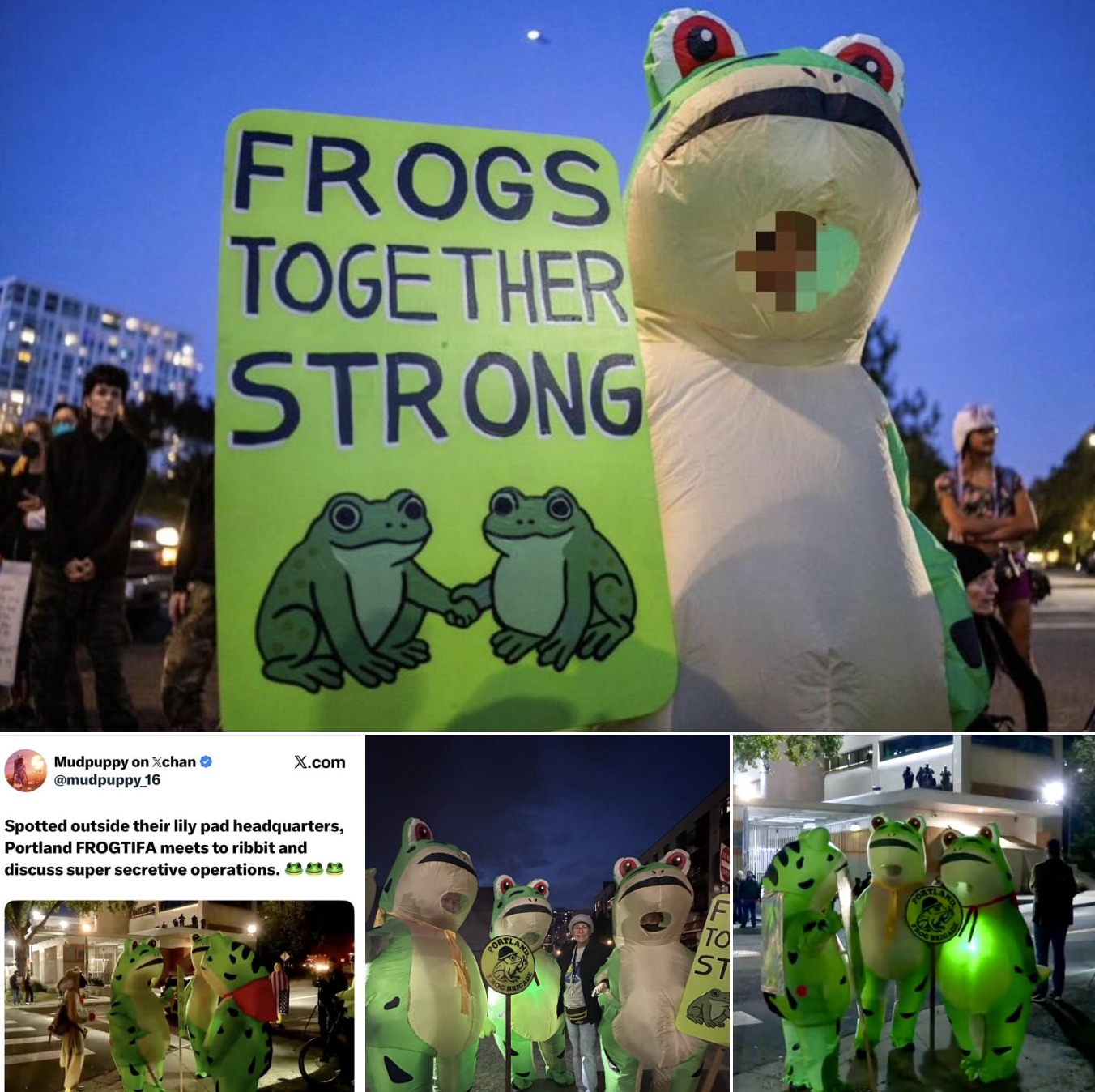
For someone who cannot see the visuals, this is a graphic about unity where a group of frogs are dressed in costumes holding signs that say "FROGS TOGETHER STRONG" with two frogs shaking hands to symbolize solidarity. The accompanying caption describes them as meeting at a "Lily Pad Headquarters" to discuss "super secretive operations," which is the text associated with this specific internet meme where people claim a frog organization is hiding underground like a secret political group.
detailed-analysis (gemma3_27b-it-q8_0)
Okay, let's break down this meme within the context of Anti-Fascism. It’s complex, layered with internet culture, and leans heavily into ironic tactics. Here's a breakdown, leveraging the requested theoretical frameworks where appropriate.
Visual Description
The core of the meme features individuals costumed as frogs, specifically oversized inflatable frog suits. The prominent frog in the front carries a sign reading "FROGS TOGETHER STRONG." There’s also a patch on the frog suit bearing a version of the Portland city flag. The meme is a series of images captured outside what is described as “Portland FROGTifa headquarters.” Additional images show more frogs assembling, apparently discussing strategies. The setting is outdoors, at night, seemingly in an urban environment. The overall aesthetic is intentionally absurd and playful, contrasting sharply with the often-serious subject matter of anti-fascist activism.
Foucauldian Genealogical Discourse Analysis
This meme is fascinating when viewed through a Foucauldian lens. The use of the frog imagery is a deliberate reversal of a pre-existing discourse.
- Pepe the Frog & the Alt-Right: Pepe the Frog originated as a benign cartoon character, but was co-opted by the Alt-Right and became a symbol of hate speech. Its appropriation was a calculated move to normalize white supremacist ideology online.
- Reclaiming & Recontextualization: "FROGTifa" actively reclaims the frog imagery, stripping it of its hateful meaning and repurposing it as a symbol of anti-fascist resistance. This is a powerful act of discursive disruption. By associating frogs with "togetherness" and "strength," the meme deliberately undermines the original, racist intent.
- Power/Knowledge: The meme highlights the Foucaultian idea of power/knowledge. The Alt-Right imposed a meaning onto Pepe. FROGTifa challenges that imposed meaning, creating a counter-discourse. This demonstrates how meaning is not inherent, but constructed and contested within power relations.
- Genealogy: Tracing the “genealogy” of the frog symbol, we see how it moves from harmless cartoon, to hate symbol, to ironic anti-fascist emblem. This illustrates how meaning changes and evolves over time, depending on the context and power dynamics.
Critical Theory
The meme operates on multiple levels of criticality.
- Critique of Spectacle: The absurdity of the frog costumes can be seen as a critique of the spectacle of political activism, a concept often discussed by theorists like Guy Debord. The outrageousness draws attention, but also mocks the seriousness that can sometimes suffocate political discourse.
- Deconstructing Ideology: By using humor and the bizarre, the meme actively deconstructs the ideological foundations of fascism. It doesn’t engage in a direct, rational argument; it undercuts the authority and gravitas of the opposing ideology through parody.
- Frankfurt School Influence: There’s a resonance with the Frankfurt School's critique of mass culture. The meme uses the "low" culture of internet memes to disrupt the "high" culture of political discourse, aiming to awaken critical consciousness.
- Irony and Detachment: The detached, ironic tone is a hallmark of contemporary critical engagement. It’s a way of acknowledging the absurdity of the political situation without being overwhelmed by it.
Marxist Conflict Theory
While not explicitly about class struggle, Marxist Conflict Theory can illuminate some aspects.
- Counter-Hegemony: FROGTifa represents a counter-hegemonic force. They are challenging the dominant (fascist) ideology by creating their own symbols and narratives.
- Class Struggle in Symbolic Form: The reclamation of the frog symbol can be seen as a symbolic battle over the meaning of cultural symbols. It’s a conflict between competing ideologies, mirroring the broader class struggle.
- False Consciousness: By actively subverting the original meaning of Pepe, FROGTifa aims to disrupt the "false consciousness" that may have led individuals to embrace Alt-Right ideology.
Postmodernism
This meme embodies several key postmodern traits.
- Pastiche & Intertextuality: It combines elements of internet culture, political activism, and cartoon imagery in a playful, self-referential way.
- Deconstruction of Grand Narratives: The absurdity of the meme undermines any notion of a single, coherent "truth" about politics or identity.
- Simulacra and Simulation: The frog costumes are a simulation of activism, blurring the lines between reality and representation. Are they “real” activists, or are they performing a parody of activism? The meme doesn’t offer a clear answer.
- Rejection of Authenticity: The use of irony and absurdity distances the meme from any claim to authenticity. It’s deliberately performative, rejecting the notion of a "genuine" political stance.
In conclusion, the "FROGTifa" meme is a remarkably complex piece of political communication. It's a playful, ironic, and deeply subversive response to the rise of fascism, leveraging internet culture and critical theory to challenge dominant ideologies and reclaim symbols of hate. It’s a demonstration of how humor and absurdity can be powerful tools for resistance and social change.
simple-description (llama3.2-vision_11b)
The meme features an image of a group of people in frog costumes, with one of them holding a sign that reads "Frogs Unite". The image is captioned with a quote from the movie "The Hunger Games" where the character says "I'm not a rebel, I'm a frog". The meme is a humorous commentary on the absurdity of a group of people in frog costumes, with the sign and quote adding a layer of satire to the image.