First Seen
2025-09-30T21:33:41.742419+00:00
simple-description (qwen3.5_2b-q8_0)
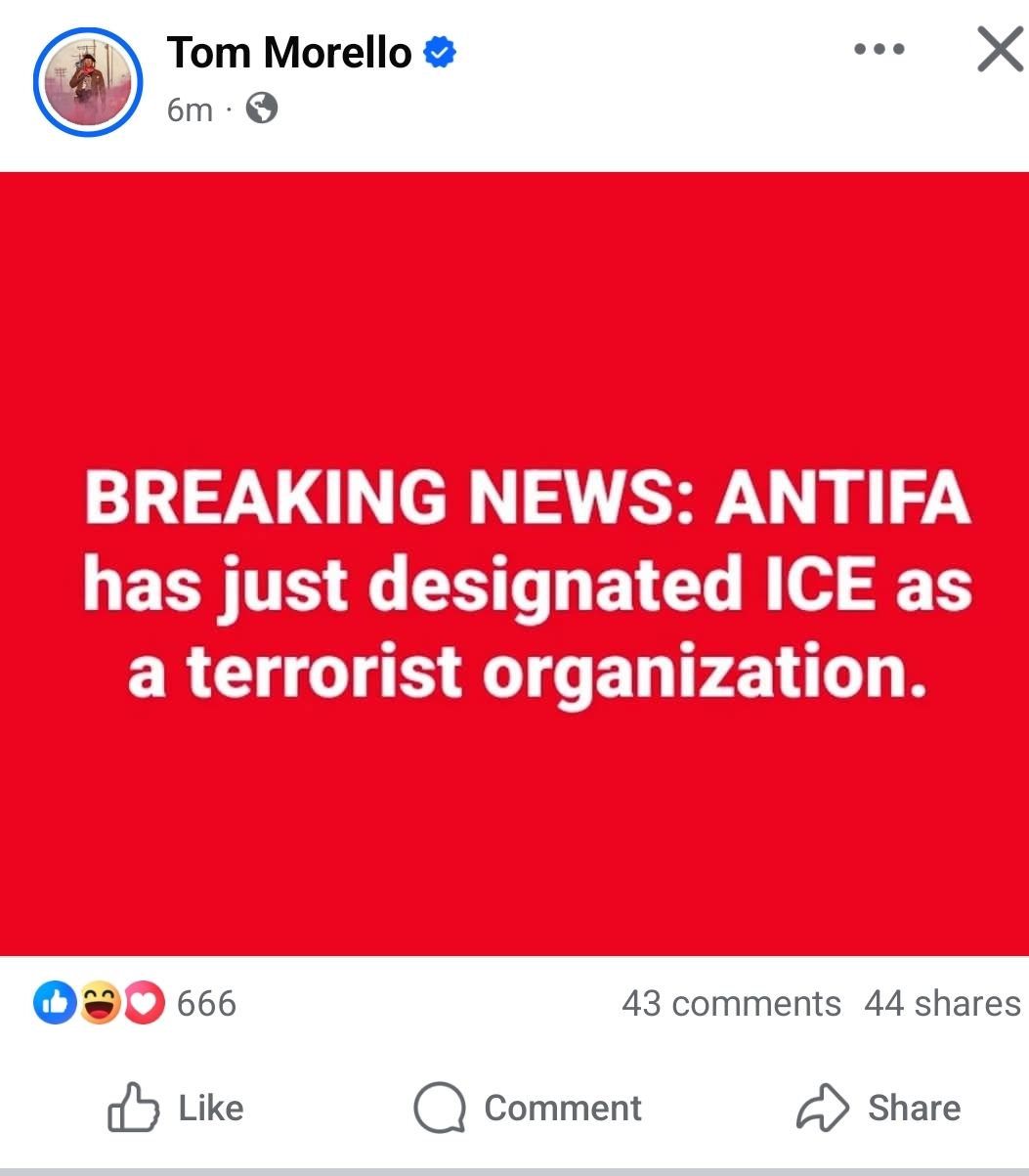
This viral image is a satirical post mocking false political rumors that become popular on platforms like Facebook, suggesting that an American self-defense group known as Antifa has been mistakenly labeled as a terrorist organization by US Customs Enforcement. The "breaking news" graphic quotes: BREAKING NEWS: ANTIFA has just designated ICE as a terrorist organization.
detailed-analysis (gemma3_27b-it-q8_0)
Okay, let's break down this image/social media post through the lens of Anti-Fascism, utilizing the requested theoretical frameworks where applicable.
Visual Description
The image is a stark, bright red square with white, bold text. The text proclaims: “BREAKING NEWS: ANTIFA has just designated ICE as a terrorist organization.” Below this, we see standard Facebook engagement metrics: likes, reactions, comments, and shares. Above the headline is the profile of Tom Morello, a musician known for his activism and leftist political views. The simple, alarmist design, and the color red (often associated with leftist movements) contribute to a sense of urgency and a clear message.
Foucauldian Genealogical Discourse Analysis
From an Anti-Fascist perspective, this post is a powerful articulation of the shift in power dynamics related to the very definition of "terrorism". Foucault’s genealogical method examines how concepts like "terrorism" are not neutral, universal truths but rather historically constructed through discourse and deployed to serve specific power interests.
- Power/Knowledge: The designation of "terrorist" is rarely objective. Historically, it's often been applied to those resisting state power or challenging the status quo. The claim here (that ANTIFA has designated ICE as a terrorist organization) is less about an objective reality and more about asserting a counter-narrative. It flips the script. Anti-Fascists see ICE as already engaged in terrorist-like practices – family separation, detention in inhumane conditions, racial profiling, and the active enforcement of a system that inflicts harm on marginalized communities.
- Discursive Shift: The statement attempts to re-frame the conversation. By claiming ANTIFA has designated ICE a terrorist organization, it’s trying to assert authority over the definition of terrorism. It implicitly argues that ICE’s actions meet the criteria often used to define terrorism. It's not about "ANTIFA" being violent, but about acknowledging the violence that ICE is already enacting.
- Normalization: Anti-Fascists argue that the state normalizes violence enacted by institutions like ICE and police. This post seeks to de-normalize that violence by directly labeling it as terrorism.
Critical Theory
Critical Theory, particularly drawing from the Frankfurt School, would analyze this post as a challenge to the dominant ideology.
- Ideology Critique: The image attacks the ideology that positions ICE as a neutral, legitimate law enforcement agency. Anti-Fascists view ICE as a tool of oppression, enforcing a border regime rooted in racism, xenophobia, and colonialism. The post confronts this ideology by directly challenging ICE's legitimacy.
- Reason and Enlightenment: Critical Theory critiques the instrumentalization of reason. Anti-Fascists would argue that the “rational” justifications for ICE’s actions (border security, national security) are masking a deeply irrational and inhumane system. The post is a provocation to expose this instrumentalization.
- Emancipation: The underlying goal is an emancipatory one – to challenge structures of power that cause suffering and to move towards a more just and equitable society. Designating ICE as a terrorist organization, from this view, is a step towards dismantling a system of oppression.
Marxist Conflict Theory
Through the lens of Marxist Conflict Theory, this post represents a clear expression of class struggle and the state’s role in maintaining capitalist power relations.
- Class and State: ICE is seen as an instrument of the state, protecting the interests of capital by controlling labor (especially migrant labor) and suppressing any threat to the existing economic order. The post is a direct challenge to that state power.
- False Consciousness: Anti-Fascists would argue that many people operate under a "false consciousness," believing that ICE is simply enforcing the law. This post aims to disrupt that false consciousness and reveal the true nature of the agency.
- Revolutionary Potential: While not explicitly calling for revolution, the post expresses a critical stance towards the existing power structure, implicitly suggesting the need for fundamental change. By labeling ICE as a terrorist organization, it undermines its legitimacy and opens up the possibility for resistance.
Postmodernism
A postmodern analysis would focus on the deconstruction of meanings and the questioning of grand narratives.
- Rejection of Metanarratives: Postmodernism rejects the idea of universal truths or grand narratives. The post, in a way, does this by challenging the dominant narrative around ICE, undermining its inherent legitimacy. There isn’t one objective “truth” about ICE – there are competing narratives.
- Discourse & Power: Postmodern thought understands that meaning is constructed through discourse. The labeling of ICE as a terrorist organization is an act of discursive power, attempting to redefine the terms of the conversation.
- Subjectivity: This approach would also emphasize that our understanding of terrorism is subjective and depends on our position within the power structure.
Queer Feminist Intersectional Analysis
This framework brings to light the specific harms ICE inflicts on marginalized groups and the ways these harms are interconnected.
- Intersectionality: ICE’s actions disproportionately impact LGBTQ+ migrants, Black and Brown migrants, Indigenous migrants, and women. These communities experience overlapping forms of oppression. The post recognizes the interconnectedness of these forms of oppression.
- Carceral Feminism: ICE’s detention system is inherently carceral and particularly harmful to women, especially those who have experienced gender-based violence. This analysis highlights the ways in which the state uses its power to control and punish marginalized bodies.
- Decolonization: The border itself is a colonial construct, perpetuating historical injustices against Indigenous peoples. By critiquing ICE, the post implicitly supports decolonization efforts.
- Resistance and Solidarity: This framework would understand the "designation" as an act of solidarity with those targeted by ICE and a form of resistance against systemic oppression.
In Conclusion:
From an Anti-Fascist standpoint, this social media post isn’t merely a statement of fact but a powerful act of political resistance. It is a challenge to the existing power structure, a deconstruction of dominant ideologies, and a call for a more just and equitable world. It’s a deliberate attempt to re-frame the narrative, to expose the violence of state power, and to mobilize resistance. The post functions as a rallying cry for solidarity and action.
simple-description (llama3.2-vision_11b)
This meme is a satirical take on the left-wing activism group Antifa, which is often associated with anti-fascism. The meme is a play on the phrase "Antifa has just designated ICE as a terrorist organization," which is a humorous and ironic statement. The meme is likely intended to poke fun at the idea that a group that is supposed to be anti-fascist would be able to designate a government agency as a terrorist organization, which is a contradictory and absurd statement.