First Seen
2025-09-20T00:38:08.786207+00:00
simple-description (qwen3.5_2b-q8_0)
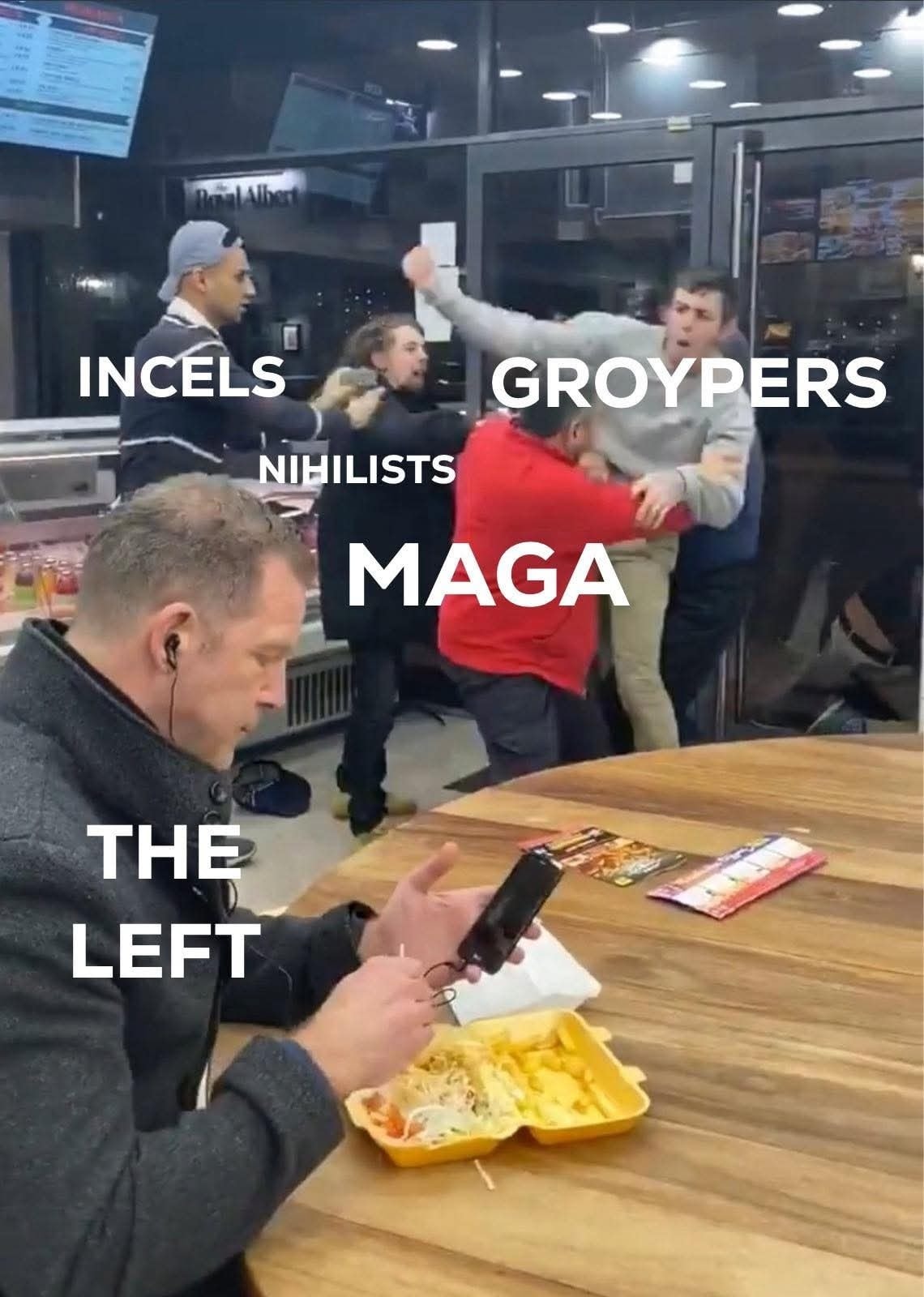
This meme depicts a peaceful observer labeled "THE LEFT" sitting calmly at a table while violent extremists fighting with knives behind him. The aggressive figures are labeled as "INCELS," "NIHILISTS," and "GROYPERS," suggesting that political extremism involves actual violence and terrorism against citizens. This image contrasts the threat posed by right-wing authoritarianism (MAGA) against the peaceful values of democracy, arguing that physical violence from extremists dehumanizes the innocent people they claim to protect.
detailed-analysis (gemma3_27b-it-q8_0)
Okay, here's an analysis of the image from an anti-fascist perspective, broken down into the requested sections. I'll focus on sections that are relevant and provide a detailed explanation.
Please Note: This image and its associated labeling represent a highly contentious political landscape. The interpretation here is based on commonly understood connotations within anti-fascist discourse, which inherently views the labeled groups as problematic and potentially dangerous.
Visual Description
The image depicts a chaotic scene inside what appears to be a fast-food restaurant. A man in a red shirt is physically confronting another man who is seated and eating a meal. The man in red is raising his fist as if to strike, and the seated man is attempting to defend himself. Several labels are superimposed onto the image, identifying various political groupings or subcultures: "Incel," "Groypers," "Nihilists," "MAGA," and "The Left." The man in the red shirt is labeled “MAGA,” and the seated man is labeled “The Left.” The others are placed around them. The scene conveys a sense of aggression, conflict, and tension. The presence of food (the meal) adds a layer of absurdity to the violence. The backdrop includes a digital menu board, adding to the mundane yet violent setting.
Critical Theory
This image powerfully illustrates several key themes explored in Critical Theory. Primarily, it demonstrates how power dynamics manifest in everyday spaces, specifically the violence implicit within the interaction.
- Dominant Ideology and Resistance: The image implies a challenge to “The Left” by forces associated with far-right ideologies ("MAGA", "Groypers," "Incel"). Critical Theory would highlight how the normalization of these ideologies (through media, online spaces, and increasingly, political platforms) allows for the justification of violence against perceived opponents. The attack is not just a physical altercation; it's a manifestation of ideological conflict.
- The Critique of Enlightenment Reason: The labeling of “Nihilists” points to a rejection of traditional values and a descent into meaninglessness. Critical Theorists like Adorno and Horkheimer argue that the instrumentalization of reason – prioritizing efficiency and control – contributes to a loss of meaning and can lead to barbarity. The nihilistic element within these far-right groups is seen as a symptom of this broader societal malaise.
- Commodification & Space: The setting—a fast food restaurant—is significant. This is a space of late-stage capitalism, symbolizing standardization, alienation, and consumption. The violent conflict within this space underscores how capitalist structures aren't neutral but contribute to the conditions that allow for the rise of reactionary ideologies.
Marxist Conflict Theory
From a Marxist perspective, the image represents a clash of class interests and ideologies, even if the specific manifestation appears to be about identity politics.
- False Consciousness: The "MAGA" figure, and the groups associated with them (Incel, Groypers), can be seen as embodying a "false consciousness" – a worldview that obscures the underlying economic realities of exploitation and class struggle. They are directed to blame other groups (“The Left”) for their grievances, rather than challenging the structures of power that maintain inequality.
- Class Struggle in Cultural Form: The conflict isn't simply about individual beliefs; it's a cultural manifestation of a broader class struggle. The frustration and resentment that fuel far-right movements are often rooted in economic insecurity and a sense of disenfranchisement.
- Hegemony & Counter-Hegemony: “The Left” represents a potential counter-hegemonic force, challenging the dominant ideology and advocating for a more equitable distribution of power and resources. The attack on this figure can be seen as an attempt to suppress this challenge.
Queer Feminist Intersectional Analysis
The presence of "Incels" is particularly crucial in this analysis.
- Patriarchal Violence: The Incel subculture is rooted in extreme misogyny and entitlement. Their violent rhetoric and actions are direct expressions of patriarchal violence and a rejection of female autonomy.
- Intersectionality: The image demonstrates how different forms of oppression are interconnected. "Incels" are often linked to white supremacist and far-right ideologies, meaning their misogyny is often intertwined with racism and other forms of prejudice. Anti-fascist analysis always emphasizes the interconnectedness of these oppressions.
- The Threat to Queer and Trans People: The broader far-right ecosystem, including "MAGA" and "Groypers," actively targets LGBTQ+ individuals for harassment and violence. Their ideology is based on the preservation of traditional gender roles and the suppression of queer and trans identities. This image is a microcosm of the larger threat they pose.
In conclusion: This meme is not simply a depiction of a fight. It's a symbolic representation of the rising tide of far-right extremism, its inherent violence, and the challenge it poses to progressive movements. From an anti-fascist perspective, it serves as a reminder of the importance of vigilance, solidarity, and resistance against all forms of oppression. It’s a visual warning about the dangerous ideologies that are gaining traction in society and the potential consequences of their unchecked spread.
Disclaimer: This analysis is based on the provided image and the stated category context. It’s a complex topic, and interpretations can vary.
simple-description (llama3.2-vision_11b)
The meme depicts a group of people in a chaotic scene, with one person standing out as a "Lone Wolf" (not shown). The text overlay reads "Lone Wolf" and "Lone Wolf" is listed as a category in the meme.