First Seen
2025-08-09T05:10:31.053991+00:00
simple-description (qwen3.5_2b-q8_0)
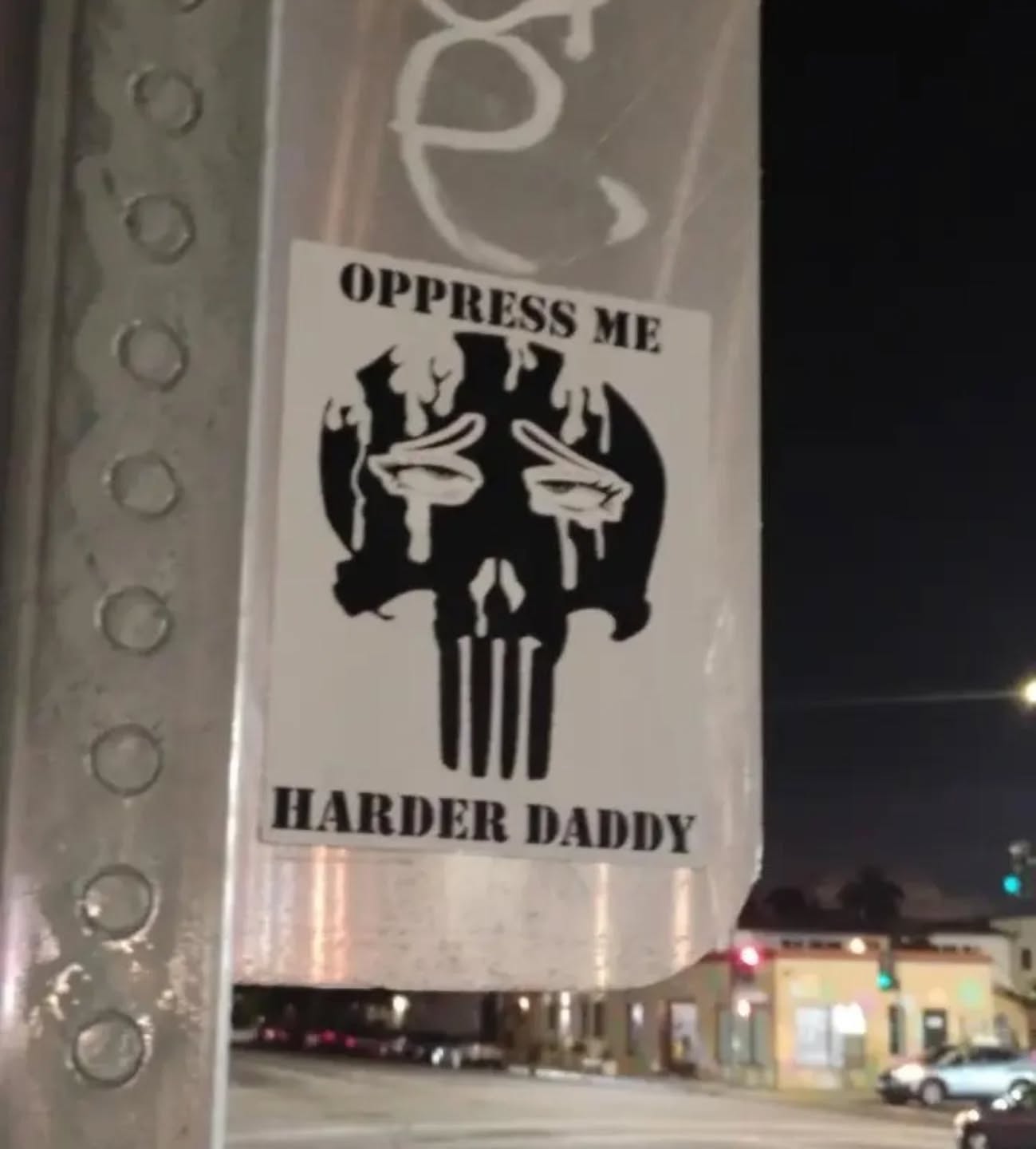
This sticker features a modified Punisher skull with the message "HARDER DADDY" beneath it (with partially visible graffiti above that reads "OPPERS ME"). From an Anti-Fascist perspective, this is a humorous and ironic rebrand of the Nazi party slogan "Das Kapital," which mocks Hitler as a strict disciplinarian ("Daddy figure") who punishes harshly ("Harder"). It uses the image of a vigilante protector to mock authoritarian leaders who enforce rigid moral or political rules with unyielding force, subverting the symbol of strength into one of mocking authority.
detailed-analysis (gemma3_27b-it-q8_0)
Okay, let's analyze this sticker from an Anti-Fascist perspective, employing the relevant theoretical frameworks. It’s a complex image, relying heavily on irony and appropriation of symbols.
Visual Description
The sticker features a stylized graphic heavily borrowing from the skull logo of the Marvel Comics character, the Punisher. This skull is modified; rather than a menacing expression, the mouth is depicted forming a kissing gesture. Above the skull are the words "OPPRESS ME HARDER," and below it, "HARDER DADDY." The sticker is pasted onto a pole in an urban environment at night, with blurry street views in the background. The sticker is white with black lettering and image, making it stand out against the silver pole.
Foucauldian Genealogical Discourse Analysis
From a Foucauldian perspective, this sticker is a fascinating entry point into the power dynamics surrounding oppression, resistance, and identity. Michel Foucault argued that power isn’t simply a top-down force exerted on subjects, but a pervasive network that produces subjects – shaping our desires, identities, and even our sense of self.
The sticker’s phrase "Oppress Me Harder" represents a deliberate inversion of the expected response to oppression. It's a provocative statement that questions the assumed negativity of domination. This echoes Foucault’s concept of “counter-conducts” – ways in which individuals resist and redefine the terms of power relations.
The addition of “Harder Daddy” is crucial. The term “daddy” is a complex one, often associated with BDSM and power exchange dynamics. It’s a deliberate deployment of sexualized language into a political context. Foucault explored the intersection of power and sexuality extensively. The sticker challenges the idea that resistance is purely a rejection of power; it suggests a perverse desire, a playful engagement with the very forces meant to control.
This isn't a simple call to be oppressed; it is a staging of the desire for domination/submission, forcing a reconsideration of how we understand both oppression and consent. The sticker's meaning isn't inherent in the words themselves, but in the discourse it creates and the reactions it provokes.
Critical Theory
Within the framework of Critical Theory (particularly influenced by the Frankfurt School), this sticker represents a critique of the normalization of domination within society. Critical theorists were concerned with how dominant ideologies obscured relations of power and control.
The Punisher skull, originally designed as a symbol of vigilante justice, has been co-opted by far-right and law enforcement elements, often signifying a harsh, authoritarian approach to social control. By appropriating this symbol and subverting its intended meaning, the sticker acts as a “negation of the negation”. It takes a symbol of oppressive force and turns it back on itself, highlighting the absurdity and violence inherent in such ideologies.
The use of “daddy” introduces a further layer of critique, referencing the patriarchal structures that underpin many forms of oppression. The statement implies that even within oppressive structures, there can be a perverse attraction or desire for control. It highlights how these systems can become internalized, shaping our desires and fantasies.
Queer Feminist Intersectional Analysis
This sticker becomes particularly potent when viewed through a Queer Feminist Intersectional lens. Intersectionality, as articulated by Kimberlé Crenshaw, recognizes that individuals experience oppression based on the confluence of multiple identities (race, gender, class, sexuality, etc.).
The appropriation of the Punisher skull as a symbol of marginalized resistance is significant. The skull, frequently used by those promoting violent reactions to perceived threats, is remixed into something else. This speaks to the power of reclaiming symbols.
The "daddy" framing introduces BDSM dynamics, which often explore power imbalances and the negotiation of consent. Within Queer theory, exploring the deconstruction of traditional gender roles and power dynamics is central. The sticker's playful subversion of the "dominant/submissive" dynamic can be interpreted as a critique of heteronormative power structures.
Furthermore, the embrace of a potentially harmful desire ("oppress me harder") can be seen as a reclaiming of agency within a world that often seeks to control and define marginalized bodies. It's a provocative statement that challenges conventional notions of victimhood and resistance. This can be read as a way of acknowledging and challenging the way violence and harm can be seductive and internalized within oppressive systems.
Important Note: The sticker’s interpretation is highly contested. It’s open to misinterpretation and could be seen as glorifying abusive dynamics. This is precisely why understanding the theoretical frameworks at play is important. Its meaning is not fixed but is actively constructed through discourse and interpretation.
Disclaimer: This analysis is based on the image provided and the stated category context. It's a theoretical interpretation and doesn’t necessarily represent the creator’s intent. It’s crucial to engage with such content critically and consider multiple perspectives.
simple-description (llama3.2-vision_11b)
The meme is a graphic of a skull with a raised fist, a common symbol of anti-fascism. The text "OPPRESS ME" is written above the skull, while "HARDER DADDY" is written below it. The image is a playful, tongue-in-cheek take on the idea of oppression, suggesting that even the most oppressive forces can be challenged and overcome.