First Seen
2025-07-24T19:40:46+00:00
simple-description (qwen3.5_2b-q8_0)
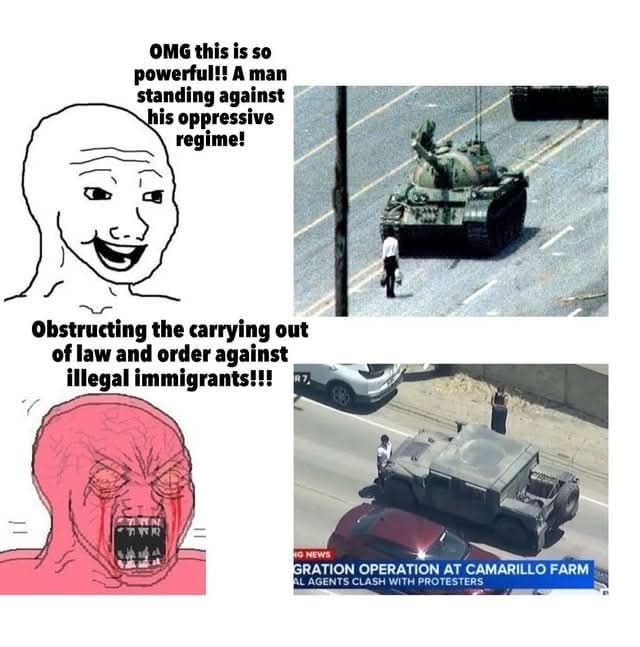
This meme uses irony and satire to critique the glorification of military force by authoritarian regimes. The top-left panel displays a cartoon character sarcastically declaring that tanks are "powerful" while an oppressive government stands with them, suggesting that such power is merely a tool of control rather than genuine security. In contrast, the bottom-right panel shows news footage from what appears to be an enforcement operation where "agents clash with protesters" at a border farm, highlighting the violence and chaos often associated with state-enforced segregation and law enforcement against illegal immigration.
detailed-analysis (gemma3_27b-it-q8_0)
Okay, let's break down this meme through the lens of Anti-Fascism, using the requested theoretical frameworks where applicable. It’s a complex image loaded with layered irony and counter-signification.
Visual Description
The meme juxtaposes two elements. On the left, we see two iterations of a "Chad" meme template, a character typically used to depict hypermasculine, dominant figures. The top Chad is smiling with the text "OMG this is so powerful!! A man standing against his oppressive regime!" The bottom Chad is hyper-distorted into a crying, grotesque version with the text “Obstructing the carrying out of law and order against illegal immigrants!!!” On the right, a photograph depicts a man standing in front of military vehicles (tanks and armored personnel carriers) during a protest. The lower part of the image includes a news chyron mentioning “OPERATION AT CAMARILLO FARM: FEDERAL AGENTS CLASH WITH PROTESTERS."
The effect is jarring. The juxtaposition aims to highlight the absurdity of framing a specific act – a man protesting federal agents – as a heroic stand against oppression, and the grotesque caricature underscores the inherent violence of such framing.
Foucauldian Genealogical Discourse Analysis
From a Foucauldian perspective, the meme deconstructs the discourse of resistance and state power. Foucault’s genealogy focuses on how concepts like “oppression,” “law and order,” and “illegality” are not natural or inherent, but are constructed through historical power relations.
- Power/Knowledge: The meme reveals how power and knowledge intertwine. The idea that a person resisting authorities is automatically "heroic" is a constructed narrative. The meme highlights how the "illegal immigrant" designation itself is a product of state power, defining who is included or excluded, legitimate or illegitimate.
- Discursive Formation: The text associated with the Chad meme attempts to create a new discursive formation around the image: reframing what is (in the context of the original incident) a potentially right-wing protest as an act of anti-establishment rebellion.
- Reversal & Deconstruction: The distorted "crying Chad" image deconstructs this attempt. It shows the ugly reality underneath the surface – the motivation being based on hostility towards immigrants rather than genuine resistance to systemic power. It mocks the appropriation of the language of resistance by those who support oppressive structures.
Critical Theory
The meme engages with key themes of Critical Theory, particularly relating to the manipulation of ideology.
- Ideology Critique: The meme performs an ideology critique. It exposes how certain narratives are presented as natural and just ("law and order") while obscuring the underlying power dynamics and injustices. By mocking the Chad, the meme reveals the ideology at play – the belief in a strong state enforcing boundaries, even through violent means.
- The Culture Industry: The use of the meme format itself is relevant. The “Chad” meme, originally a form of internet humor, has been co-opted and repurposed. This appropriation points to how the “culture industry” (as Adorno and Horkheimer described it) produces and circulates standardized forms of expression that can be used to reinforce or challenge dominant ideologies.
- False Consciousness: The top Chad image illustrates a kind of "false consciousness"—a state of being unaware of one’s true class or social interests. The character’s enthusiastic embrace of a situation that actually serves oppressive forces demonstrates a lack of critical self-awareness.
Marxist Conflict Theory
From a Marxist viewpoint, the meme exposes the conflict between classes and the role of the state in maintaining that conflict.
- State as Instrument of Class Rule: The presence of the tanks and federal agents directly represents the state as an instrument of the ruling class, enforcing its interests. The operation at the farm is likely related to labor exploitation and control over resources, benefitting capital.
- False Opposition: The meme suggests that the protest isn't a genuine challenge to the existing power structure, but rather a dispute within that structure. It's a conflict between different factions regarding how to manage and exploit labor, not a fundamental critique of capitalism itself.
- Proletarian vs. Petty Bourgeoisie: Depending on the context of the protesters, they may be petty bourgeois elements reacting to perceived threats to their status or way of life, rather than a genuine expression of proletarian struggle. The meme mocks their attempt to position themselves as heroic resistors.
Postmodernism
Postmodern analysis would focus on the meme's self-referentiality and its questioning of grand narratives.
- Simulacra & Simulation: The meme plays with the simulacrum – a copy without an original. The Chad meme is already a constructed image, and its use here is further divorced from its original meaning. It simulates resistance without actually being resistance.
- Deconstruction of Meaning: The meme actively deconstructs the notion of a clear, fixed meaning. The irony and contradiction undermine any attempt to present a straightforward narrative. The meaning is fragmented and dependent on the viewer's understanding of the context.
- Meta-Commentary: It functions as a meta-commentary on the nature of online activism and political discourse, where images and narratives are easily manipulated and appropriated.
In Conclusion
This meme, viewed through an Anti-Fascist lens, is a pointed satire that dissects the appropriation of the language of resistance by those who ultimately support oppressive systems. It exposes the underlying motivations of those who champion “law and order” at the expense of marginalized groups, and it reveals the dangers of uncritical acceptance of dominant narratives. It’s a highly cynical but effective critique of power dynamics, ideology, and the performative nature of online political expression.
Disclaimer: I've aimed for a comprehensive analysis based on the prompt. The interpretation of memes is often subjective, and the specific nuances can depend on the online communities where it circulates.
simple-description (llama3.2-vision_11b)
The meme is a commentary on the absurdity of comparing anti-fascist activists to authoritarian regimes. It juxtaposes a cartoon of a person with a caption "OMG this is so powerful!" with a photo of a tank and a caption "a man standing against his oppressive regime." The meme is poking fun at the idea that a single person can be compared to a powerful military force, highlighting the absurdity of such a comparison.
detailed-analysis (gemma3-27b-vision)
Okay, let's break down this highly charged image and meme, analyzing it through the requested theoretical lenses. It's important to note this image is loaded with political and emotional content, specifically relating to immigration, protest, and potentially right-wing extremist ideologies. The analysis will attempt to remain objective, identifying the power dynamics and ideological undercurrents at play.
I. Visual Description
The image is a collage composed of four elements:
- "Chad" Meme: A cartoonish, hyper-masculine caricature of a man with a wide grin, frequently used online to represent perceived dominance and alpha-male status.
- "Karen" Meme: A cartoonish, rage-filled caricature of a woman with an exaggerated expression of fury, frequently used to represent demanding, entitled, and often racist behavior.
- Photograph of a Protester in Front of a Tank: A grainy, blurred photograph depicting a man standing in front of a military tank, seemingly during a protest. The setting appears to be an outdoor area, potentially a street or road.
- News Screenshot: A screengrab from a news report titled "Migration Operation at Camarillo Farm" showing an encounter between law enforcement/federal agents and protestors. The video seems to show law enforcement or federal agents in dark clothing and vehicles confronting demonstrators.
These elements are combined to create a meme. Text is overlaid on the images: “OMG this is so powerful!! A man standing against his oppressive regime!” and “Obstructing the carrying out of law and order against illegal immigrants!!!”
II. Foucauldian Genealogical Discourse Analysis
Michel Foucault’s work focuses on power dynamics and how knowledge, discourse, and institutions shape our understanding of reality. Applying this to the image:
- Discourse of Resistance: The text framing the man in front of the tank as "standing against his oppressive regime" constructs a specific narrative of resistance. It presents a challenge to established authority as inherently virtuous.
- Genealogy of "Illegality": The phrase "illegal immigrants" itself is key. Foucault would ask: how has the category of "illegal" been historically constructed? What discourses have framed migration as a problem of "illegality" rather than, say, a humanitarian issue or a product of global economic inequality? The term functions to other and criminalize a group, justifying control and punishment.
- Panoptic Control: The military tank represents the visible manifestation of power and surveillance. Even though the tank isn't actively engaging, its presence instills a sense of being watched and controlled, fitting with Foucault’s concept of the panopticon.
- Normalization of Force: The meme seemingly frames the deployment of a tank, a weapon of war, as a legitimate response to protest. This normalization of force is a concern within Foucauldian thought.
III. Critical Theory
Critical Theory, originating from the Frankfurt School, examines how power structures perpetuate social inequality.
- Ideology and Hegemony: The meme’s framing is ideological. It constructs a narrative of "law and order" and frames those opposing it as disruptive and illegitimate. This reinforces dominant power structures and promotes the status quo. It implicitly suggests that enforcing immigration laws, even with military force, is a necessary and justified act. The imagery and text work together to create a persuasive argument that naturalizes the use of force.
- False Consciousness: The use of the ‘Chad’ and ‘Karen’ memes suggest that the original poster believes their own ideology is common sense and correct. The memes act to re-enforce their own viewpoint and dismiss any opposition as simply “crazy”.
- Critique of Instrumental Reason: The focus on "law and order" can be seen as an example of instrumental reason – a purely technical, calculating approach to social problems. This neglects ethical considerations, such as the human rights of migrants or the impact of militarization on communities.
IV. Marxist Conflict Theory
Marxist theory views society as shaped by class struggle. While immigration isn’t directly a class issue, it intersects with economic dynamics.
- Exploitation of Labor: Immigration often involves a search for economic opportunity, driven by disparities in wealth and labor exploitation between countries. The framing of "illegal immigrants" can serve to depress wages and create a vulnerable workforce.
- State as Tool of the Ruling Class: The use of military force to enforce immigration laws can be interpreted as the state acting in the interests of the ruling class – protecting the economic status quo and maintaining control over labor.
- Ideological Control: The meme serves as a piece of ideological propaganda, reinforcing the narrative that maintaining borders and controlling immigration is necessary for protecting national interests and economic stability.
V. Postmodernism
Postmodernism challenges grand narratives and emphasizes the fluidity of meaning and the constructed nature of reality.
- Simulacra and Simulation: The meme itself is a simulacrum – a copy without an original. It appropriates images and language to create a new, simplified, and emotionally charged representation of a complex situation. It’s a simulation of resistance and defiance.
- Deconstruction of Meaning: The meme's meaning is not fixed. It’s open to interpretation, but the framing and emotional charge (the angry ‘Karen’ and ‘Chad’ memes) clearly push it toward a specific, conservative political position.
- Rejection of Universal Truths: Postmodernism questions the idea of objective truth. The meme suggests that "law and order" is simply one perspective, while opposing viewpoints are dismissed.
VI. Queer Feminist Intersectional Analysis
This framework considers how multiple forms of oppression (based on gender, sexuality, race, class, etc.) intersect and create unique experiences of marginalization.
- Borderlands and the Body: Borders are not just lines on a map; they are sites of control over bodies, particularly those of migrants, who are often subjected to violence, exploitation, and dehumanization. This impacts LGBTQ+ migrants uniquely, who may face additional discrimination and persecution.
- Racialization of Immigration: The meme taps into anxieties about who “belongs” and often implicitly frames immigration through a racial lens. This connects to historical and ongoing patterns of racial discrimination.
- Masculinity and Power: The ‘Chad’ meme represents a hyper-masculine ideal that reinforces patriarchal power structures. This can also be connected to broader anxieties about national identity and the perceived loss of control. The memes’ reliance on exaggerated caricatures is inherently dismissive and othering.
Disclaimer: This is a complex image with multiple layers of meaning. This analysis offers interpretations based on the theoretical frameworks outlined, but other readings are possible. The analysis does not endorse the views expressed in the image.
simple-description (llama3.2-vision)
This meme is a satirical commentary on the contrast between the way people perceive and react to different forms of violence. The left side features a character with a smug expression, saying "OMG this is so powerful! A man standing against his oppressive regime!" This is contrasted with a character who is more emotional, saying "obstructing the carrying out of law and order against illegal immigrants." The right side shows two images: one of a tank in Tiananmen Square (1989) and a news story about an immigration operation at the US-Mexico border. The meme suggests that some people are more upset by one instance of violence (the tank) than another (the border operation), and that this is based on their own personal interests and bias. The meme is meant to be humorous and satiric, but also to critique the way we often use language and moralizing to … read more .