First Seen
2025-06-21T05:38:16.727905+00:00
detailed-analysis (gemma3_27b-it-q8_0)
Okay, let's break down this meme through the lens of Anti-Fascism, utilizing the requested theoretical frameworks where applicable.
Please note: This analysis is based on the assumption that the Anti-Fascism context understands "fascism" broadly, encompassing not just historical Italian Fascism but also contemporary far-right ideologies, nationalism, xenophobia, and authoritarian tendencies. Also note that Anti-Fascism is a political practice as well as an intellectual approach.
Visual Description
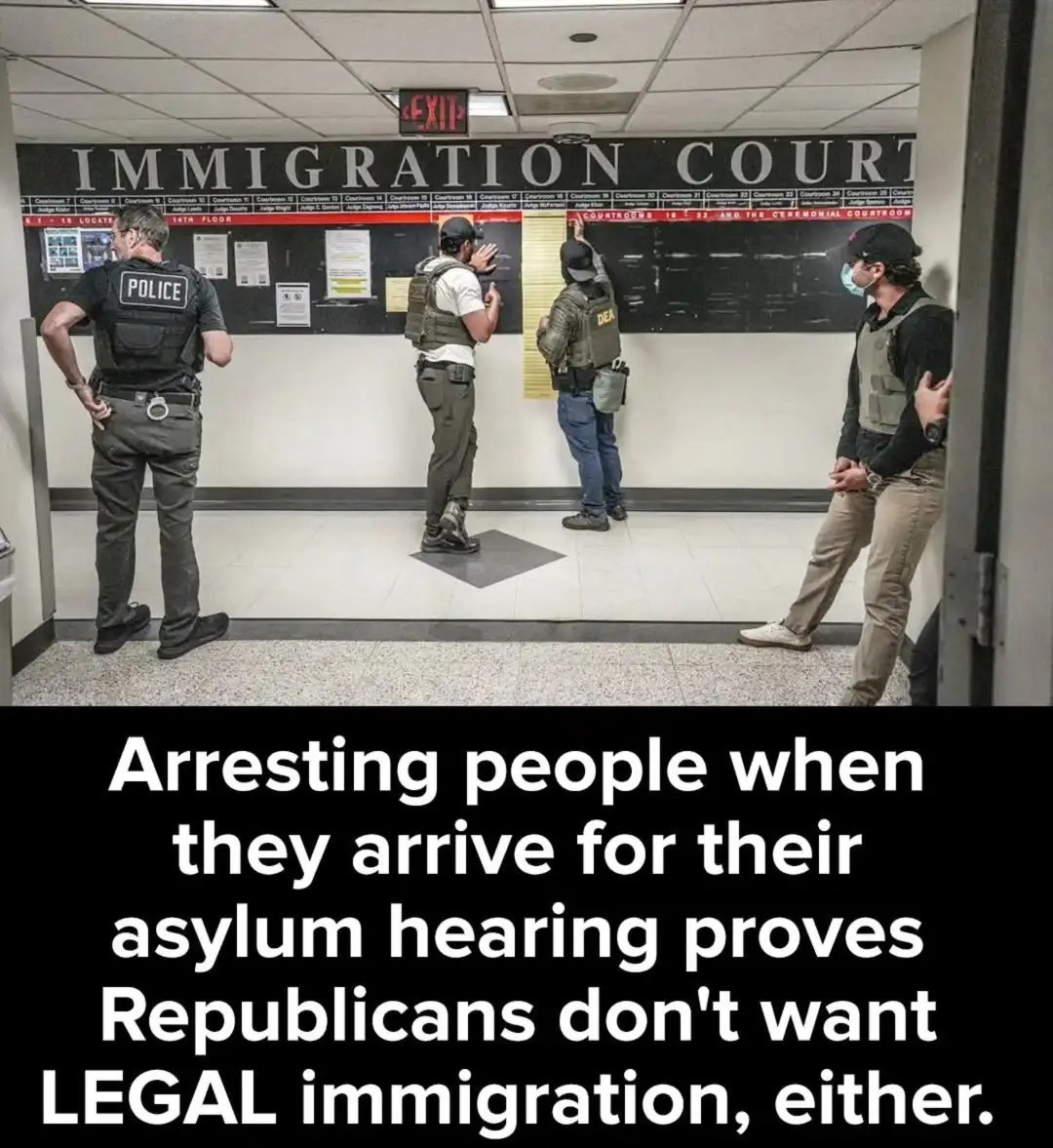
The image depicts uniformed law enforcement officers (labeled "POLICE" and "DEA" on their vests) standing around and apparently detaining individuals within a building lobby identified as an "IMMIGRATION COURT." The individuals being detained are shown in a vulnerable position, appearing to be held or questioned. The setting is austere, with bulletin boards displaying case information, emphasizing a bureaucratic, official, and potentially intimidating environment. The text overlay states: "Arresting people when they arrive for their asylum hearing proves Republicans don't want LEGAL immigration, either."
Foucauldian Genealogical Discourse Analysis
This meme directly speaks to Foucault’s concepts of power and discourse. The image represents a micro-physics of power operating within the legal/immigration system.
- Discourse of the Border/Immigration: Historically, the discourse surrounding immigration has been constructed to justify state control and surveillance. The image illustrates how this discourse manifests as physical force and detention. The very categorization of people as "immigrants" or "asylum seekers" is a product of a specific power/knowledge regime.
- Biopower: Foucault’s concept of biopower, the regulation of life, is central. The state doesn’t just punish “illegal” immigration; it controls who can live within its borders, their movement, and ultimately, their lives. The asylum process itself is an exercise of biopower – determining who is “worthy” of protection and who is not. The act of arresting people seeking legal status highlights how the state regulates life, even within the framework of the law.
- Genealogy: Tracing the historical development of immigration policies reveals a lineage of exclusionary practices, often linked to nationalist and racist ideologies. This meme points towards an escalation of such practices, suggesting a current genealogy of increasingly harsh treatment.
The text overlay argues that the actions depicted expose a deeper ideological motivation—a rejection of even legal immigration, challenging the narrative that strict enforcement is simply about law and order.
Critical Theory
From a Critical Theory perspective, particularly drawing from the Frankfurt School, this meme critiques the instrumental rationality of the state and its role in perpetuating systems of domination.
- Instrumental Rationality: The immigration court, and the actions of law enforcement within it, appear to operate based on a cold, calculated logic of control. The focus is on procedures, enforcement, and border security—rather than on the human dignity of those seeking refuge.
- Ideology: The meme challenges the dominant ideology surrounding immigration, which often frames it as a problem of security or economic burden. By showing the arresting of asylum seekers, it suggests that the real problem is a deeper ideological commitment to exclusionary nationalism.
- Commodification of Life: Immigration processes can be seen as commodifying human lives, reducing individuals to legal categories and subjecting them to bureaucratic scrutiny.
The meme exposes the contradiction between the proclaimed values of legal process and the reality of state violence against those seeking legal pathways to safety.
Marxist Conflict Theory
From a Marxist perspective, this image can be understood in terms of class struggle and the state's role in maintaining the interests of the ruling class.
- State as an Instrument of Class Rule: The state, in this view, functions to protect the interests of the capitalist class. Restrictive immigration policies can be seen as a way to suppress wages, create a more vulnerable workforce, and divide the working class along racial and national lines.
- Exploitation & Reserve Army of Labor: Immigrants, even those with legal status, are often vulnerable to exploitation due to their precarious legal position. Restricting immigration is thus tied to the desire of the ruling class to keep the reserve army of labor (the pool of unemployed or underemployed workers) large, thereby lowering wages and limiting worker power.
- Nationalism as False Consciousness: Nationalism, often used to justify restrictive immigration policies, serves as a form of false consciousness, masking the underlying class interests at play.
The meme implies that the Republican party’s actions are not about upholding the law, but about maintaining a system that benefits the ruling class through the exploitation of labor and the suppression of dissent.
Postmodernism
A Postmodern approach to the meme would question the fixed categories and grand narratives surrounding immigration.
- Deconstruction of "Legal" vs. "Illegal": The meme challenges the neat binary between "legal" and "illegal" immigration. By showing the arrest of people seeking legal status, it exposes the arbitrariness of these categories and the power structures that enforce them.
- Rejection of Universal Truths: There is no singular "truth" about immigration. The meme points to the subjective nature of the immigration process, where interpretations and biases shape outcomes.
- Emphasis on Discourse: The power of language and representation is central. The meme uses a stark image and direct text to disrupt the dominant discourse surrounding immigration, challenging viewers to question their assumptions.
The meme itself is a form of disruptive intervention, aiming to destabilize dominant narratives through a pointed critique of the hypocrisy of those in power.
In Conclusion
From an Anti-Fascist perspective, this meme is a tool for exposing the underlying ideological motivations of those who seek to control borders and limit immigration. It utilizes a variety of critical theoretical frameworks to dismantle the justifications offered for restrictive immigration policies and highlight the power dynamics at play. It is a call to action, urging viewers to recognize the insidious nature of the forces that seek to exclude and oppress.
simple-description (llama3.2-vision_11b)
The meme is a photo of a group of people, likely migrants or refugees, being arrested by law enforcement. The text below the image reads, "Arresting people when they arrive for their asylum hearing proves Republicans don't want LEGAL immigration, either." This meme is from the perspective of the Anti-Fascism category, which argues that the Republican Party's stance on immigration is not just about preventing illegal immigration, but also about limiting the number of people who can immigrate to the United States.
detailed-analysis (gemma3-27b-vision)
Okay, here's a breakdown of the image and accompanying text, analyzed through the lenses you requested. I'll include sections only where those lenses are applicable. Please note that these are complex theories, and applying them to a single image involves interpretation.
Image Description:
The image depicts the interior of what appears to be a courthouse, specifically designated as an “Immigration Court” visible in a sign. Several armed law enforcement or security personnel (wearing vests labeled “POLICE” and “DEA”) are surrounding two individuals who appear to be detainees, likely recent arrivals seeking asylum. The detainees are positioned in the center of the frame, seemingly being apprehended or in custody. The scene is stark, with sterile lighting and functional architecture. The overall mood is tense and authoritarian. The composition emphasizes the power dynamic, with the armed officials flanking the detainees.
Foucauldian Genealogical Discourse Analysis
This image is ripe for a Foucauldian reading. Michel Foucault’s genealogical method examines how power operates through discourse and institutions to create and maintain social norms.
- Discipline & Surveillance: The scene embodies discipline and surveillance. The armed officers represent the “panoptic” force Foucault describes – the constant possibility of being watched and controlled. The very presence of the immigration court, with its institutional architecture and procedures, is a mechanism of control.
- Construction of the “Immigrant”: The image doesn’t just depict an arrest; it participates in the construction of the “immigrant” as a threat. The framing – showing them being apprehended – inherently positions them as potentially dangerous or criminal. This contributes to a discourse that justifies increased control and securitization.
- Biopower: The act of controlling the movement and fate of these individuals is an example of biopower – the power to regulate life itself. Immigration policies and enforcement are not just about border control, but about determining who gets to live, move, and participate in society.
- Genealogy of Immigration Enforcement: A genealogical analysis would trace the historical development of immigration laws and enforcement practices, revealing how they have evolved to produce these present-day forms of control. It would examine the shifting definitions of “illegal” and the associated justifications for harsher treatment.
Critical Theory
- Power Dynamics: The image vividly demonstrates asymmetrical power relations. The armed officials represent state power, while the detainees are rendered vulnerable and subject to that power. Critical theory (rooted in the Frankfurt School) would examine how these power imbalances are maintained and legitimized.
- Ideology: The accompanying text, “Arresting people when they arrive for their asylum hearing proves Republicans don't want LEGAL immigration, either,” attempts to reveal the underlying ideology at play. It suggests that the act of arresting asylum seekers is not about enforcing laws but about enacting a broader political agenda. This is a claim that challenges the surface level narrative and attempts to expose the motivations behind the action.
- Domination & Oppression: The scene embodies a form of domination and oppression. The detainees are stripped of agency and subject to the authority of the state. Critical theory would analyze how these forms of domination are perpetuated through institutional structures and cultural norms.
Marxist Conflict Theory
While not the primary lens, Marxist conflict theory can offer some insights.
- Class & Exploitation: Immigration policies often intersect with labor markets. Some argue that restrictive immigration policies are partly driven by a desire to limit the supply of labor, thereby increasing wages for domestic workers. The image, while not directly depicting labor, can be seen as a manifestation of the state's efforts to control the movement of people and manage the workforce.
- State as an Instrument of Class Rule: From a Marxist perspective, the state (represented by the armed officers) functions as an instrument of class rule. Immigration enforcement can be seen as a way to protect the interests of the dominant class by controlling access to resources and opportunities.
Relevance of Postmodernism & Queer Feminist Intersectional Analysis
These theories are less directly applicable in the analysis of this specific image. The image’s content does not inherently lend itself to a queer feminist or postmodern reading. While, a postmodern argument could be made about the image being a constructed narrative with multiple interpretations, it’s not central to understanding the image. The same goes for a queer feminist analysis.
Important Note: These are interpretations. There is no single "correct" way to analyze an image. The purpose of applying these theoretical lenses is to reveal the complex power dynamics, social constructs, and underlying ideologies that are at play.
simple-description (llama3.2-vision)
The meme features a photo of law enforcement officers and immigration officials at an immigration court. The image shows them discussing a list of people who are being held for their asylum hearing. The text at the bottom of the image reads, "Arresting people when they arrive for their asylum hearing proves Republicans don't want legal immigration, either." This statement suggests that the actions of these officials are not just about immigration law, but also about a desire to prevent immigration altogether.