First Seen
2025-06-17T18:41:20.642768+00:00
detailed-analysis (gemma3_27b-it-q8_0)
Okay, let's break down this social media post/meme (as it functions as a quick, shareable commentary) through the lens of Anti-Fascism, using the requested theoretical frameworks where relevant.
Overall Framing: Anti-Fascist Perspective
From an anti-fascist perspective, this event is deeply alarming and reads as a clear instance of state repression and intimidation tactics. Anti-fascism is fundamentally concerned with identifying and dismantling systems of power that seek to marginalize, control, and ultimately suppress democratic freedoms. The action taken against Brad Lander (even if legalistic in its execution) is seen not as an isolated incident but as part of a broader pattern of authoritarian tendencies and a deliberate attempt to silence dissent and those who advocate for justice for marginalized communities, especially within the context of immigration.
Visual Description
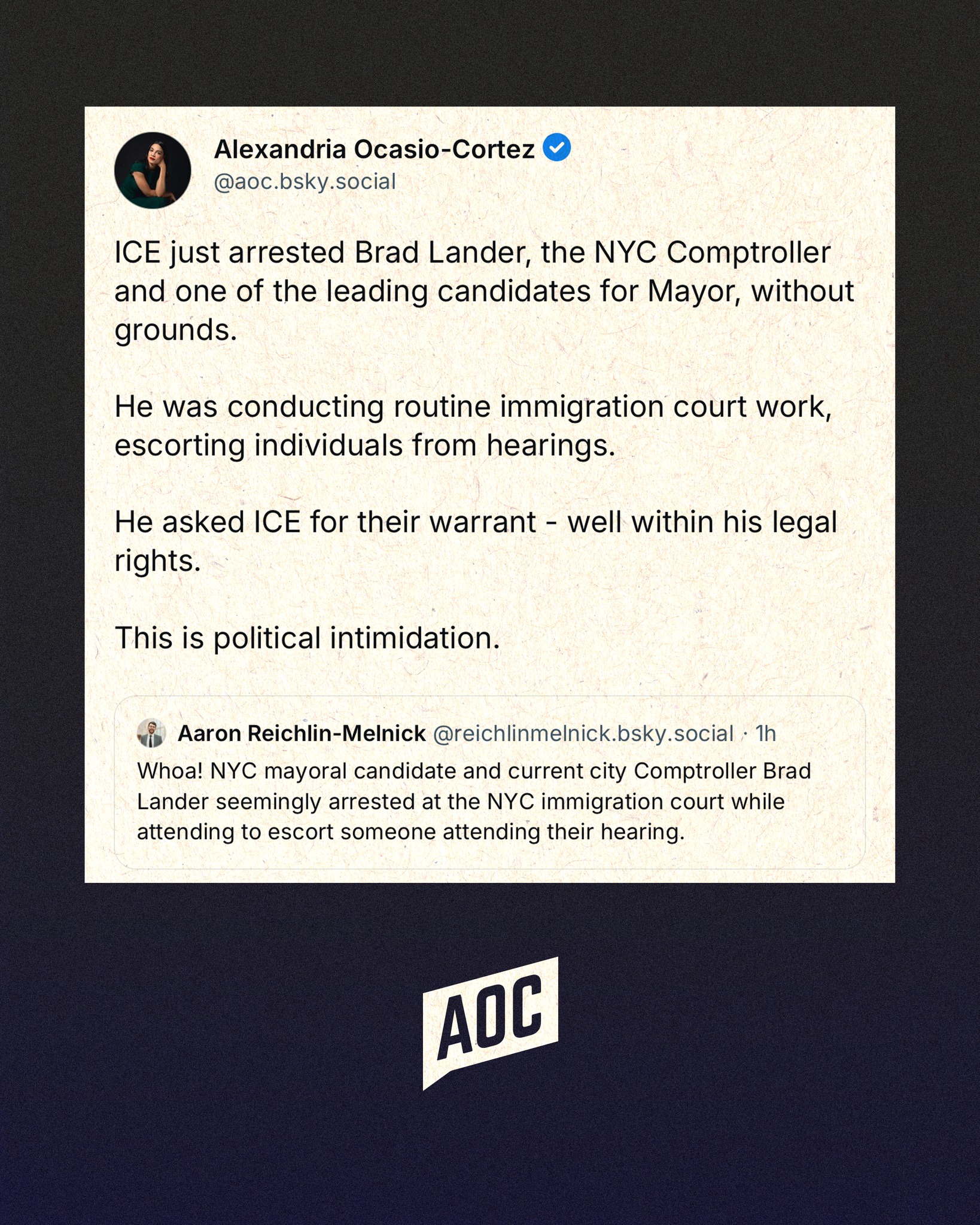
The “meme” is a screenshot of a social media post from Alexandria Ocasio-Cortez (AOC) and a reply from Aaron Reichlin-Melnick. AOC’s post is overlaid on a dark background with the letters “AOC” in white, as if branding the statement. This branding amplifies the message as coming from a key progressive voice. The aesthetic is clean and direct. The text is the central focus. The use of screenshots and a direct quote format is typical of social media commentary and aids in rapid dissemination. It evokes a feeling of immediacy and urgency.
Foucauldian Genealogical Discourse Analysis
Michel Foucault’s work is highly relevant here. From a Foucauldian perspective, this incident is about the exercise of power, not necessarily overt brutality but the subtle, dispersed mechanisms of control.
- Disciplinary Power: The arrest, even if technically lawful, functions as a disciplinary measure. It doesn’t primarily aim at punishment but at normalization – sending a message to other activists, politicians, and anyone supporting immigrant rights that such engagement carries risk.
- Surveillance & Visibility: The act of arresting a public figure while they are engaging in support work increases surveillance. It signals that ICE is watching, documenting, and actively monitoring those involved in resisting immigration enforcement.
- Genealogy of Immigration Control: Foucault would encourage us to trace the historical development of immigration control, revealing how seemingly neutral concepts like “borders” and “national security” are historically constructed discourses used to justify the exclusion and control of populations. This arrest is a contemporary manifestation of that historical power dynamic. The demand for a warrant and the legal framework used can be seen as a tool to justify this power.
- Power/Knowledge: The framing of the action (by ICE) as legitimate within the legal system is a demonstration of power/knowledge. The legal system provides the “knowledge” that legitimizes the exercise of power. AOC challenges this by labeling it "political intimidation."
Critical Theory
Critical Theory, particularly the Frankfurt School’s focus on the "instrumentalization of reason", is helpful here.
- Reason as Domination: ICE may present its actions as rational and lawful, appealing to a concept of legal reason. However, Critical Theory would argue that this reason is not neutral; it serves the interests of the state and the existing power structure. The legality of the action does not negate its inherently political and potentially oppressive nature.
- Critique of Positivism: The demand for a warrant, while appearing to uphold legal process, can be viewed as a legitimizing tactic to obscure the underlying political motivations. Critical Theory challenges the notion that objective, value-free legal reasoning is possible, arguing that it always reflects specific ideologies.
- The Culture Industry: The quick spread of the post on social media represents a counter-narrative against the state’s narrative. This is a moment of disruption to the culture industry’s dominant message.
Marxist Conflict Theory
This incident can be understood as a manifestation of class struggle and the defense of capitalist interests.
- State as a Tool of the Ruling Class: Marxist theory posits that the state (in this case, ICE) operates to protect the interests of the ruling class. Restricting immigration and suppressing activism can serve to depress wages, maintain a vulnerable workforce, and prevent the organization of workers.
- Repression of Solidarity: Brad Lander’s support work represents solidarity with a vulnerable population (immigrants). The arrest aims to disrupt that solidarity and prevent the formation of collective resistance.
- Ideological Control: By labeling the action as "political intimidation," AOC challenges the official narrative and exposes the underlying power dynamics at play. This challenges the dominant ideology that reinforces the status quo.
Postmodernism
The idea of grand narratives doesn’t fit here. Postmodern thought helps us deconstruct the simple narratives often used to justify state action.
- Deconstruction of Legality: Postmodernism would question the very notion of “legality” as a neutral and objective standard. It would argue that law is a social construct, shaped by power relations and used to maintain existing hierarchies.
- Discourse & Meaning: The meaning of the arrest is not inherent in the event itself; it is constructed through discourse. AOC’s framing as “political intimidation” is a key intervention in that discourse.
- Subjectivity: The arrest itself is presented through subjective experiences. AOC’s post is an individual’s perspective on the event and an effort to shape the narrative.
Queer Feminist Intersectional Analysis
While not directly at the forefront of the post, this perspective adds nuance.
- Intersectionality: Immigrants often face multiple forms of oppression based on race, class, gender, and sexuality. The arrest not only targets an advocate but also reinforces the vulnerability of the communities he supports.
- State Violence & Marginalized Bodies: State violence (even in seemingly “lawful” forms) disproportionately impacts marginalized bodies.
- Solidarity & Resistance: AOC's response signifies solidarity with both Brad Lander and the immigrant communities he serves. It represents a challenge to patriarchal, heteronormative, and white supremacist structures that underpin systems of oppression.
In conclusion, this social media post, viewed through the lens of Anti-Fascism and these theoretical frameworks, highlights a potential escalation of state power, a challenge to democratic freedoms, and a need for continued resistance against authoritarian tendencies. The "meme" functions as a rapid-response mobilization tool, aimed at raising awareness and rallying support for those facing state repression.
simple-description (llama3.2-vision_11b)
The meme is a screenshot of a tweet from AOC's Twitter account, where she shares a news article about ICE (Immigration and Customs Enforcement) arresting a candidate for mayor, Brad Lander, who was also a candidate for mayor of New York City. The tweet is a sarcastic commentary on the irony of a candidate for mayor being arrested by ICE, and the absurdity of the situation. The tweet reads: "ICE just arrested Brad Lander, the NYC Comptroller and one of the leading candidates for Mayor, without grounds."
detailed-analysis (gemma3-27b-vision)
Okay, let's break down this social media post from Alexandria Ocasio-Cortez (AOC) and the related reply from Aaron Reichlin-Melnick through the lenses you've requested. Please note that applying these frameworks often involves interpretation and multiple layers of analysis. I'll state if a section isn't strongly applicable.
Visual Description
The image is a screenshot of two social media posts. The top post is from Alexandria Ocasio-Cortez (AOC) on what appears to be a decentralized social media platform ("bsky.social"). It is text-based, communicating the arrest of Brad Lander, NYC Comptroller and mayoral candidate. The post asserts the arrest was without grounds and occurred while Lander was assisting people with immigration court appearances. AOC characterizes this as political intimidation.
The lower post is a reply from Aaron Reichlin-Melnick, confirming the event and reiterating Lander was simply escorting someone to court. Both posts are framed within a simple aesthetic, characteristic of the platform. The word "AOC" is superimposed on the lower part of the image.
Foucauldian Genealogical Discourse Analysis
This situation lends itself well to a Foucauldian analysis.
- Power/Knowledge: The event reveals the operation of power/knowledge within the context of immigration enforcement. ICE (Immigration and Customs Enforcement) possesses the power to define what constitutes legitimate activity (or not) within immigration court, and this definition is enforced through the exercise of state power (arrest). The power to arrest inherently carries with it the power to define who is seen as a subject worthy of protection under the law, and who is perceived as an illegal threat.
- Discipline & Surveillance: The arrest itself can be seen as an act of discipline, a demonstration of ICE’s authority to monitor and control movement within the immigration system. The act of arresting someone while they were performing a charitable act (escorting someone to court) is a demonstration of control meant to dissuade others from challenging the system.
- Genealogy: Tracing the genealogy of ICE’s power—how it evolved from earlier forms of immigration control—would reveal a history of constructing "the illegal immigrant" as a dangerous and threatening "other." This framing justifies increasingly harsh enforcement measures, like arbitrary arrests.
- Discourse & Truth: AOC's framing ("political intimidation") directly challenges ICE's potential narrative (that Lander somehow violated the law). This is a struggle over defining "truth" within the context of immigration policy. The very language used (e.g., "without grounds") implies an illegitimate exercise of power.
Critical Theory
This event can be analyzed through a broadly Critical Theory lens, specifically drawing on the Frankfurt School's concern with the manipulation of power and the suppression of dissenting voices.
- Ideology & Domination: The arrest, especially if demonstrably unjustified, serves to reinforce the ideological dominance of the current immigration enforcement regime. It sends a message that challenging ICE's authority will be met with repercussions, effectively silencing potential opposition.
- Instrumental Reason: The focus on “enforcement” (arrest, detention, deportation) can be seen as an example of instrumental reason – prioritizing efficiency and control over ethical considerations. In this case, the arrest appears to be driven by the logic of maintaining control over immigration flows, regardless of the consequences for individuals or civil liberties.
- Critique of Power: AOC’s response is a direct critique of the power structures at play. She is actively challenging the legitimacy of the arrest and exposing what she believes to be an abuse of power. This is a core tenet of Critical Theory – unmasking hidden power dynamics.
Marxist Conflict Theory
While not the central focus, Conflict Theory can illuminate aspects of this event.
- Class Struggle: The situation can be connected to broader power dynamics within the United States. Immigration policy often disproportionately affects marginalized communities, contributing to a system of economic and social stratification. Lander, as a public official, represents a challenge to the status quo, while ICE represents the forces of the state upholding the existing order.
- State Apparatus: ICE functions as a component of the state apparatus, tasked with maintaining control over borders and labor markets. The arrest can be seen as an assertion of the state's power to regulate and control the population.
- Conflict over Resources: Immigration control is often linked to control over economic resources. Restricting immigration can protect domestic labor markets, while allowing it can provide a source of cheap labor. The arrest could be viewed as a means of reinforcing existing power dynamics related to labor and economic control.
Postmodernism
Postmodern analysis would focus on deconstructing the certainties and universal truths underlying the narrative.
- Deconstruction of Narrative: The situation invites a deconstruction of the "rule of law" narrative. What constitutes a legitimate arrest? Whose definition of “legitimate” prevails? By questioning these assumptions, a postmodern analysis would expose the constructed nature of legal authority.
- Fragmentation of Meaning: The conflicting accounts of the event (ICE's rationale vs. AOC's interpretation) contribute to a fragmentation of meaning. There is no single, objective "truth" – only competing narratives.
- Emphasis on Discourse: A postmodern approach would prioritize the discourse surrounding the arrest. The language used by both sides (e.g., "political intimidation," "enforcement") shapes public perception and influences the understanding of the event.
Queer Feminist Intersectional Analysis
This analysis is least directly applicable but can still provide valuable insights.
- Intersectional Vulnerability: The people Brad Lander was escorting may have been particularly vulnerable due to their immigration status, potentially intersecting with other marginalized identities (race, gender, sexuality, class). This highlights how systemic power structures can create heightened risks for specific groups.
- State Violence: The arrest can be seen as an act of state violence, particularly given the disproportionate impact of immigration enforcement on marginalized communities. This connects to feminist concerns about the state’s power to control bodies and regulate lives.
- Challenging Authority: AOC’s response can be viewed as a challenge to patriarchal structures of authority. By speaking out against what she perceives as an abuse of power, she is asserting her voice and challenging the status quo.
Important Note: These are interpretations based on the provided text and image. A deeper analysis would require additional context and information about the specific circumstances of the arrest. Each framework provides a unique lens through which to examine the event, and multiple frameworks can be used in conjunction to create a more nuanced understanding.
simple-description (llama3.2-vision)
The meme is a Twitter post from Alexandria Ocasio-Cin