First Seen
2025-06-17T05:30:44.962908+00:00
detailed-analysis (gemma3_27b-it-q8_0)
Here's an analysis of the meme from an anti-fascist perspective, utilizing relevant theoretical frameworks where applicable. Given the nature of the meme's content, this analysis will be direct and deal with the implications of political violence.
Visual Description
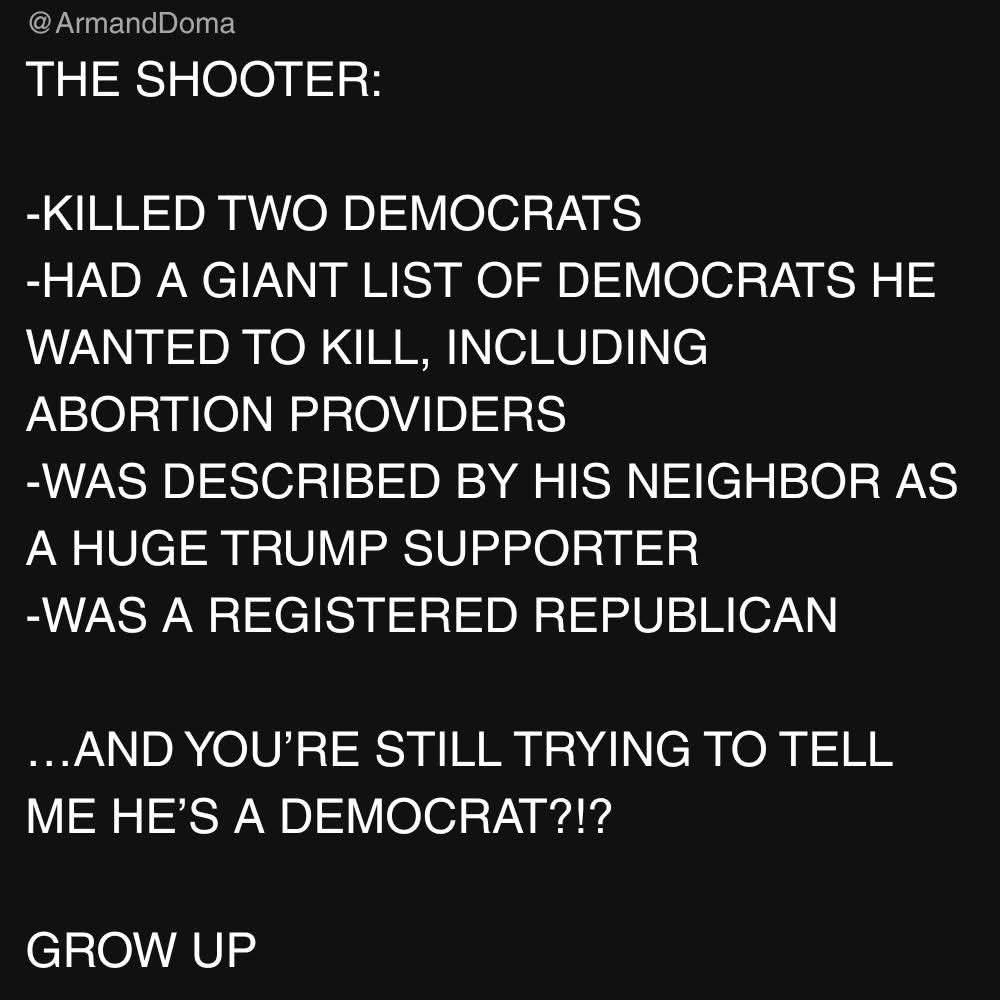
The meme is text-based, presented as a list of facts concerning a shooter. The list details the shooter's actions (killing Democrats, having a target list), political affiliations (Trump supporter, registered Republican), culminating in a rhetorical question directed at those attempting to misrepresent the perpetrator's ideology. The concluding phrase, “GROW UP,” is a dismissive command aimed at those attempting to downplay or obscure the shooter’s clear political motivations.
Foucauldian Genealogical Discourse Analysis
From a Foucauldian perspective, this meme dissects the discourse surrounding political violence. A key function of power is the construction of narratives. This meme counters the common tactic, deployed by the right-wing media and political actors, of attempting to portray perpetrators of far-right violence as either mentally ill outliers or falsely flag them as being associated with the left. This strategy seeks to disassociate violent acts from the underlying ideologies that motivate them, effectively erasing the role of fascism and right-wing extremism.
The meme genealogizes the present-day attempt to disavow the shooter’s political alignment. It demonstrates a pattern of rhetorical moves (denial, misrepresentation, framing) meant to protect the image of the right and obscure the very real danger it poses. By directly confronting the attempt to “tell me he’s a Democrat?” the meme exposes the power dynamics embedded within this narrative construction. The command "GROW UP" is a rejection of this narrative, demanding recognition of the perpetrator’s actual politics.
Critical Theory
Critical Theory, particularly associated with the Frankfurt School, concerns itself with the critique of domination and the analysis of ideology. This meme embodies a critical response to the ideology of right-wing denialism. It challenges the false consciousness surrounding right-wing extremism, where the true motivations behind violence are concealed.
The meme highlights how ideologies can normalize, justify, and even incite violence. The shooter's actions, fueled by his political beliefs, represent the logical conclusion of a particular discourse of hate and political polarization. This is especially relevant in the context of a growing climate of anti-democratic sentiments and far-right radicalization.
Marxist Conflict Theory
From a Marxist lens, the meme exposes a clash of class and ideological interests. The targeted victims – Democrats, abortion providers – represent groups advocating for social justice and progressive policies, which challenge the power structures that benefit the ruling class (represented here by the shooter's alignment with the Republican party and Trump).
The meme reveals the inherent conflict within a capitalist society where class antagonism is exacerbated by ideological divides. The shooter’s violence is seen as an attempt to suppress dissent and maintain the status quo that privileges certain groups over others. It illustrates how the ruling class, or those aligned with it, will resort to violence – direct or through proxies – to defend their interests.
Anti-Fascist Interpretation
Within the specific context of anti-fascism, this meme is a direct condemnation of the far-right's use of political violence. It's a rebuttal of the common tactic of “whataboutism” – deflecting attention from right-wing extremism by falsely accusing the left of similar acts.
Anti-fascists view the meme as a necessary corrective to the mainstream media’s often cautious and nuanced reporting on political violence. This meme cuts through the ambiguity and directly names the perpetrator’s political motivations. It emphasizes the importance of naming and confronting fascism, rather than attempting to sanitize or downplay its dangers. The meme is also a call to action, urging people to move beyond denial and recognize the growing threat of right-wing violence.
Disclaimer: This analysis is provided for educational purposes and is based on the provided context of the meme. It represents a specific viewpoint (anti-fascism) and may not reflect all interpretations.
simple-description (llama3.2-vision_11b)
The meme is a satirical commentary on the 2023 Buffalo shooting, where the shooter was motivated by anti-fascist ideology. The image presents a fictional scenario where a mass shooter is described by his neighbors as a "huge Trump supporter" and a "registered Republican", but then suddenly reveals he is a Democrat. The meme is humorous and ironic, highlighting the absurdity of a mass shooter being described as a Democrat, when in reality, the shooter's ideology is often associated with the Republican Party. The text in the image reads: "THE SHOOTER: KILLED TWO DEMOCRATS. HAD A GIANT LIST OF DEMOCRATS HE WANTED TO KILL, INCLUDING ABORTION PROVIDERS. WAS DESCRIBED BY HIS NEIGHBOR AS A HUGE TRUMP SUPPORTER. WAS A REGISTERED REPUBLICAN. AND YOU'RE STILL TRYING TO TELL ME HE'S A DEMOCRAT?!"
detailed-analysis (gemma3-27b-vision)
Okay, here's an analysis of the image, broken down into sections based on the theoretical frameworks you requested. It's important to note that these frameworks can overlap, and applying them to this particular image (which is a direct statement about a violent act) requires sensitivity and an understanding that these are analytical lenses, not necessarily ways to excuse or downplay the gravity of the events.
Image Description:
The image is a simple black screen with white text. The text is a list of statements about the perpetrator of a shooting incident. The statements point to the shooter being actively hostile towards Democrats and supportive of Republican ideology. It lists:
- Killed two Democrats
- Had a list of Democrats to kill, including abortion providers.
- Described as a huge Trump supporter
- Was a registered Republican.
The final lines are rhetorical questions: “And you’re still trying to tell me he’s a Democrat?!” followed by “Grow up.” The image is attributed to a Twitter handle "@ArmandDoma". The overall tone is accusatory and defiant, pushing back against what the author perceives as an attempt to downplay or misrepresent the shooter's political motivations.
Foucauldian Genealogical Discourse Analysis
This framework is powerfully applicable. Foucault examines how knowledge and power are intertwined, creating discourses that shape our understanding of the world.
- Discourse of Political Identity: The image directly challenges the discourse around political identity. The author is contesting the idea that the shooter's political leanings are complex or open to interpretation. It presents the shooter as decisively aligned with conservative ideologies.
- The Construction of "The Shooter": The author is constructing an image of "the shooter" through a specific narrative focused on political affiliation. This is key in Foucault’s work - how we categorize individuals becomes a power-laden act. By labeling the perpetrator as a Trump supporter and registered Republican, the author emphasizes a specific origin and motivation for the violence.
- Power/Knowledge: The image argues that the "truth" about the shooter's motivations is being obscured or minimized. This is a power dynamic: who gets to define the narrative and control the understanding of the event? The author is claiming to reveal a suppressed truth.
- Genealogy: The image suggests a line of thinking—a genealogy—connecting the shooter’s ideology to the act of violence. It implies a historical connection between right-wing extremism and political violence, although it doesn’t explicitly lay out the full chain of events.
Critical Theory
Critical Theory (particularly that of the Frankfurt School) examines power structures and their influence on culture, ideology, and social relations.
- Ideology and Domination: The image implicitly critiques the ideology underlying right-wing extremism. The author suggests that this ideology, whether explicitly stated or embedded in broader cultural narratives, contributed to the violent act. It argues that the shooter was acting within, and potentially upholding, a system of domination that targets Democrats and those providing reproductive healthcare.
- Critique of Representation: The image itself is a critique of representation. It challenges the way the shooter's actions might be presented in mainstream media or public discourse, which the author believes might downplay the political context.
- Reason and Enlightenment: While not a direct focus, Critical Theory sometimes examines the failures of "instrumental reason" (reason used for domination). The image subtly points to a distorted application of rational thought within extremist ideology, leading to violent ends.
- Culture Industry: The image could be seen as a counter-narrative within the “culture industry,” attempting to expose the political motivations behind a violent act and disrupt dominant narratives.
Marxist Conflict Theory
While the image doesn't explicitly discuss class struggle, a Marxist analysis can be applied by interpreting the conflict as stemming from ideological and political clashes, which often serve to reinforce or challenge existing power structures.
- Class Conflict (Interpreted): Although not directly about economic class, the conflict between Democrats and Republicans can be seen as representing broader ideological and cultural divides, which often intersect with class interests.
- Power Dynamics: The act of violence can be understood as an attempt to assert power and control over a perceived enemy. The author is suggesting that the shooter was acting in defense of a particular worldview and against those perceived as threatening it.
- Ideology as a Tool: The author is implying that ideology (in this case, conservative extremism) served as a tool for justifying violence and maintaining existing power structures.
- Alienation: A Marxist reading could interpret the shooter's actions as a manifestation of alienation – a sense of disconnection from society and a resort to extreme measures to address perceived injustices.
Postmodernism
Postmodernism, with its emphasis on deconstruction, relativism, and the rejection of grand narratives, offers a different lens:
- Deconstruction of Meaning: The image attempts to deconstruct the meaning of the shooter’s actions by focusing on political identity. It challenges the idea that there is a single, straightforward explanation for the violence.
- Rejection of Grand Narratives: The author is rejecting the idea that the shooter’s actions can be understood within a simplistic or overarching narrative. It suggests that the political context is crucial for understanding the motivations behind the violence.
- Subjectivity and Interpretation: Postmodernism acknowledges the subjectivity of interpretation. The author is presenting their own interpretation of the events, challenging others to question dominant narratives.
- Simulacra and Simulation: (More abstractly) The image could be seen as commenting on the “simulation” of political identity, where labels and affiliations become increasingly detached from genuine beliefs or values.
Queer Feminist Intersectional Analysis
This framework is relevant given the mention of abortion providers.
- Intersectional Oppression: The image highlights the intersection of political affiliation with gender, reproductive rights, and violence against marginalized groups. The targeting of abortion providers demonstrates how political extremism often intersects with misogyny and anti-reproductive rights movements.
- Gendered Violence: Targeting abortion providers is a form of gendered violence, aiming to control women's bodies and reproductive autonomy. The image implicates the shooter's political ideology as a contributing factor to this violence.
- Power and Control: The shooter's actions are an attempt to exert power and control over those perceived as challenging dominant norms, particularly women and those advocating for reproductive rights.
- Challenging Hegemony: The image itself can be seen as a challenge to the hegemonic narratives that normalize or downplay political violence and its connection to broader social injustices.
Important Note: This is a complex image with layers of meaning. These analyses are not exhaustive, and other interpretations are possible. It's crucial to approach this image with sensitivity and a recognition of the seriousness of the violent act it references.
simple-description (llama3.2-vision)
This meme is a satirical commentary on the mass shooting in Buffalo, New York, that occurred in May 2022. The image features a list of bullet points that describe the shooter's actions and characteristics, including the killing of two Democrats, the creation of a list of Democrats to kill, and the shooter's own political affiliations. The meme is written in a playful, sarcastic tone, with the final line "And you're still trying to tell me he's a Democrat?!" implying that the shooter's actions are so extreme that it's impossible to believe he identifies as a Democrat. Overall, the meme is a humorous commentary on the shooter's actions and the media's attempts to label him as a Democrat.