First Seen
2025-06-12T18:33:49.115924+00:00
detailed-analysis (gemma3_27b-it-q8_0)
Okay, let's break down this meme from an anti-fascist perspective, leveraging the theoretical frameworks you've requested. It's a deeply political statement, and the layers of meaning are significant.
Visual Description
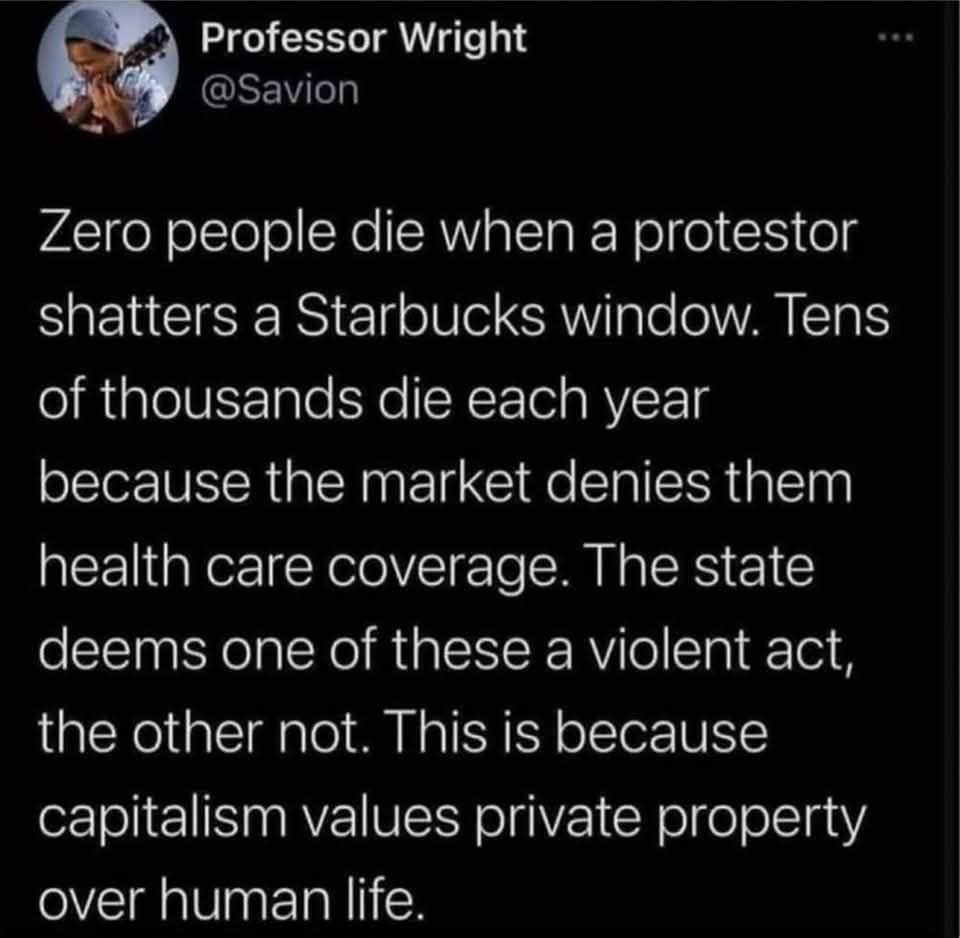
The meme is simply text on a dark background, with a profile picture of “Professor Wright @Savion” at the top. The starkness of the presentation emphasizes the directness of the comparison being made. There's no imagery to distract from the core message. This deliberate lack of visual "fluff" suggests a commitment to raw, unadorned truth.
Marxist Conflict Theory
This meme is strongly rooted in Marxist conflict theory. The central argument revolves around the prioritization of property rights (Starbucks window) under capitalism over human life (healthcare access and, consequently, lives lost).
- Class Struggle: The meme highlights an inherent contradiction within a capitalist system. It argues that the "violence" of breaking a window (often seen as a property crime, and thus a disruption of the capitalist order) is less seriously considered by the state than the “violence” of systemic denial of healthcare, which disproportionately affects the working class. It subtly frames the protests as an expression of class struggle.
- Base and Superstructure: The "state" and its definition of violence are viewed as part of the "superstructure" (legal system, ideology, etc.) which serves to maintain the "base" (the economic system, in this case, capitalism). The state’s definition of “violence” is not neutral; it's biased toward protecting capitalist interests.
- Commodification of Life: The denial of healthcare isn’t presented as a mere policy failure but as a direct consequence of commodifying life itself. Under capitalism, access to essential resources like healthcare is determined by the ability to pay, turning life into a commodity.
- False Consciousness: The meme challenges the "common sense" notion that property damage is more violent than systemic neglect leading to death. It attempts to disrupt "false consciousness" by revealing the underlying logic that prioritizes capital accumulation over human well-being.
Critical Theory
The meme aligns with critical theory's project of exposing power structures and challenging dominant ideologies.
- Critique of Instrumental Reason: The meme points to how “reason” (as manifested in the legal system and state actions) is used instrumentally to justify maintaining the existing order, even if that order leads to preventable death. It is not about an objective evaluation of harm but about protecting capital.
- Unmasking Power Relations: It unmasks the power relations embedded within the definition of "violence." Who gets to define what constitutes violence, and what interests are served by those definitions?
- Domination: The denial of healthcare is framed as a form of domination, whereby the system systematically disadvantages and harms certain populations.
Foucauldian Genealogical Discourse Analysis
A Foucauldian approach would focus on the history of the concepts involved—violence, property, and healthcare—and how those concepts have been constructed through power relations.
- Discourse & Power: The meme implies a discourse surrounding "violence" that has been deliberately shaped to protect capitalist interests. The very way we talk about violence is not neutral but is a product of historical power struggles. Breaking a window is easily categorized as a transgression, making it readily identifiable and punishable. The “slow violence” of denying healthcare is more diffuse, harder to pinpoint, and therefore harder to address.
- Genealogy of “Property”: A genealogical analysis would trace the historical development of the concept of “property,” showing how it has become sacralized and protected by the state, often at the expense of human lives.
- Biopower: The denial of healthcare, in this view, represents a form of “biopower”–the state’s ability to control and manage populations through policies affecting their health and well-being. The meme exposes how biopower can operate not through overt repression but through seemingly neutral policies that have deadly consequences.
Postmodernism (Limited Application)
While the meme isn’t explicitly postmodern, there's a degree of deconstruction happening. It challenges the stability of the category "violence" by juxtaposing two drastically different actions and arguing that the state's categorization is arbitrary and ideologically motivated. It disrupts the traditional framing of events.
Anti-Fascist Connection
Why is this relevant to anti-fascism? Anti-fascism often sees fascism as the ultimate expression of capitalist power and the protection of private property. This meme speaks to the underlying principles that allow for the conditions which enable fascism to take hold. The prioritization of property over people is a hallmark of authoritarian ideologies, where individual rights are sacrificed for the sake of order and the maintenance of the existing power structure. By highlighting this dynamic within capitalism itself, the meme suggests that combating fascism requires a deeper critique of the economic system that sustains it.
In conclusion, this meme is a powerful and concise statement about the inherent contradictions of capitalism and the way power structures operate to protect capital at the expense of human life. It's a call to reconsider what we define as "violence" and to challenge the status quo.
simple-description (llama3.2-vision_11b)
This meme is a satirical commentary on the societal impact of anti-fascist movements. The image features a quote from a fictional character, but the actual quote is not provided. The meme is likely a humorous critique of the societal impact of anti-fascist movements, but the quote is not available to describe.
detailed-analysis (gemma3-27b-vision)
Okay, let's break down the image/text you provided, applying the theoretical frameworks you've requested. I'll organize it by section, only including those frameworks that genuinely apply and have something meaningful to say about the content.
Visual Description
The image is a screenshot of a Twitter (now X) post. It features a profile picture (a man in a turban) next to the Twitter handle "@Savion" labeled "Professor Wright". The main element is a block of text, presented as the tweet’s content. The background is a dark, typical Twitter interface color. The style is direct and opinionated, characteristic of social media posting. The image is highly textual; the focus is almost entirely on the message itself.
Marxist Conflict Theory
This post is strongly rooted in Marxist conflict theory. The central argument directly highlights a conflict between two forms of "damage" – the destruction of property (a Starbucks window) and the systematic denial of healthcare, leading to death. The poster explicitly frames this as a result of capitalism valuing private property over human life.
Here's how it aligns with core Marxist principles:
- Class Struggle: Implicit in the critique is a struggle between the owning class (those who benefit from the capitalist system and protect private property) and the working class (those denied healthcare and whose lives are devalued).
- Base and Superstructure: The "base" (economic system of capitalism) is seen as determining the "superstructure" (the laws, norms, and ideologies that uphold it). The state's prioritization of protecting property is presented as a manifestation of this. The poster argues that it is not simply that we cannot afford healthcare, it is that the system does not value human life over profit.
- Alienation: While not explicitly stated, the denial of healthcare and the valuing of property over life contribute to alienation – a sense of powerlessness and disconnection from meaningful existence.
- Commodity Fetishism: The focus on protecting the window (a commodity) as opposed to addressing the loss of human life exemplifies commodity fetishism– placing value on things rather than on people.
- Capitalism as inherently exploitative: The post frames the system as prioritizing profit and property over human well-being, implying an inherent injustice in the capitalist structure.
Critical Theory
This post resonates deeply with critical theory, particularly its focus on power structures and social critique.
- Deconstruction of Norms: The post challenges the normal assumption that damaging property is a greater "crime" or more concerning than the ongoing, systemic harm caused by lack of healthcare. It attempts to dismantle the accepted hierarchy of values.
- Critique of Ideology: The statement exposes the ideology inherent in how society defines violence and prioritizes certain forms of protection over others. It suggests that the notion of "violent act" is socially constructed to serve the interests of the ruling class.
- Emancipation: The underlying goal is to reveal the injustices of the system and potentially inspire action towards a more equitable and humane society.
- Focus on Systemic Issues: Critical theory emphasizes the importance of understanding problems not as isolated incidents, but as symptoms of larger systemic issues, which this post does by linking the protection of property to the denial of healthcare.
Foucauldian Genealogical Discourse Analysis
A Foucauldian approach would focus on the history of how "violence" and "criminality" have been defined and the power dynamics embedded within those definitions.
- Power/Knowledge: The post argues that the definitions of "violence" and "criminality" are not objective, but are constructed through power relations. The state (and broader societal structures) have the power to define what is considered violent, and this definition serves its own interests.
- Discourse: The post disrupts the dominant discourse around violence. It challenges the assumption that property destruction is inherently more harmful than the systemic denial of healthcare.
- Genealogy: A genealogical analysis would trace the historical development of the concepts of "property," "violence," and "healthcare" to reveal how these ideas have been shaped by power relations and how they serve specific interests.
- Surveillance/Discipline: Implicitly, the post suggests that the state’s vigorous protection of private property is a form of surveillance and discipline, reinforcing the norms of capitalist society.
Postmodernism
While there are elements of postmodernism present in the questioning of established norms, it's not a central feature.
- Deconstruction: The post does engage in a form of deconstruction by challenging the conventional understanding of "violence."
- Rejection of Metanarratives: It subtly challenges the idea that there is a single, universal definition of "harm."
- However, the post is not primarily concerned with language games or the instability of meaning, which are hallmarks of postmodern thought. It has a clear political message and aims to expose a concrete injustice.
Queer Feminist Intersectional Analysis
While not explicitly central to the message, an intersectional feminist lens can enrich the understanding.
- Systemic Oppression: The denial of healthcare disproportionately affects marginalized groups (people of color, low-income individuals, women, LGBTQ+ individuals), highlighting the intersection of class, race, gender, and sexuality in shaping vulnerability.
- The valuing of property as patriarchal: Property ownership historically has been a means of exercising control and power, specifically along gendered lines, reinforcing patriarchal structures.
- Vulnerability of bodies: Intersectionality would also consider whose bodies are most at risk. Marginalized groups are more vulnerable to healthcare denial and have less power to challenge it.
In conclusion, the post is most strongly rooted in Marxist conflict theory and critical theory. It can also be meaningfully analyzed through a Foucauldian lens and enriched by an intersectional feminist analysis. Postmodernism plays a more peripheral role.
simple-description (llama3.2-vision)
The meme is a satirical commentary on the prioritization of certain lives over others. It states that when a protestor shatters a Starbucks window, no one dies, but when 10,000 people die in a year because they are denied health insurance, it's not considered a violent act. The text also mentions that this is because capitalism values private property over human life.