First Seen
2025-06-12T17:59:35.895848+00:00
detailed-analysis (gemma3_27b-it-q8_0)
Okay, let's break down this meme through the lens of Anti-Fascism, applying relevant theoretical frameworks where appropriate. It's a complex image/text combo, so a multi-layered analysis is needed.
Overall Context: Anti-Fascism
From an Anti-Fascist perspective, this meme is a scathing critique of the conditions that allowed for the rise of a perceived authoritarian figure (Donald Trump) and the ongoing dynamics of power that continue to support and enable such a figure. The core argument is that the power structure protecting Trump wasn't accidental; it was the product of deliberate financial support from wealthy elites with potentially deeply problematic connections. The meme paints a picture of a regime actively suppressing dissent through force, implicitly drawing parallels to historical fascist movements. It's not just about Trump as an individual, but about the systemic issues – oligarchy, media control, abuse of power – that create fertile ground for authoritarianism.
1. Visual Description
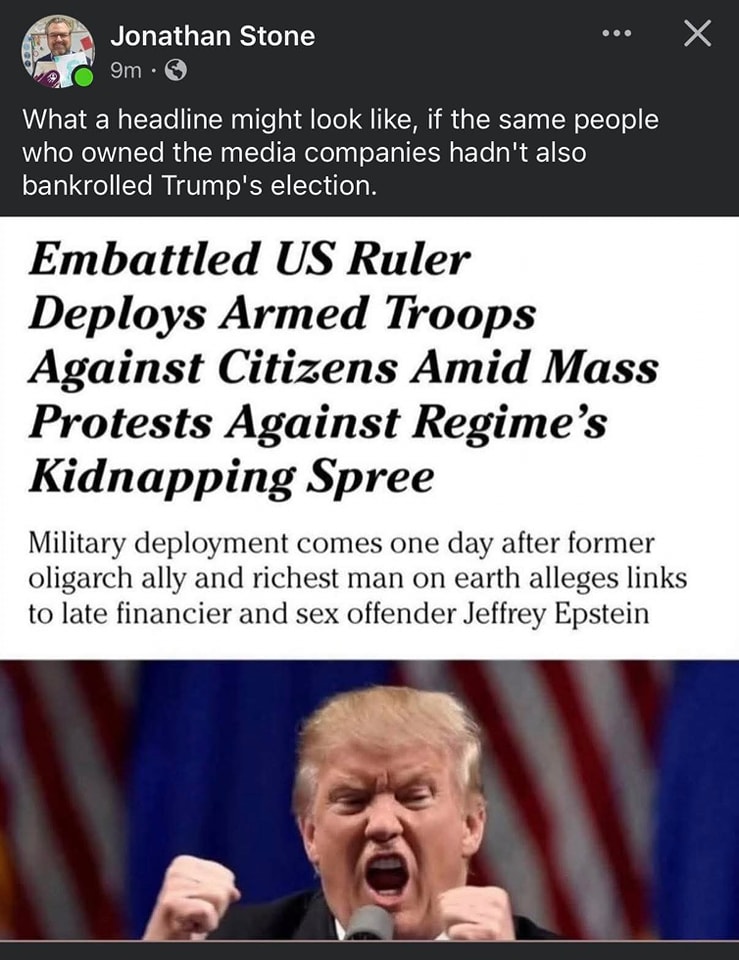
The image features a dramatically lit photograph of Donald Trump mid-scream, seemingly addressing a crowd. The intensity of his expression, combined with the angle and framing, emphasizes a sense of rage, dominance, and potentially tyrannical energy. The US flag draped around him adds a layer of irony, as it suggests a distortion of patriotic ideals. The overall impression is one of a figure out of control, wielding power aggressively. This is intentional: the visual is designed to evoke a visceral negative reaction, positioning Trump as a threat.
2. Foucauldian Genealogical Discourse Analysis
Michel Foucault's work on power, discourse, and genealogy is highly relevant here. The meme is dissecting the discourse around Trump’s rise.
- Genealogy of Power: Foucault’s genealogy traces the historical development of power structures. This meme implicitly argues that the power behind Trump isn't a recent phenomenon, but rather the result of historical accumulations of wealth and influence. The reference to Jeffrey Epstein is crucial: it attempts to link Trump to a network of power built on exploitation, blackmail, and abuse.
- Power/Knowledge: Foucault argued that power and knowledge are inextricably linked. The meme suggests that what we know (or don’t know) about Trump and his associates is carefully curated by those in power (the "oligarchs" who own media companies). The headline itself reconstructs a narrative that challenges the dominant discourse.
- Discipline & Biopolitics: The "deployment of armed troops against citizens" evokes Foucault’s concepts of discipline and biopolitics. It suggests a state increasingly willing to exercise control over the population through violence and surveillance – managing and regulating life itself.
3. Critical Theory
The meme operates firmly within the tradition of Critical Theory, specifically the Frankfurt School's critique of ideology and the culture industry.
- Ideology Critique: The meme challenges the ideology that supports the status quo – the idea that the political system is fair and democratic. It asserts that the system is rigged in favor of the wealthy and powerful.
- Culture Industry: The claim about media ownership is a direct critique of the "culture industry." The meme suggests that media outlets are not neutral arbiters of information, but tools used to manipulate public opinion and maintain existing power structures.
- Enlightenment Critique: Critical theorists (like Adorno and Horkheimer) argued that the Enlightenment's promise of reason and progress had been corrupted. This meme implies that the current situation is a regression – a return to authoritarianism disguised as democracy.
4. Marxist Conflict Theory
This meme resonates strongly with Marxist Conflict Theory.
- Class Struggle: The central conflict here is framed as a struggle between the ruling class (the "oligarchs") and the oppressed (the "citizens"). The deployment of troops is seen as a form of class repression – the state using violence to protect the interests of the wealthy.
- False Consciousness: The meme implies that many people are suffering from "false consciousness," being misled by the dominant ideology into accepting a system that is harmful to their interests.
- Capitalist Control: It suggests that the capitalist system inherently creates conditions that allow for the concentration of power and the emergence of authoritarianism. The financial support of Trump by wealthy individuals is presented as a direct consequence of capitalist dynamics.
5. Postmodernism
While not the primary framework, Postmodern elements are present.
- Deconstruction of Narratives: The hypothetical headline ("Embattled US Ruler Deploys Armed Troops…") deconstructs typical media narratives. It presents a starkly different account of events, challenging the “official” story.
- Skepticism Towards Grand Narratives: The meme implicitly rejects grand narratives of American exceptionalism or democratic progress, showing the US as susceptible to authoritarian tendencies.
6. Queer Feminist Intersectional Analysis
While not explicitly centered, the reference to Jeffrey Epstein and allegations of sex crimes opens up space for this perspective.
- Interlocking Systems of Oppression: The Epstein connection alludes to the ways in which power structures (wealth, politics, celebrity) are used to enable sexual abuse and exploitation. It points to the intersection of these systems.
- Patriarchy and Power: The abuse of power associated with Epstein is rooted in patriarchal structures that normalize the exploitation of marginalized bodies, particularly women and girls. (Note: this is an implied connection, and further investigation would be needed.)
In conclusion:
This meme is a complex and layered political statement. From an Anti-Fascist perspective, it's a call to recognize the systemic nature of authoritarianism, the role of wealth and media control in its rise, and the need for resistance. It draws on a range of critical theories to deconstruct dominant narratives and expose the underlying power dynamics at play. It's a piece designed to provoke thought, challenge assumptions, and mobilize action.
simple-description (llama3.2-vision_11b)
The meme is a satirical image that juxtaposes a news headline about a fictional event with a photo of Donald Trump, implying that the headline is a real news story about the former president. The text "Donald Trump's 'I Know More Than The Generals' Moment" appears above the image, and the image shows Trump with his hands on his hips and a confident expression. The meme is likely to be humorous and ironic, poking fun at Trump's reputation for being a self-proclaimed expert on military strategy.
detailed-analysis (gemma3-27b-vision)
Okay, let's break down this social media post, analyzing it through the requested theoretical lenses. It's complex, leaning heavily into conspiratorial rhetoric, so the analyses will reflect that.
Please note: These analyses are interpretations based on the image and text as presented. They aim to apply the theories, not necessarily to validate the claims within the post. The post itself appears to be strongly biased.
1. Visual Description
The post consists of a Facebook post by "Jonathan Stone" with an image and accompanying text.
- Image: The image depicts Donald Trump shouting into a microphone, seemingly during a rally or speech. He has a red face, clenched jaw, and open mouth, conveying anger and aggression. The lighting is dramatic, casting shadows and emphasizing his emotional state. The background appears to show a crowd, but the focus is entirely on Trump’s face.
- Text: The Facebook post proposes a counterfactual scenario: how a headline might look if media ownership hadn't supported Trump's election. Below this is the deliberately provocative headline: “Embattled US Ruler Deploys Armed Troops Against Citizens Amid Mass Protests Against Regime’s Kidnapping Spree”. It is followed by a line associating this event with “former oligarch ally and richest man on earth alleges links to late financier and sex offender Jeffrey Epstein." The language is highly charged and sensationalist.
2. Foucauldian Genealogical Discourse Analysis
This post offers rich material for a Foucauldian analysis.
- Discourse & Power: The post constructs a particular discourse about power and authority. It doesn’t present “facts” as much as it presents a narrative designed to incite fear and distrust. It presents Trump as a ruler (rather than an elected official), immediately invoking images of authoritarianism. The "kidnapping spree" is a particularly powerful example of framing that constructs a crisis.
- Genealogy & Historical Context: The linking of Trump to Jeffrey Epstein is crucial. This isn't simply about reporting a scandal; it's about constructing a genealogy of power. The post implies a hidden network of elites (oligarchs) engaged in illicit activities that underpin political power. The Epstein connection serves as a way to delegitimize Trump by associating him with historical acts of abuse and corruption.
- Truth & Power: The post suggests that the “true” story is being suppressed by media ownership. This is a claim about how power operates – those who control the narrative (media) control the truth. The counterfactual nature of the opening line is key—it admits that this is not reality, but a possibility, which implies the presented headlines are a veiled truth.
- Disciplinary Power: The framing of Trump as a "ruler deploying troops" invokes the idea of sovereign power (the power to take life and death).
3. Critical Theory (Frankfurt School)
This post can be analyzed through the lens of Critical Theory, which focuses on power structures and ideology.
- Ideology & Manipulation: The post presents a critique of the “system” - the media, political elites, and the hidden connections between them. It suggests that the public is being manipulated by a distorted narrative, manufactured by those in power. The framing is highly emotive, appealing to fear and outrage.
- Culture Industry: The post can be seen as a meta-commentary on the media itself. It suggests that the mainstream media is complicit in maintaining the status quo, and that alternative sources are necessary to uncover the “truth.”
- Instrumental Reason: The post implies a cynical view of power, where rational calculation is used to manipulate and control the population. The association with Epstein suggests a lack of ethical considerations in the pursuit of power.
- Loss of Autonomy: The suggestion that elections are manipulated by wealthy individuals and media owners indicates a loss of agency and autonomy for the citizenry.
4. Marxist Conflict Theory
From a Marxist perspective, the post reveals class conflict and the dynamics of power between the ruling class and the masses.
- Class Struggle: The post implies a struggle between the "oligarchs" (the ruling class) and the "citizens" (the proletariat). The deployment of troops against protestors is presented as an act of repression by the ruling class to maintain their dominance.
- Capitalist Control: The mention of media ownership suggests that capitalism allows wealthy individuals to control the narrative and manipulate public opinion.
- State as an Instrument of the Ruling Class: The deployment of troops is seen as evidence that the state acts in the interests of the ruling class, suppressing dissent and protecting their wealth and power.
- False Consciousness: The post suggests the mainstream media is part of the apparatus that creates "false consciousness," preventing the proletariat from recognizing their own exploitation.
5. Postmodernism
From a postmodern perspective, this post dismantles notions of objective truth and emphasizes the constructed nature of reality.
- Meta-Narrative & Deconstruction: The post explicitly challenges the “official” narrative about Trump's election and actions, suggesting that it’s a fabricated story constructed to serve certain interests. It deconstructs the idea of a neutral or objective media.
- Simulacra & Hyperreality: The counterfactual headline ("What if...") points towards a "hyperreality" where the line between reality and simulation becomes blurred. The post prioritizes the image of Trump as a ruler over the reality of his position.
- Relativism: The post implies that truth is relative and shaped by power dynamics. There is no single, objective truth, only competing narratives.
- Rejection of Grand Narratives: The post rejects the idea of a unifying or progressive narrative. It suggests that power operates in a fragmented and chaotic manner.
6. Queer Feminist Intersectional Analysis
This is the most difficult lens to apply directly, as the post does not explicitly address issues of gender, sexuality, or intersectionality. However, we can make some connections:
- Power & Domination: The post’s central theme of power and domination resonates with feminist analyses of patriarchal structures. The idea of a "ruler" deploying troops is inherently linked to patriarchal forms of authority. The framing suggests that power is enacted through violence and control.
- Epstein's Crimes & Gendered Violence: The linking of Trump to Jeffrey Epstein, a convicted sex offender, is crucial. Epstein’s crimes were acts of severe gendered violence. By associating Trump with Epstein, the post implies a complicity in these acts.
- Vulnerability & Marginalization: The image of "citizens" facing armed troops highlights the vulnerability of marginalized groups. Those most likely to be targeted by state repression are often those who are already marginalized based on race, class, gender, sexuality, or other factors.
- Disrupting the "Master Narrative": A queer feminist perspective would challenge the traditional "master narrative" of power, highlighting how power operates in multiple and intersecting ways. The post’s attempt to disrupt the “official” narrative can be seen as a form of resistance to dominant power structures.
Important Considerations: This post is strongly partisan and relies heavily on implication and conjecture. A critical analysis requires recognizing its inherent biases and avoiding the acceptance of its claims as facts.
simple-description (llama3.2-vision)
The meme features a screenshot of a news article with a headline that reads "Embattled US Ruler Deploys Armed Troops Against Citizens Amid Mass Protests Against Regime's Kidnapping Spree". The article appears to be satirical, using hyperbolic language to describe the US president's actions in response to protests. The image is accompanied by a comment that notes the similarity in language to a headline about a real-world authoritarian leader, implying that the US president's actions are similarly authoritarian. The meme is likely intended to be humorous or ironic, highlighting the perceived similarities between the US president's actions and those of a real-world authoritarian leader.