First Seen
2025-06-12T18:33:58.444035+00:00
detailed-analysis (gemma3_27b-it-q8_0)
Okay, let's break down this meme from an anti-fascist perspective, employing relevant theoretical frameworks where applicable.
Visual Description
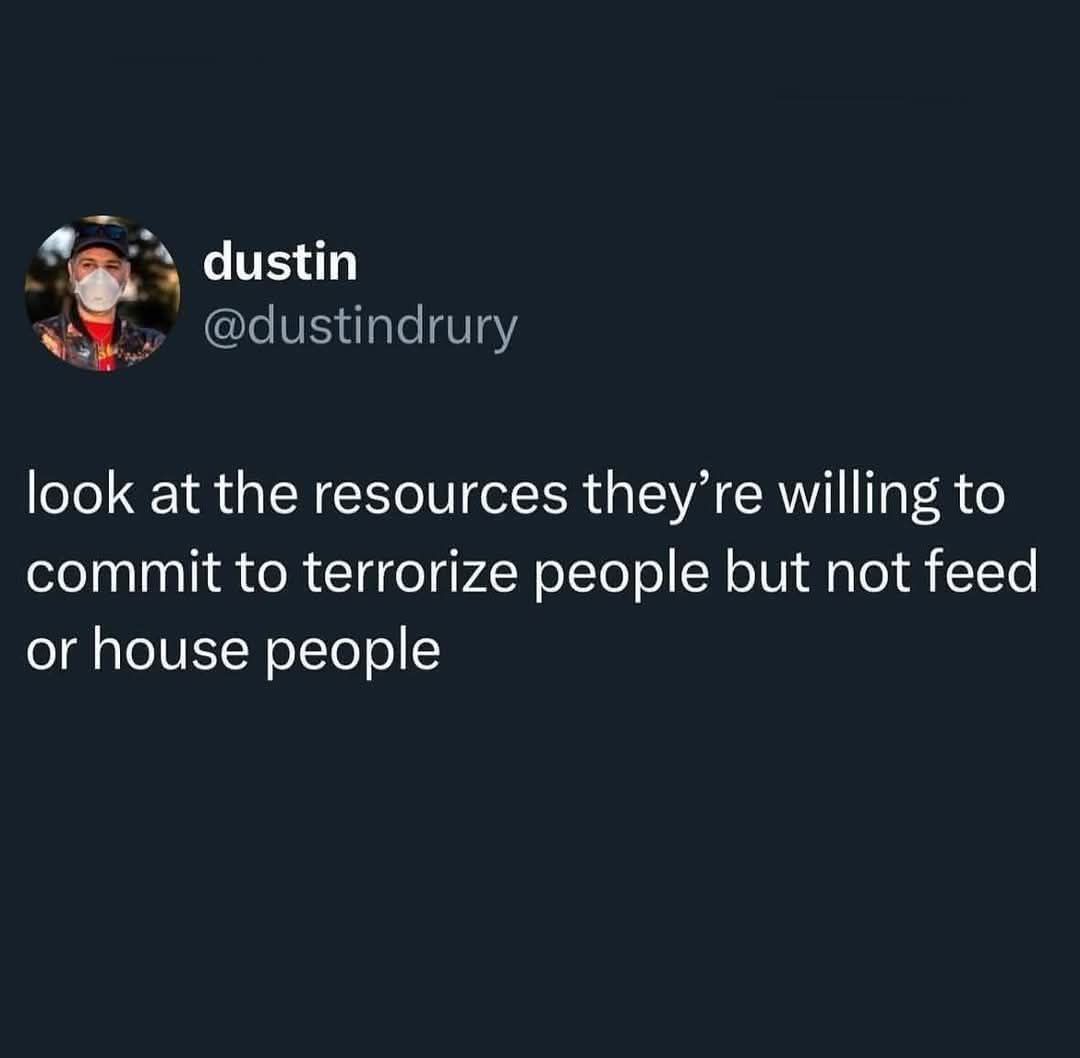
The image is a screenshot of a Twitter post by a user named Dustin Drury (@dustindrury). Dustin is wearing a bandana over their mouth and nose, potentially suggesting an activist context, or awareness of possible surveillance. The background is the standard dark blue of the Twitter interface. The primary content is the text of the tweet, which reads: "look at the resources they’re willing to commit to terrorize people but not to feed or house people."
Critical Theory
This meme sharply critiques the prioritization of control, repression, and violence over basic human needs—a cornerstone concern within Critical Theory. Critical Theory (drawing from the Frankfurt School) examines how power structures maintain themselves, often through ideological manipulation. This meme points to a dysfunction within the system; that is, immense resources are mobilized to maintain the status quo through fear and intimidation (terrorizing people), while fundamental needs (food, shelter) are deliberately neglected.
The meme speaks to the "instrumental reason" concept within Critical Theory. Instrumental reason is the application of rationality towards efficiency and control, regardless of ethical or humanistic concerns. The "they" referenced in the meme represent a power structure that operates under this logic. They are rational in their pursuit of control but devoid of ethical consideration for the well-being of the population. They efficiently use resources for suppression, but aren’t efficient in meeting basic needs.
Marxist Conflict Theory
From a Marxist perspective, this meme highlights the inherent contradictions within a capitalist system. Capitalism, in its pursuit of profit, often necessitates the creation of a surplus population – people who are dispossessed, unemployed, or marginalized. Maintaining this surplus population requires control and repression.
The meme illustrates the misallocation of resources under capitalism. Resources are directed towards the security forces (police, military, surveillance) to manage the consequences of systemic inequalities, instead of addressing those inequalities themselves. It highlights how the state, acting as a tool of the ruling class, invests in maintaining power structures (terrorizing) instead of fulfilling the basic needs of the proletariat (feeding/housing).
The "they" in the meme can be interpreted as the bourgeois class and the state apparatuses they control. It’s a critique of the ruling class prioritizing the preservation of their power through violence over the welfare of the working class.
Foucauldian Genealogical Discourse Analysis
Michel Foucault’s work on power and discourse is highly relevant. The meme suggests that the very discourse surrounding safety and security is used to justify the allocation of resources to repression. Foucault argued that power is not simply top-down, but is diffused throughout society and exercised through discourses that shape our understanding of the world.
The meme questions the normalized narrative of prioritizing “security” (terrorizing) over “care” (feeding/housing). By juxtaposing these two aspects, the meme deconstructs the discourse that legitimizes spending on repression. Foucault's concept of biopower – the way modern states regulate and control populations through managing life processes – is also at play. The state shows a perverse biopower: actively managing and controlling through harm (terrorizing) while failing to promote flourishing through basic provisions.
Anti-Fascist Interpretation: Core Argument
Within the anti-fascist framework, the meme is a direct condemnation of the structures that facilitate and enable fascist ideologies. Fascism inherently relies on violence, fear, and the suppression of dissent to maintain control. The meme powerfully exposes the material conditions that support this: the willingness to dedicate significant resources to harm and intimidate, while ignoring basic human needs.
The use of the word “terrorize” is not hyperbolic. Anti-fascists often use this term to describe the actions of white supremacist groups, far-right movements, and state-sponsored repression against marginalized communities. The meme is pointing out a consistent pattern: the prioritization of violence and control over human welfare, which is a characteristic of both historical and contemporary fascist movements.
In essence, the meme is a concise and potent critique of the political economy of oppression, framed within a distinctly anti-fascist viewpoint. It’s an argument that resources exist to care for people, but are strategically diverted to maintain a system of power through fear and coercion.
simple-description (llama3.2-vision_11b)
The meme is a commentary on the tendency of some individuals to claim they are fighting against fascism, but in reality, they are promoting fascist ideologies. The meme suggests that these individuals are not actually fighting against fascism, but rather are using the term to justify their own fascist behavior. The text on the image reads: "When you're a fascist but you want to seem anti-fascist".
detailed-analysis (gemma3-27b-vision)
Okay, here's an analysis of the provided Twitter post, broken down into relevant theoretical frameworks. I'll only include sections where the theory meaningfully applies.
Visual Description
The image is a screenshot of a Twitter post. A user with the handle @dustindrury is displayed. The profile picture is of a person wearing a bandana and a somewhat rough-looking outfit, appearing to be a self-portrait. Above the handle is the name "dustin." The post itself is text-based, appearing as a white, sans-serif font on a solid black background. The tweet reads: "look at the resources they're willing to commit to terrorize people but not feed or house people." The visual elements are minimal, focusing on the text and the user identification.
Critical Theory
This tweet is a strong example of a critical theory critique of power structures. It highlights a fundamental contradiction inherent in the allocation of resources within a system. The focus isn't simply on what resources are used, but how those resources are prioritized. The "they" in the tweet likely refers to institutions, governments, or those in positions of power, while the "people" refer to those subjected to those power structures.
The statement suggests a perverse imbalance – a willingness to invest heavily in domination and control ("terrorize") while simultaneously neglecting basic human needs ("feed or house"). This is a core concern of Critical Theory: to expose how power operates not just through overt force but also through the structuring of social, economic, and political systems that perpetuate inequality. The statement implicitly argues that this prioritization of terror over care is not accidental, but rather a deliberate (or at least structurally reinforced) aspect of how power functions.
Marxist Conflict Theory
From a Marxist perspective, this tweet articulates a central tenet of conflict theory: the inherent struggle between classes for limited resources. The “they” can be interpreted as the ruling class or the state, acting in the interests of capital. The resources invested in “terrorizing people” (police, military, surveillance) are tools for maintaining the status quo and suppressing dissent, thereby protecting the interests of the ruling class.
The contrast with the lack of resources devoted to “feeding or housing people” exposes the core contradiction of capitalism: an abundance of resources capable of meeting everyone’s basic needs, but a systemic prioritization of profit over human welfare. This isn't merely about a lack of funds, but about the intentional misallocation of resources to maintain a system built on exploitation and control. The tweet implicitly suggests that the "terror" serves to prevent challenges to the current economic order.
Queer Feminist Intersectional Analysis
While not the primary focus, the tweet can also be read through an intersectional lens. The populations most often subjected to “terror” (broadly defined as state violence, systemic discrimination, and social control) disproportionately include marginalized groups – people of color, LGBTQ+ individuals, disabled people, and the poor.
The denial of "feeding or housing" also falls disproportionately on these same groups, creating a layered experience of oppression. The tweet therefore highlights how systemic inequalities aren't separate issues, but interconnected and mutually reinforcing. The resources used for “terror” actively work to maintain these inequalities, while the lack of resources for basic needs exacerbates them. In essence, the lack of care is itself a form of violence, directed towards already vulnerable populations.
Let me know if you'd like me to elaborate on any of these points or explore other potential theoretical interpretations.
simple-description (llama3.2-vision)
The meme is a tweet from Twitter user @dustindrury (Dustin Drury) that reads: "look at the resources they're willing to commit to terrorize people but not feed or house people." The tweet is critical of people who have resources to commit to terrorizing others but not to provide basic needs like food and housing. The tweet is meant to be a commentary on how some people prioritize certain things over others.