First Seen
2025-06-08T19:49:29.470253+00:00
detailed-analysis (gemma3_27b-it-q8_0)
Okay, let's break down this meme from an Anti-Fascist perspective, utilizing the requested theoretical lenses where applicable. Given the context, the meme is deeply critical of Elon Musk, positioned as a figure increasingly isolated and experiencing the consequences of his political and business decisions.
Visual Description
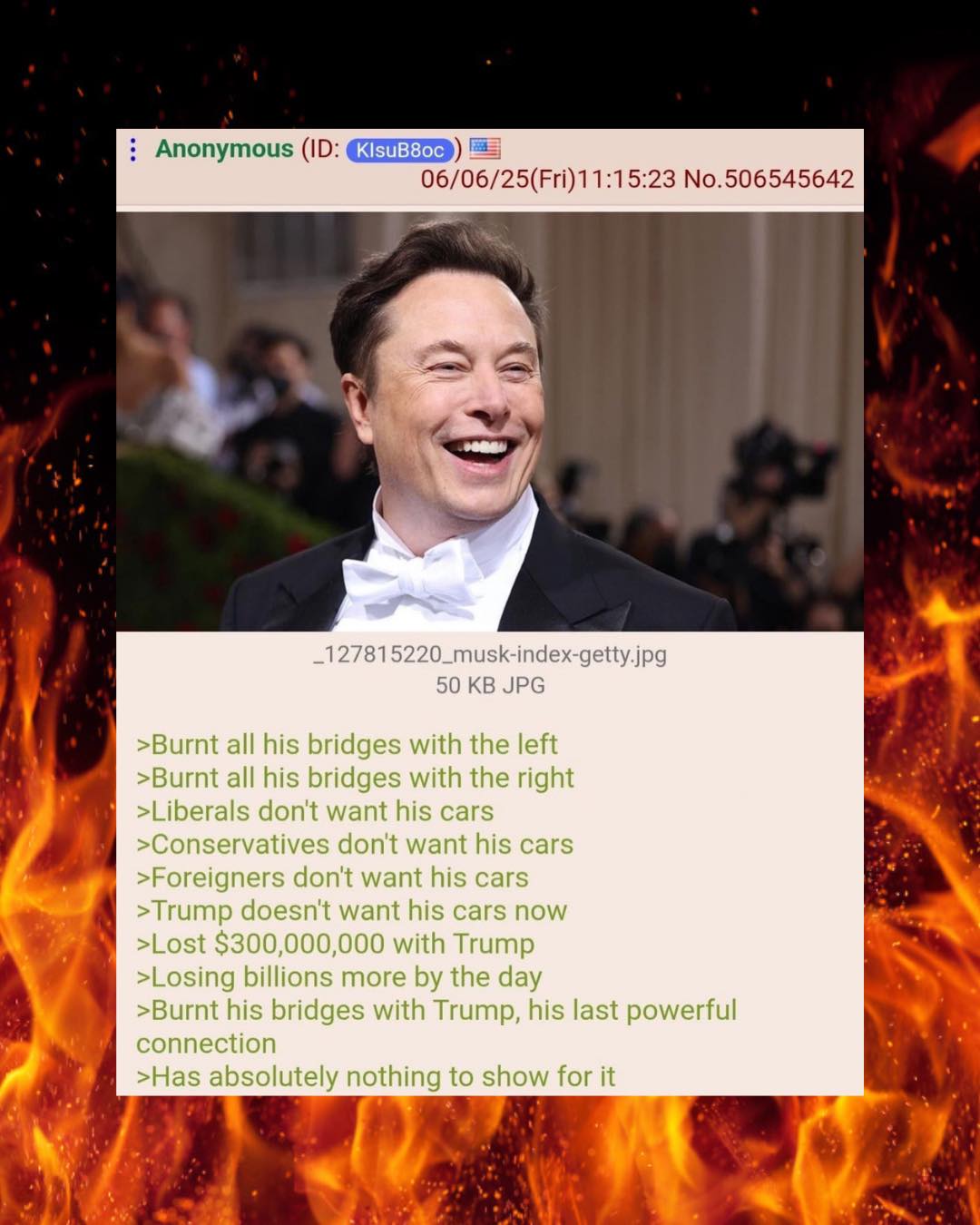
The image depicts Elon Musk, dressed in a tuxedo, seemingly addressing an audience. The backdrop, however, is not celebratory. Instead, it is engulfed in flames. The flames visually dominate the image and envelop Musk, signifying destruction, failure, and the loss of power. The positioning is deliberate; Musk is within the inferno, not observing it from afar, which suggests he's experiencing the fallout directly. The image evokes a sense of "everything is burning" – not literally, but metaphorically in terms of Musk’s reputation, influence, and financial status.
Critical Theory
From a Critical Theory perspective (particularly following the Frankfurt School), the meme is an example of demystification. Musk has been presented for years as a visionary, a technological savior, a 'genius' disruptor. This meme actively works to dismantle that carefully constructed image. It reveals, through a sardonic and pointed list, that his attempts to position himself as a powerful political player (primarily through his acquisition of Twitter/X and subsequent political pronouncements) have resulted in widespread alienation.
Musk’s wealth and status (key elements in constructing his ‘genius’ persona) are shown to be precarious. He's portrayed as having built his power on superficial narratives that are now crumbling. The meme argues he’s “absolutely nothing to show for it”, illustrating the hollowness of power built on ideology and the fleeting nature of capitalist success. It suggests the narrative of individual achievement and innovation (a core tenet of capitalist ideology) is crumbling, exposing the vulnerabilities and potential for failure inherent in the system.
Marxist Conflict Theory
The meme embodies core tenets of Marxist Conflict Theory. The escalating list illustrates a fundamental conflict: Musk (representing the capitalist class/bourgeoisie) is alienating all potential allies. This isn’t merely a political misstep; it’s a symptom of the inherent contradictions within capitalism.
- Class Antagonism: The meme hints at alienation across class lines – liberals, conservatives, even the wealthy (Trump) are now rejecting him. This challenges the idea of a unified ruling class.
- Crisis of Legitimacy: The “losing billions more by day” element highlights the instability of capital accumulation. The meme suggests his capital is vanishing, and with it, his power. The loss of legitimacy further underscores this instability.
- Ideological Struggle: The meme contests Musk’s manufactured authority. The list refutes the idea that Musk's actions represent a positive or productive force.
The fire in the image symbolizes the destruction of his capital and the collapse of his influence. The meme argues that his actions are leading to a crisis, and ultimately, his downfall.
Foucauldian Genealogical Discourse Analysis
From a Foucauldian perspective, the meme deconstructs the "discourse" surrounding Elon Musk. For years, a particular discourse (a system of knowledge, language, and power) was constructed around Musk – one of innovative genius, benevolent leader, and future-shaping visionary. The meme doesn't simply refute this discourse; it traces its genealogy – reveals how it was constructed, maintained, and now, is actively being dismantled.
The list of “burnt bridges” demonstrates how Musk’s power was contingent on maintaining certain relationships and narratives. By alienating these groups, he undermines the very foundations of his power. The meme exposes how power operates not through direct command, but through the complex interplay of discourse and social relations.
The fire itself can be interpreted as a dismantling of the discursive framework surrounding Musk. It signifies a shift in the power dynamics, a disruption of the narratives that once defined him.
Postmodernism
A postmodern reading would emphasize the deconstruction of grand narratives, particularly the narratives of progress and technological determinism often associated with figures like Musk. The meme rejects the idea that technology inherently leads to a better future, or that a single individual (Musk) can control that future.
The fragmentation of the list itself (a series of short, pointed statements) is characteristic of postmodern aesthetics. It rejects a cohesive, singular narrative in favor of a more fragmented and ironic portrayal.
The meme's reliance on humor and irony ("Conservatives don’t want his cars") is a typical postmodern strategy for undermining authority and challenging conventional norms.
Why Queer Feminist Intersectional Analysis isn't Directly Applicable Here
While intersectionality is vital in Anti-Fascist thought, it's less directly applicable to this specific meme. It's primarily focused on economic and political power dynamics, and the failures of a single male figure within that framework. While the critiques of Musk certainly have implications for broader social justice issues, the meme doesn’t explicitly address gender, sexuality, or the interlocking systems of oppression in a way that warrants a full queer feminist intersectional analysis. That doesn’t mean these considerations are irrelevant to critiquing Musk generally, just that they aren’t at the forefront of this particular meme's message.
In Conclusion:
From an Anti-Fascist standpoint, this meme serves as a potent critique of Elon Musk’s failed attempts to wield political power and reshape public discourse. It uses sharp wit and symbolic imagery to expose the precariousness of his wealth, the hollowness of his ideology, and his increasing isolation. It's a clear message: Musk’s pursuit of power has backfired, and his empire is crumbling.
simple-description (llama3.2-vision_11b)
The meme is a screenshot of a 4chan post from the Anti-Fascism category, where a user is expressing their frustration with Elon Musk's actions and policies. The text reads "Elon Musk is a fascist" and the user is complaining about Musk's involvement in the "fascist" movement. The post is a commentary on the current state of politics and the role of corporations in society.
detailed-analysis (gemma3-27b-vision)
Okay, here's an analysis of the image and its accompanying text, broken down by the requested theoretical frameworks. It's a complex set of elements, so each section will attempt to apply the lens appropriately.
Please note: This is a complex analysis, and interpretations can vary. These frameworks are lenses through which we can interpret the content, not necessarily definitive statements of "truth."
1. Visual Description
The image features a photograph of Elon Musk, smiling broadly and wearing a formal suit. He is positioned center-frame, likely on a stage or at an event. The lighting is warm and dramatic, suggesting a public appearance or media event. Flourescent lights are visable in the background. The image is framed by digital fire/flames on both sides, creating a sense of destruction, crisis, or intense negativity. The file name "_127815220_musk-index-getty.jpg" indicates the source as Getty Images, lending the image a certain degree of official or documentary status.
2. Foucauldian Genealogical Discourse Analysis
This image and its accompanying text can be analyzed through Foucault's lens by examining the discourses surrounding Elon Musk and the power/knowledge relationships embedded within them.
- Discourses: The text clearly participates in a discourse of failure and alienation. The repeated "doesn't want" statements build a narrative of Musk losing support across multiple ideological factions (left, right, conservatives, foreigners). This isn't a discussion of his actual technological achievements but a social and political assessment of his dwindling influence.
- Power/Knowledge: Historically, Musk’s power has stemmed from his position as a tech innovator and capitalist. His wealth and control of companies like Tesla and SpaceX have given him significant societal influence. The text challenges this power, framing him as someone who has squandered it through political missteps and financial losses. The claim of "losing billions" isn't just financial; it represents a loss of symbolic capital – the respect and admiration previously accorded to him.
- Genealogy: The digital fire surrounding the image can be interpreted as a genealogical tracing of the conditions of possibility for this narrative. The history of media representation, political polarization, and the rise of social media all contribute to the environment where a figure like Musk can experience such a swift decline in public approval. The image's online existence, framed by fire, suggests it's part of an online discourse, an evolution of the spread of ideas.
3. Critical Theory
Critical Theory, particularly that of the Frankfurt School, would focus on the underlying ideologies and power structures reflected in the image and text.
- Commodity Fetishism: Musk’s companies (cars, rockets) can be seen through this lens as commodities that have become fetishized, imbued with symbolic meaning beyond their material value. The text’s emphasis on “doesn’t want” suggests a rejection of this fetishized image, as people are no longer willing to participate in the ideology surrounding his brands.
- Culture Industry: Musk, as a public figure, is a product of the "culture industry," manufactured and promoted through media channels. This image is a counter-narrative to the positive PR that often surrounds him, revealing the constructed nature of his public image and highlighting his vulnerabilities.
- Reason and Domination: Musk’s pursuit of technological innovation could be seen as an example of “instrumental reason” – a form of rationality focused on efficiency and control. The text suggests that this pursuit has become alienated from broader social and political concerns, resulting in his loss of support.
4. Marxist Conflict Theory
From a Marxist perspective, the image and text demonstrate class conflict and the instability of capitalist power dynamics.
- Class Struggle: Musk represents the capitalist class, and the "doesn’t want" statements indicate a growing resistance to his wealth and influence. The rejection of his products isn't merely about consumer preferences; it's a form of symbolic resistance to the capitalist system he embodies.
- Alienation: Musk's loss of support reflects a broader alienation of the ruling class from the masses. His political missteps and financial losses are symptoms of a deeper crisis within the capitalist system. The digital fire can represent the burning of the status quo.
- False Consciousness: The initial adoration of Musk might have been a form of "false consciousness," where people were blinded by the allure of his wealth and innovation. The text suggests a growing awareness of the exploitative nature of capitalism and a rejection of its symbols.
5. Postmodernism
A postmodern reading would focus on the deconstruction of meaning, the blurring of boundaries, and the rejection of grand narratives.
- Simulacra and Simulation: Musk’s public image can be seen as a "simulacrum" – a copy without an original. The text challenges the authenticity of this image, exposing it as a constructed performance.
- Deconstruction: The text's repetitive "doesn’t want" statements deconstruct the traditional narrative of Musk as a successful and admired figure. It undermines his authority by revealing his lack of broad support.
- Fragmentation and Loss of Meaning: The fragmented nature of the text and the digital fire surrounding the image reflect a broader sense of fragmentation and loss of meaning in contemporary society. There is no coherent narrative, only a series of disconnected statements.
6. Queer Feminist Intersectional Analysis
Applying a Queer Feminist Intersectional lens is a bit more challenging given the direct lack of gender or sexual identity issues in the initial content. However, one could interpret it in the following ways:
- Disruption of the "Genius" Myth: The text challenges the idea of the "lone genius" (often associated with patriarchal narratives of innovation), exposing Musk as fallible and lacking universal appeal. This disrupts the dominant narrative of male success.
- Exposing Power Dynamics: The text demonstrates how power is constructed and maintained through systems of privilege. Musk's loss of support reveals the fragility of those systems and the potential for marginalized groups to challenge them.
- Critique of Capitalist Extraction: Musk's companies and his wealth represent a system of extraction that often relies on the exploitation of labor and resources, disproportionately affecting marginalized communities.
Important Note: These are just interpretations. The image and text are open to multiple readings, and the "correct" one depends on the specific theoretical framework used. This breakdown aims to demonstrate how different lenses can illuminate different aspects of the content.
simple-description (llama3.2-vision)
This meme is a screenshot of a post from an anonymous user on the imageboard 4chan. The post features a photo of Elon Musk with a caption that reads: "Burn all his bridges with the left, burn all his bridges with the right, liberals don't want his cars, conservatives don't want his cars, foreigners don't want his cars, Trump doesn't want his cars now, lost $300 million with Trump, losing billions more by the day, burning his bridges with Trump, his last powerful connection, has absolutely nothing to show for it." The post is meant to be humorous and satirical, poking fun at Musk's failed attempts to build a left-wing or right-wing brand, and his struggles to appeal to both sides of the political spectrum. The post is meant to be humorous and satirical, poking fun at Musk's failed attempts to build a left-wing or right-wing brand, and his struggles to appeal to both sides of the political spectrum. The post is meant to be humorous and satirical, poking fun at Musk's failed attempts to build a left-wing or right-wing brand, and his struggles to appeal to both sides of the political spectrum. The post is meant to be humorous and satirical, p.