First Seen
2025-06-09T17:00:15.555496+00:00
detailed-analysis (gemma3_27b-it-q8_0)
Okay, let's break down this meme from an Anti-Fascist perspective, utilizing relevant theoretical frameworks where appropriate.
Visual Description
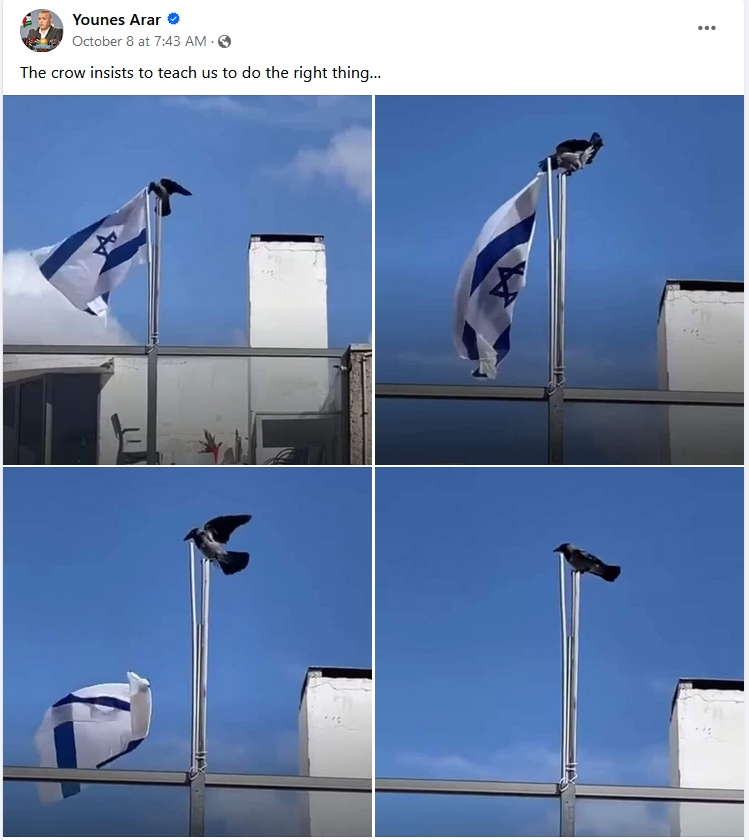
The image is a four-panel sequence showing a crow landing on a flagpole flying the flag of Israel. The first two panels show the flag waving normally. In the third panel, the crow lands on the flagpole, and the flag begins to droop. By the fourth panel, the crow is perched on the pole, and the flag is significantly lowered and almost touching the building behind it. The caption states, "The crow insists us to do the right thing."
Foucauldian Genealogical Discourse Analysis
From a Foucauldian perspective, the meme is interesting because it disrupts the established "discourse" surrounding national flags and the state they represent. The flag is a symbol of power, authority, and a particular historical narrative constructed by the state (in this case, Israel). The crow's action is an event that momentarily breaks that narrative, destabilizing the symbol's power.
Foucault would ask how the discourse around the Israeli flag has been constructed and maintained. This includes examining the historical narratives presented, the ways it’s used to inspire loyalty, and the mechanisms used to suppress dissenting views. The crow's act isn’t about inherent meaning; it’s about interrupting the flow of power and revealing the constructed nature of the symbol. It's a small disruption, but it reveals the flag as not being inherently sacred or inviolable. It points to the flag being a constructed signifier, vulnerable to challenge.
This connects to Anti-Fascism by recognizing that fascist and nationalistic ideologies often rely on powerful symbolic representations to maintain control. Disrupting those symbols, even in seemingly minor ways, is a tactic to undermine their authority.
Critical Theory
Critical Theory, particularly the Frankfurt School's focus on ideology, is highly relevant here. The Israeli flag, from this perspective, functions as an ideological tool. It represents a specific worldview, a set of power relations, and often, a justification for particular actions (e.g., occupation, expansion).
The crow’s act can be interpreted as a symbolic rejection of this ideology. It's a rejection of the reification of the nation-state – the treatment of it as a concrete, natural entity, rather than a social and political construct.
Anti-Fascists see a connection between nationalism and fascism. They would argue the flag is not merely a benign symbol of national identity but can be co-opted by right-wing and fascist movements to promote exclusion, discrimination, and violence. The crow’s “insistence” (as the caption frames it) on bringing the flag down represents a challenge to this ideological dominance. It points to the necessity of critically examining the underlying power structures embedded within national symbols.
Marxist Conflict Theory
Within a Marxist framework, the flag represents the interests of the ruling class – in this case, the Israeli state and the dominant groups within it. The crow’s action, while seemingly symbolic, represents a potential disruption of that power dynamic.
The image could be seen as an allegory for class struggle. The flag embodies the power structure, while the crow (often associated with scavenging and independence) represents a force challenging that structure. It suggests a resistance, albeit a small one, against the forces of oppression.
This interpretation aligns with Anti-Fascism's view that fascism is rooted in economic and political inequalities. By challenging the symbols of the state, the crow is implicitly challenging the system that perpetuates those inequalities.
Postmodernism
A postmodern reading would highlight the ambiguity and deconstruction of meaning within the image. The crow isn't necessarily enacting a grand political statement; it's simply a crow doing what crows do. However, the interpretation of that action – given the context of the flag and the caption – is where meaning is created.
Postmodernism would challenge the notion of a single, definitive reading of the image. It would recognize the role of the viewer in constructing meaning, and the power of the meme to circulate and be re-interpreted in different ways.
In relation to Anti-Fascism, postmodernism acknowledges that fascist ideologies often rely on simplistic narratives and rigid interpretations of symbols. Challenging these narratives and embracing ambiguity is a way to undermine the coherence of the fascist worldview.
In summary:
From an Anti-Fascist standpoint, this meme is a powerful, albeit subtly provocative, image. It leverages the symbolism of a national flag to suggest resistance, challenge ideology, and disrupt power structures. The image doesn’t offer a concrete political program, but it functions as a visual expression of dissent and a call to action—to "do the right thing," which, within an Anti-Fascist context, implies actively opposing oppression and fighting for a more just world. The layers of theoretical interpretation deepen the meme's resonance within that category.
Disclaimer: Interpretations of memes are subjective and can vary based on individual perspectives and contextual understanding. This analysis is based on the information provided and the stated category context.
simple-description (llama3.2-vision_11b)
This meme uses a picture of a crow perched on a flagpole, with the Israeli flag in the background, to poke fun at the idea that the crow is "teaching" the flag to fly properly. The text above the image reads, "The crow insists to teach us to do the right thing." The meme is likely referencing the Israeli-Palestinian conflict and the idea that the crow is trying to teach the flag (representing Israel) to fly properly, implying that the country is struggling to achieve peace.
detailed-analysis (gemma3-27b-vision)
Here's an analysis of the image and its accompanying text, broken down into relevant theoretical frameworks. It's important to note that these frameworks often overlap and inform one another.
Visual Description
The image is a four-panel collage of photographs taken against a clear, bright blue sky. The central focus is a flagpole topped with the flag of Israel. A crow is perched on the flagpole, progressively lower across the four panels. It appears to be actively dismantling or pulling at the flag. The background shows a portion of a building, with what looks like ventilation or exhaust units on the roof. The framing focuses attention on the interaction between the crow and the flag, making it the dominant visual narrative. The composition is stark – flag, crow, sky – minimizing distractions and emphasizing symbolic contrast.
Foucauldian Genealogical Discourse Analysis
This image offers rich material for a Foucauldian analysis. The flag is a powerful symbol, imbued with a discourse of national identity, belonging, and authority. The crow's act of deconstruction challenges that discourse, disrupting the seemingly natural, authoritative presentation of the Israeli nation-state.
A genealogical approach would examine how the meaning of the Israeli flag has been constructed over time. It’s not an inherent, fixed meaning; rather, it is produced through historical power relations, political struggles, and ideological formations. The crow's actions can be read as a challenge to that constructed meaning, exposing its contingency and challenging the accepted narratives surrounding it.
The image then isn't simply about a bird and a flag; it's about the power dynamics embedded in symbolism and the possibility of disrupting established power structures through acts of deconstruction. The text, "The crow insists to teach us to do the right thing," frames the crow as an agent of correction, implying that the established order represented by the flag is wrong.
Critical Theory
From a critical theory perspective, this image can be understood as a critique of power, ideology, and domination. The Israeli flag, as a national symbol, represents the state’s power and its claims to legitimacy. The crow's actions can be interpreted as a rejection of that power.
The image functions as a visual allegory for resistance. It evokes themes of challenging authority, dismantling oppressive structures, and reclaiming agency. The text further emphasizes this reading, suggesting a moral imperative to reject the status quo.
Critical theorists would also focus on the context in which the image is shared. The fact that it was posted online, and likely shared within certain networks, suggests a deliberate attempt to circulate a dissenting message and mobilize resistance.
Marxist Conflict Theory
Within a Marxist framework, the image can be seen as an expression of class struggle, albeit in symbolic form. The flag represents the interests of the ruling class and the state apparatus, which serves to maintain the existing social order.
The crow, acting as a disruptive force, embodies the potential for resistance from those who are marginalized or oppressed. Its act of dismantling the flag can be interpreted as a rejection of the dominant ideology and a demand for social change.
The text, "The crow insists to teach us to do the right thing," implies that the existing order is inherently unjust and that a different, more equitable social structure is necessary. The “right thing” is likely a challenge to the existing power dynamics and the demand for liberation.
Postmodernism
From a postmodern perspective, the image challenges the notion of fixed meaning and grand narratives. The Israeli flag, traditionally presented as a symbol of national unity and identity, is destabilized by the crow's actions. The crow's deconstruction of the flag disrupts the idea of a coherent, unified national narrative.
The image embraces ambiguity and multiplicity. It doesn't offer a clear or straightforward message; instead, it invites multiple interpretations and encourages viewers to question the assumptions underlying national symbolism.
The text further reinforces this postmodern sensibility by presenting the crow as an unconventional teacher, suggesting that knowledge and truth are not necessarily found in traditional authorities or established institutions.
It’s worth noting that the context surrounding the image – the date of posting, the account posting it, the likely audience – would provide additional layers of interpretation.
simple-description (llama3.2-vision)
The meme features a series of images depicting a crow perched atop an Israeli flag, with the bird appearing to be defecating on the flag. The caption reads, "The crow insists to teach us to do the right thing...". The meme is likely intended to be humorous and satirical, poking fun at the idea that even a bird can be more responsible and moral than some people. The use of a crow, a symbol of mischief and trouble, adds to the comedic effect.