First Seen
2025-06-13T19:49:26.264077+00:00
detailed-analysis (gemma3_27b-it-q8_0)
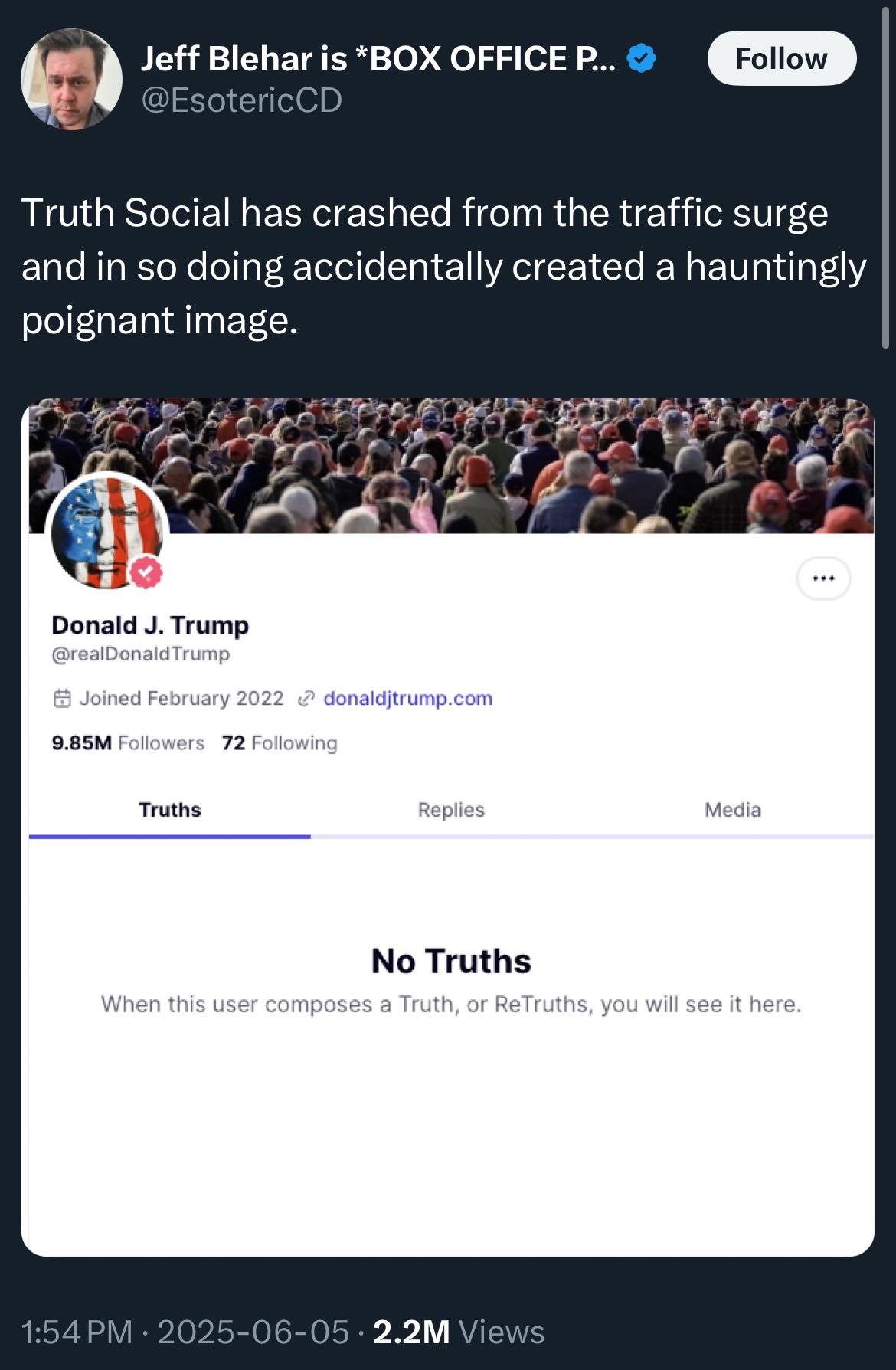
Okay, let's break down this meme through the lens of Anti-Fascism, addressing the relevant theoretical frameworks. It's a complex image that touches on several layers of meaning, especially given the context of the platform it originates from.
Visual Description
The image depicts a densely packed crowd of people, seemingly at a rally or event. They are all facing towards the same direction, appearing to focus on something out of frame (likely a speaker). The visual immediately calls to mind images of historical fascist rallies – Nuremberg rallies, Mussolini's gatherings, etc. The sheer uniformity of the crowd's direction, the mass of bodies, and the (implied) charismatic leader directing their attention evoke a sense of collective fervor and potential for manipulation. The low resolution/quality of the image adds to a feeling of distorted reality or even a sort of “digital decay” mirroring the decaying political landscape the image references.
Foucauldian Genealogical Discourse Analysis
From a Foucauldian perspective, this meme is incredibly potent. Michel Foucault’s work centers on how power operates through discourse - systems of thought and language. The image isn't simply of a crowd, but embodies a discourse of power.
- Genealogy of Fascism: Foucault advocated for genealogical analysis which aims to trace the historical construction of ideas and practices. The image intentionally draws on the historical genealogy of fascist rallies. It taps into a pre-existing visual vocabulary associated with authoritarianism. The deliberate evocation of those historical images reveals how fascist aesthetics and strategies persist even in seemingly new contexts.
- Disciplinary Power: The way the crowd is oriented suggests a form of disciplinary power – a shaping of individuals through surveillance (the implied focal point they’re all looking at), normalization, and examination. Trump’s Truth Social platform itself attempts to function as a space where narratives are controlled and dissent is discouraged. The platform’s structure aims to discipline thought and behavior.
- Truth Regimes: The platform’s name “Truth Social” and the "Truths" tab is a blatant attempt to establish a specific “truth regime.” This is a Foucauldian concept – the system of rules, practices, and institutions that determine what counts as “truth” within a particular society. By labeling content as “Truths,” the platform seeks to create an alternative reality and legitimize its own ideological claims.
Critical Theory
Critical Theory, stemming from the Frankfurt School, examines how power structures are reinforced and legitimized through culture. This meme resonates strongly with Critical Theory.
- Culture Industry: The platform, Truth Social, can be understood as part of a "culture industry" that produces and distributes ideologies that maintain the status quo. Even the collapse of the platform can be interpreted as a spectacle designed to generate attention and reinforce a sense of victimhood among its users.
- The Authoritarian Personality: The image, by invoking historical fascist gatherings, implicitly references the psychological research on the “authoritarian personality.” This research explored the personality traits that make individuals susceptible to fascist ideologies (e.g., submission to authority, aggression towards outgroups). The meme suggests that such personality types are being mobilized and cultivated within the platform’s user base.
- Instrumental Reason: Critical Theory highlights the dangers of “instrumental reason” – a form of rationality focused solely on efficiency and control, devoid of ethical considerations. The platform’s functionality, its reliance on algorithms and data collection, can be seen as an example of instrumental reason applied to political manipulation.
Marxist Conflict Theory
While not the most prominent angle, Marxist Conflict Theory provides some insights.
- Class Struggle: The image can be seen as a manifestation of the ongoing class struggle, albeit a distorted one. The platform caters to a specific segment of the population (largely, but not exclusively, working-class and lower-middle-class individuals) who feel alienated and disempowered. It exploits their grievances to promote a reactionary ideology that ultimately serves the interests of the ruling class.
- Ideology as False Consciousness: The “Truths” presented on the platform can be analyzed as a form of “false consciousness” – beliefs that obscure the true nature of class relations and prevent the oppressed from recognizing their own exploitation.
Postmodernism
Postmodernism can provide some nuanced understanding, particularly its focus on the breakdown of grand narratives and the instability of meaning.
- Simulacra and Simulation: (Jean Baudrillard) The image, and the platform itself, can be seen as operating in the realm of “simulacra and simulation.” The “truth” presented on Truth Social is not based on reality, but on representations of representations, creating a hyperreal environment disconnected from the material world. The image's deliberate evocation of past imagery makes it a simulation of a simulation.
- Deconstruction of Truth: The platform's naming and its "Truths" tag actively work to deconstruct the concept of objective truth. It creates a relativistic environment where “truth” is whatever is asserted by those in power.
- The Spectacle: (Guy Debord) The collapse of the platform, and the attention it garnered, can be viewed as a spectacle – a mediated image that distracts from underlying social and political problems. The focus on the platform’s technical failures serves to divert attention from the more fundamental issues of political polarization and the spread of misinformation.
Overall Anti-Fascist Interpretation:
From an Anti-Fascist perspective, this meme is a powerful indictment of the persistent threat of fascism and the ways in which it manifests in the digital age. It's not just about a website crashing; it's about the underlying ideologies and power structures that the platform embodies. It highlights the importance of recognizing and resisting the tactics of manipulation, disinformation, and the normalization of authoritarian aesthetics. The "hauntingly poignant" nature of the image, as the original tweeter notes, stems from the chilling recognition of history repeating itself.
Important Note: This analysis is based on the visual and contextual information provided. A deeper dive might involve examining the platform's algorithms, user demographics, and the specific content shared by its users to gain a more comprehensive understanding.
simple-description (llama3.2-vision_11b)
The meme is a screenshot of a Twitter account that has been suspended, with a message from the platform stating "Account suspended for violating our rules". The account in question is that of former US President Donald Trump, who has been banned from multiple social media platforms for violating their policies on hate speech and misinformation. The meme is likely being shared to highlight the irony of a "free speech" advocate being suspended from a platform that values free speech.
detailed-analysis (gemma3-27b-vision)
Okay, here's a breakdown of the image and associated text using the requested theoretical lenses. Please note that applying these theories can be complex and open to interpretation; this is one possible reading.
Visual Description
The image is a screenshot of Donald Trump’s profile on his social media platform, Truth Social. The platform appears to be experiencing technical difficulties, indicated by a message stating “No Truths” are available, suggesting the feed is empty or crashed. The backdrop of the profile is a crowded space filled with people, presumably attendees at a rally. The overall visual impression is one of overload and a failure to deliver content within a platform that seemingly promises "truth." The color scheme is largely red, white, and blue, evocative of American patriotism and potentially suggesting a deliberate branding strategy.
Foucauldian Genealogical Discourse Analysis
This image offers fertile ground for a Foucauldian analysis, particularly focusing on the construction of “truth” itself.
- Discourse and Power: The platform's name, “Truth Social,” immediately establishes a discourse around "truth." This isn’t presented as an objective reality but as a constructed concept. The platform attempts to define truth, and by controlling its circulation, wield power. The crash signifies a failure of this power, a breakdown in the apparatus designed to disseminate this constructed truth.
- Genealogy of Truth: Examining the genealogy of "truth" in the context of Trump's political career reveals a consistent pattern of framing narratives as “true” based on subjective assertions and appeals to emotion rather than factual accuracy. This platform is an attempt to create a controlled genealogy, solidifying a specific version of events and reinforcing a particular worldview.
- Panopticism and Surveillance: While not immediately obvious, the platform’s very structure, as a social media network, implies a form of digital panopticism, where users are potentially monitored and their data collected, thus contributing to power dynamics. The crash disrupts this surveillance apparatus.
Critical Theory
From a critical theory perspective, the image is symptomatic of the broader societal issues of manufactured consent, ideology, and the manipulation of information.
- Culture Industry: Truth Social can be viewed as a component of a larger culture industry, aimed at producing and distributing ideologies that reinforce existing power structures. The platform is not merely a neutral tool for communication, but a system designed to shape public opinion.
- Ideology and False Consciousness: The promise of “truth” is a rhetorical device designed to conceal the platform’s ideological agenda. The crash highlights the fragility of this ideological project. It potentially allows for a moment of reflection on the constructed nature of "truth" and the power structures that underpin it.
- Commodification of Truth: The platform attempts to commodify truth by associating it with a brand (Trump’s persona) and creating a space where users are encouraged to consume and share a particular narrative.
Marxist Conflict Theory
From a Marxist perspective, the image underscores the struggle for control over the means of communication and the narrative.
- Class Struggle: The platform’s appeal to a particular demographic (often characterized by socio-economic anxieties and cultural grievances) can be seen as a manifestation of class struggle. It attempts to mobilize a base of support and consolidate power.
- Hegemony: The platform represents an attempt to establish or reinforce a hegemonic worldview – a dominant ideology that is presented as natural or inevitable. The crash potentially weakens this hegemonic grip.
- Control of Information: The ability to control the flow of information is a crucial element of power. The platform is a tool for shaping public opinion and promoting a specific agenda. The crash disrupts this control.
Postmodernism
The image encapsulates several key tenets of postmodern thought.
- Deconstruction of Truth: The platform’s crash can be interpreted as a deconstruction of the very notion of “truth.” It highlights the instability and contingency of meaning.
- Simulation and Hyperreality: The platform can be seen as contributing to a hyperreal environment where simulations of reality replace authentic experience. The crash momentarily breaks this illusion.
- Fragmentation and Instability: The crash underscores the fragmentation and instability of the digital landscape. It suggests that truth is not a fixed or objective entity but a constantly shifting and negotiated construct.
Queer Feminist Intersectional Analysis
While not immediately apparent, a queer feminist intersectional lens can reveal hidden power dynamics.
- Silencing & Erasure: The platform’s ideological bent often marginalizes or silences the voices of marginalized groups, including LGBTQ+ individuals, women, and people of color. The crash, in a paradoxical way, temporarily levels the playing field by removing the platform’s ability to amplify dominant narratives.
- Control of Narrative & Representation: The platform attempts to control the representation of identity and experiences. This can contribute to harmful stereotypes and reinforce oppressive power structures.
- Intersectional Power Dynamics: The platform's appeal is often rooted in a specific intersection of identities (e.g., white, heterosexual, working-class men) that are privileged within the existing power structure. The crash disrupts this dominance, albeit temporarily.
Disclaimer: These are just interpretations, and other readings are possible. The beauty of theoretical analysis lies in its ability to reveal multiple layers of meaning and complexity.
simple-description (llama3.2-vision)
This meme is about a Twitter account named "Truth Social" that has experienced a traffic surge, but in a negative way. The account's owner, former US President Donald Trump, has crashed the site with a massive influx of new users, creating a "hauntingly poignant" image of a social media platform struggling to keep up with demand. The account's description is simply "No Truths," which is meant to be ironic given the site's name. The tweet is from Jeff Blehar, who is a Box Office Pro reporter. The tweet states: "Truth Social has crashed from the traffic surge and in so doing has created a hauntingly poignant image."