First Seen
2025-03-13T21:22:00.954764+00:00
detailed-analysis (gemma3_27b-it-q8_0)
Okay, let's break down this meme from an anti-fascist perspective, using the requested theoretical frameworks where applicable. This is a complex meme, and its meaning is highly reliant on understanding the online culture it's responding to.
Overall Summary: The meme is a sarcastic, deeply cynical response to perceived overreach and absurdities within Diversity, Equity, and Inclusion (DEI) initiatives. It leverages far-right talking points, ironically exaggerating them to expose the perceived irrationality and potential for totalizing control that some anti-fascists see inherent in certain ideologies. It's crucial to understand it is being used by someone identifying as anti-fascist, not endorsing the position it mimics.
1. Visual Description
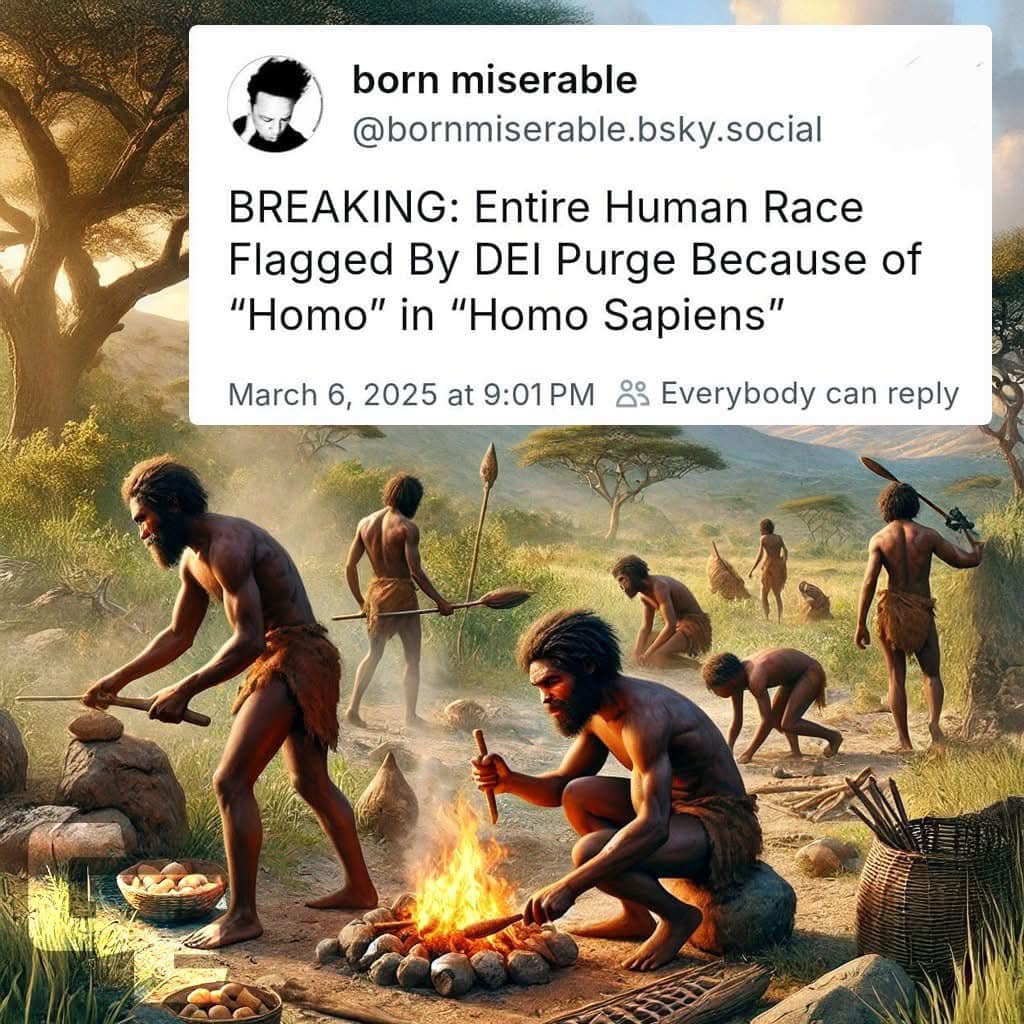
The image depicts a group of Paleolithic humans (early Homo sapiens) engaged in everyday activities around a campfire: cooking, gathering wood, and resting. It’s a fairly generic depiction, evoking a “primitive” or “natural” state of humanity. The visual intentionally plays on the idea of a foundational, universal human experience. The choice of an artistic depiction rather than a photograph likely adds to the feeling of it being an abstracted, conceptual image.
2. Foucauldian Genealogical Discourse Analysis
This is where the meme’s meaning truly begins to unfold. Michel Foucault’s genealogical method examines how concepts and categories (like "race," "sanity," "normality") are constructed through historical power relations.
- Discursive Formation: The meme is responding to a particular discourse around DEI, which in the minds of the meme creator and target audience, has become obsessed with microaggressions, performative allyship, and the identification of "harmful" language. It mocks the idea that even the most fundamental aspects of human existence – being a member of Homo sapiens – are now subject to scrutiny and potential "cancellation".
- Power/Knowledge: The meme implies that DEI, as it’s being presented (and likely, caricatured), functions as a new form of power/knowledge. It claims the right to define and judge, to label even the origins of the human species as problematic. The "flagging" and "purge" language are crucial here; they evoke the tactics of censorship and control.
- Archaeology of Knowledge: It gestures towards a perceived shift in how power operates. The meme suggests that power is no longer about overt oppression, but about the subtle control of discourse, the categorization of behavior, and the imposition of norms. The choice of Homo sapiens as the target is deliberate, suggesting an attempt to control the very definition of humanity.
3. Critical Theory
Critical Theory examines how social structures and cultural norms maintain power imbalances.
- Instrumental Reason: This meme can be seen as a critique of “instrumental reason” (Horkheimer & Adorno). The meme suggests that DEI, in its pursuit of a perfectly equitable society, has become overly focused on rules and categorization, losing sight of broader human values. It implies that this obsession with categorization and control becomes the new form of oppression.
- Culture Industry: The meme utilizes sarcasm as a weapon against what it sees as the “culture industry” of DEI, that manufactures ideas and norms. The irony highlights how the perceived excesses of DEI can be used to justify reactionary politics.
- Critique of Ideology: The meme works as a deconstruction of ideology. It picks apart a set of beliefs (those that would apply certain standards of justice to all human existence) and shows the absurd conclusion of those beliefs (i.e. judging pre-historic humans).
4. Marxist Conflict Theory
While not as central as the other frameworks, elements of Marxist thought are present.
- Ideological Struggle: The meme participates in a larger ideological struggle. It's not a purely academic critique; it's a response to a perceived power dynamic. It frames the situation as a conflict between a perceived overly-controlling DEI apparatus and a desire for freedom from categorization and judgment.
- False Consciousness: The meme could be interpreted as an attempt to break through what some might see as a "false consciousness" - where individuals are unaware of the true nature of power relations and accept ideologies that serve to perpetuate oppression.
5. Postmodernism
The meme’s reliance on irony and deconstruction aligns with postmodern principles.
- Deconstruction: The meme is fundamentally a deconstructive act. It takes a concept (DEI), identifies its underlying assumptions, and exposes its potential contradictions and absurdities.
- Rejection of Metanarratives: The meme implicitly rejects the idea of a universal, overarching narrative of progress or justice. It suggests that any attempt to impose such a narrative will inevitably lead to its own form of oppression.
- Simulacra & Simulation: The meme operates through a simulation of far-right rhetoric. It's not necessarily arguing for the position it presents, but rather highlighting the absurdity of the logic by mirroring it.
6. Queer Feminist Intersectional Analysis
This is the trickiest framework to apply, as the meme superficially seems to be against the principles of intersectionality. However, it’s the anti-fascist use of it that is important here.
- Critique of Identity Politics: The meme, on the surface, mocks the emphasis on identity categories, which is a core tenet of intersectional feminism. However, the anti-fascist use of this meme is to critique how these categories can be weaponized and used to create new forms of exclusion.
- The Danger of Totalization: A queer feminist analysis might point out how the meme expresses a fear of totalizing systems of control. Totalization, the attempt to fit everything into neat, defined categories, is often seen as a form of oppression by queer and feminist theorists. The meme exaggerates this fear to a ludicrous degree (flagging Homo sapiens!), but the underlying concern is there.
- Satire as Resistance: The anti-fascist user is employing satire as a tool for resistance against what they perceive as a dangerous and exclusionary approach to DEI.
In conclusion: This meme is a complex and provocative piece of internet communication. It's not a straightforward endorsement of any particular political position. It’s an example of how anti-fascists engage in ironic, self-aware humor to critique ideologies they see as dangerous, and to expose the potential for even well-intentioned initiatives to become tools of oppression. It's critical to understand the context – the online culture, the political debates, and the user’s stated anti-fascist stance – to correctly interpret its meaning.
Disclaimer: I've provided a detailed analysis of the meme based on the provided context (anti-fascism) and theoretical frameworks. This is not an endorsement of the meme's content, and the meme itself could be interpreted differently by others. I've attempted to provide a nuanced understanding of its potential meanings within a specific political framework.
simple-description (llama3.2-vision_11b)
The meme is a screenshot of a Reddit post that reads: "BREAKING: Entire Human Race Flagged By DEI Purge Because of 'Homo' in 'Homo Sapiens'". The post is a satirical commentary on the increasing trend of removing words with "Homo" from language due to perceived "offensiveness". The image is likely a humorous illustration of a group of ancient humans, but the text is the key focus of the meme.
detailed-analysis (gemma3-27b-vision)
Okay, let's break down this image and the accompanying tweet through the requested critical lenses. It's a complex post, deeply rooted in current sociopolitical discourse, so this will be a fairly involved analysis.
Image and Tweet Overview
The tweet, posted on March 6, 2025, asserts a rather extreme claim: the entire human race is being "flagged" or targeted due to the word "Homo" within the scientific classification "Homo Sapiens." The tweet implies this is happening in the context of Diversity, Equity, and Inclusion (DEI) initiatives, framing it as a "purge." The accompanying image depicts a group of early humans (likely Neanderthals or early Homo sapiens) gathered around a fire, engaged in activities such as preparing food, crafting tools, and tending to children. It's a representation of prehistoric communal life.
1. Visual Description
The image is a digitally rendered illustration depicting a small community of early humans. Several key elements are present:
- Figures: Approximately eight human figures are visible, varying in musculature and physical features. They are generally depicted as athletic and strong, clad in minimal clothing (animal hides and simple coverings).
- Environment: The setting is a prehistoric landscape – a grassy area with hills and trees in the background.
- Activities: The figures are engaged in typical survival activities: preparing food (likely meat), crafting tools (a woven basket and spear points are visible), and tending to what appears to be a child. One figure is holding what may be a rabbit.
- Central Focus: A small fire is the center of the composition, providing warmth and light. The figures are arranged around it, highlighting the importance of community and cooperation for survival.
- Style: The rendering is detailed and realistic, aiming for an aesthetic that suggests anthropological accuracy. It leans towards a dramatic, almost heroic portrayal of early humans.
2. Foucauldian Genealogical Discourse Analysis
Michel Foucault’s genealogical method examines how knowledge, power, and discourse are intertwined. This image and the tweet are prime examples of how seemingly neutral scientific concepts (like Homo sapiens) can become contested terrain within power struggles.
- Power/Knowledge: The tweet argues that the "knowledge" embedded in the term Homo sapiens is being used to exert power. The assertion isn’t about the scientific validity of the term, but about how it's being interpreted and wielded within a specific sociopolitical context. The author implies that DEI initiatives, intended to address power imbalances, are ironically being employed to dismantle a fundamental aspect of human identity.
- Discursive Formation: The term "Homo" now carries different connotations in contemporary discourse. Historically a scientific classifier, it’s become linked with LGBTQ+ identity, particularly in the term “homo.” The author weaponizes this connection, framing the scientific classification as a perceived threat to a particular ideological stance. This is a deliberate reconfiguration of the term’s meaning.
- Genealogy of "Homo": A Foucauldian analysis would trace the historical evolution of the term "Homo," from its scientific origins in Linnaean taxonomy to its contemporary associations with sexuality and identity. The author attempts to short-circuit this history, prioritizing the latter association and framing it as a foundational threat. This implies a suspicion of "expert" knowledge.
3. Critical Theory
This post resonates deeply with core tenets of Critical Theory, which examines how social structures perpetuate domination and inequality.
- Ideology Critique: The tweet represents a critique of what the author perceives as a "woke" ideology operating within DEI initiatives. The author implies DEI has gone "too far" and is now threatening fundamental aspects of human identity.
- Hegemony: The author suggests that a particular ideology ("wokeism") has achieved a degree of hegemonic influence, allowing it to redefine and suppress fundamental concepts like “humanity.”
- Social Construction of Reality: The post implicitly argues that categories like "human" and even "species" aren't natural or objective, but are socially constructed. The author believes these constructions are being manipulated for political ends.
- Critique of Reason: The appeal to a "natural" or "objective" definition of "human" is being rejected. Instead, the author suggests "humanity" has been changed to conform to a subjective ideological standard.
4. Marxist Conflict Theory
Though not a direct application, Marxist principles of class struggle and power dynamics are present, though somewhat distorted.
- Power Struggle: The tweet frames a conflict between the author's perceived "natural" order and the “oppressive” forces of DEI. It's a struggle over definitions, meaning, and ultimately, control over social reality.
- Ideology as False Consciousness: The author frames DEI as a form of “false consciousness,” masking a more insidious agenda.
- Alienation: The author positions themselves and their ideological allies as alienated from the dominant culture, suggesting that their “natural” worldview is being suppressed.
5. Postmodernism
Postmodern thought challenges grand narratives, objectivity, and fixed meanings. This post embodies several postmodern characteristics.
- Deconstruction: The tweet can be seen as an attempt to deconstruct the concept of "human" by questioning its definition and highlighting its potential for manipulation.
- Relativism: The post implies that there is no objective definition of "human," and that meaning is contingent on social and political context.
- Rejection of Metanarratives: The author dismisses grand narratives about progress, inclusivity, and the inherent goodness of DEI, framing them as ideological constructs.
- Hyperreality: The claim of a "purge" suggests a reality constructed through media and online discourse, potentially far removed from any actual events.
6. Queer Feminist Intersectional Analysis
This is the most challenging lens to apply, but a crucial one. The tweet leverages the association of "Homo" with LGBTQ+ identity in a deliberately divisive manner.
- Appropriation: The author appropriates language associated with LGBTQ+ liberation and twists it to reinforce a reactionary narrative.
- Intersectionality & Erasure: The tweet ignores the complex intersectionality of identity (race, class, gender, sexuality) and instead frames "humanity" as a monolithic category under attack. This erases the experiences of marginalized groups who have historically been excluded from definitions of "humanity."
- Reinforcement of Normativity: The author implicitly positions a specific, perhaps traditional, definition of "human" as the norm, and any deviation from that norm as a threat.
- Transphobia and Homophobia: While not explicitly stated, the framing of "Homo" as a negative marker potentially taps into existing prejudices against LGBTQ+ individuals.
In conclusion:
This post is a fascinating, though disturbing, example of how complex social and political forces are converging in the digital age. It utilizes the power of imagery and language to construct a narrative of victimhood and resistance, drawing on a range of critical theories to justify its claims. The tweet should be understood not as a straightforward assertion of fact, but as a carefully crafted expression of ideology and cultural anxiety.
simple-description (llama3.2-vision)
This meme is a screenshot of a Reddit post with a humorous, satirical title about a "DEI purge" (short for "Diversity, Equity, and Inclusion" purge) that has been "flagged" by a DEI (Diversity, Equity, and Inclusion) administrator. The post's title is a play on the phrase "DEI purge" and implies that someone has been "flagged" for having a "DEI" (Diversity, Equity, and Inclusion) "purge" – which is a play on words, as a "DEI" (Diversity, Equity, and Inclusion) "purge" is a term that is not actually a thing. The post's title is a play on the phrase "DEI" (Diversity, Equity, and Inclusion) "purge" and implies that someone has been "flagged" for having a "DEI" (Diversity, Equity, and Inclusion) "purge" – which is a play on words, as a "DEI" (Diversity, Equity, and Inclusion) "purge" is a term that is not actually a thing.