First Seen
2025-01-22T03:14:43.040567+00:00
detailed-analysis (gemma3_27b-it-q8_0)
Okay, let's break down this image and the context provided through the lenses of various critical theories, especially prioritizing those relevant to the stated category of "Anti-Fascism."
Please note: This is a sensitive image referencing a historical act of political violence. The analysis aims to understand the symbolic intent within a theoretical framework, not to endorse the act itself. The use of violence, even symbolically, is a complex and often problematic issue.
---
Visual Description
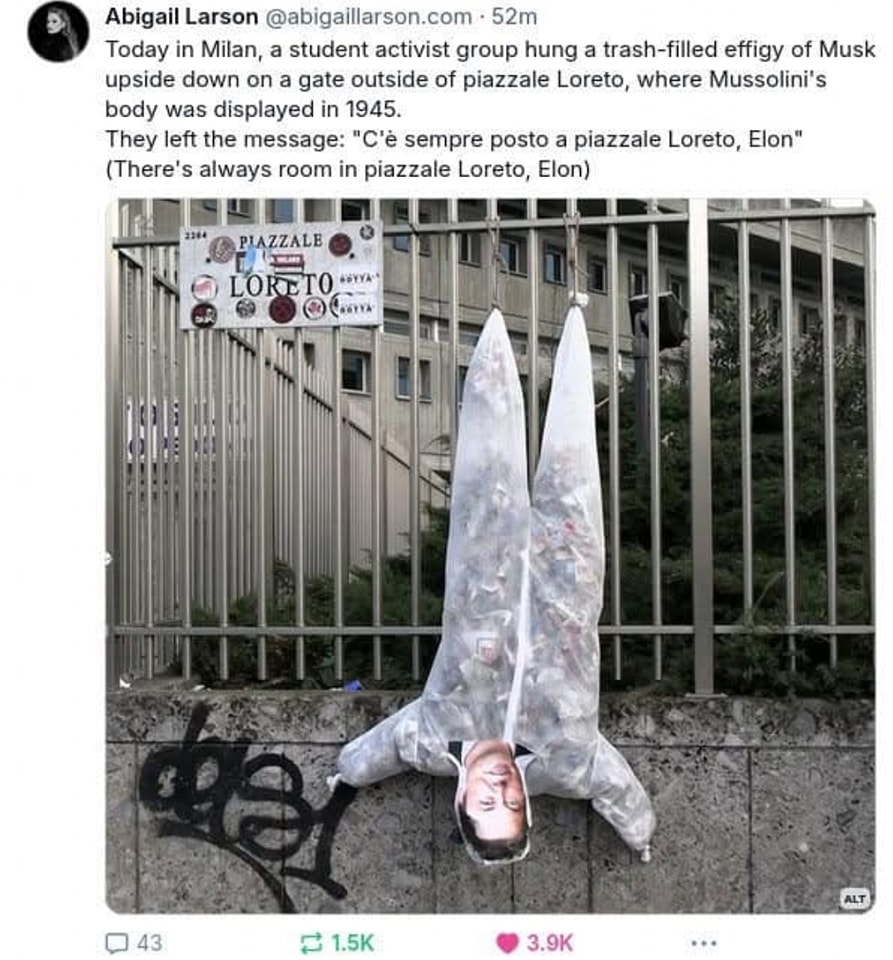
The image depicts an effigy of Elon Musk hanging upside down from a gate. The "body" of the effigy is constructed from what appears to be plastic waste – bottles, containers, etc. – encased in a transparent plastic covering. A photograph of Musk’s face is attached at the “head” of the effigy. The location is identified as outside Piazzale Loreto in Milan, Italy. A sign reading "Piazzale Loreto" is visible in the background. Graffiti can also be seen on the ground. The lighting suggests an overcast day. The immediate surrounding environment appears to be urban, with a building in the background.
Historical Context is Crucial: Piazzale Loreto is a profoundly significant location in Italian history. After the capture and execution of Benito Mussolini and several of his ministers in 1945, their bodies were publicly displayed there, hanging upside down, as a symbol of the defeat of Fascism and the retribution for their crimes. This historical act is the core reference point for the image.
---
Foucauldian Genealogical Discourse Analysis
Michel Foucault’s work on power, knowledge, and discourse provides a strong analytical framework here.
- Discourse of Fascism: The placement of the effigy in Piazzale Loreto deliberately activates a specific historical discourse—the discourse of anti-Fascist resistance and the downfall of Mussolini. It recalls the symbolic violence used against the Fascist regime, framing Musk within that same discourse.
- Genealogy of Power: Foucault’s genealogical method traces the historical emergence of concepts and power relations. The act isn't simply an isolated event but a continuation of a lineage of resistance and the deployment of symbolic violence to challenge authority. The action attempts to delegitimize Musk by associating him with a defeated, reviled ideology.
- Power/Knowledge: The action utilizes the knowledge of the historical significance of Piazzale Loreto to exert power—to condemn Musk and his actions. The message ("C'è sempre posto a piazzale Loreto, Elon") directly connects Musk to the fate of Mussolini, utilizing a historically charged statement.
- Subjectivation: The act attempts to position Musk as an object of public scorn and judgement, and position the activist group as agents of resistance.
---
Critical Theory
Critical Theory, particularly informed by the Frankfurt School, focuses on uncovering power structures and challenging dominant ideologies.
- Critique of Technological Capitalism: Musk is often seen as a key figure in contemporary technological capitalism. The effigy, constructed from waste, can be read as a critique of the environmental consequences of unchecked capitalist production and consumption, as well as the exploitative labor practices often associated with the tech industry.
- Culture Industry & Symbolic Violence: The image represents a form of counter-cultural intervention against the overwhelming influence of the "culture industry" (Adorno & Horkheimer). It’s an attempt to disrupt the dominant narratives surrounding Musk and his companies. The act itself can be considered symbolic violence – a demonstration of power through a potent, unsettling image.
- The Authoritarian Tendencies of Tech: Increasingly, tech billionaires are viewed as wielding immense political and economic power, raising concerns about the potential for new forms of authoritarian control. The effigy draws a direct line between this contemporary power and historical fascism, suggesting a continuity in authoritarian impulses.
---
Marxist Conflict Theory
From a Marxist perspective, this action can be interpreted as a manifestation of class struggle.
- Capitalist Elite as Modern-Day Bourgeoisie: Musk embodies the extreme wealth and power of the modern capitalist elite. The effigy can be understood as a symbolic attack on that class.
- Alienation & Exploitation: The use of trash to construct the effigy speaks to the broader themes of alienation and exploitation inherent in capitalist production. The waste is a byproduct of the system that Musk profits from.
- Revolutionary Sentiment: While not explicitly calling for revolution, the image demonstrates a level of discontent and a willingness to confront power directly. It reflects a potential for radical action spurred by economic inequality and perceived injustice.
---
Postmodernism
A postmodern lens would focus on the breakdown of grand narratives and the destabilization of meaning.
- Simulacra & Simulation: The effigy itself is a simulacrum – a copy without an original. It’s a representation of Musk, but also a representation of the historical act of displaying Mussolini. This blurring of reality and representation is a key element of postmodern thought.
- Deconstruction of Authority: The image deconstructs the aura of power surrounding Musk by associating him with a figure widely considered a villain. It challenges the legitimacy of his authority.
- Multiple Interpretations: Postmodernism embraces ambiguity and multiple interpretations. The image is open to various readings, reflecting the fragmented nature of contemporary reality.
---
In conclusion:
The image of Musk’s effigy in Piazzale Loreto is a complex and politically charged act. Through the lens of Anti-Fascism, it is a deliberate invocation of historical resistance and a condemnation of perceived authoritarian tendencies. It’s a layered statement encompassing critiques of capitalism, technological power, and the potential for new forms of oppression. Its power lies in its historical resonance and its ability to connect contemporary concerns with the legacies of the past. The fact that the text is in Italian further underscores the importance of the location and historical context.
Disclaimer: This analysis is based on the information provided and general theoretical frameworks. Interpretations can vary.
simple-description (llama3.2-vision_11b)
This meme is a satirical commentary on the Italian government's response to the COVID-19 pandemic, particularly the use of the "I Tramonti" law, which allows the government to impose restrictions on citizens' freedom. The image shows a person hanging upside down from a street sign, with a sign that reads "I Tramonti" in the background. The text in the image reads "I Tramonti" and "I Tramonti" again, with the latter being a reference to the law's name.
detailed-analysis (gemma3-27b-vision)
Here's an analysis of the image and the tweet, broken down into sections as requested. It's important to note that applying these theoretical lenses is often interpretative, and overlaps between them exist.
Visual Description
The image depicts a life-sized effigy of Elon Musk hanging upside down from a gate. The effigy is crudely constructed, appearing to be filled with trash or other stuffing, and is covered in a patterned fabric (possibly a camouflage pattern). The head is a realistic mask of Elon Musk, creating a disturbing juxtaposition.
The scene is set in Milan, Italy, specifically outside of Piazzale Loreto. The gate is a dark metal fence. A street sign clearly displays “Piazzale Loreto.” The background includes a paved street and buildings. A smudged, dark word, possibly “Dal” can be seen on the ground near the base of the effigy. The lighting is natural, suggesting an outdoor, daytime setting. The overall aesthetic is provocative and deliberately shocking.
Foucauldian Genealogical Discourse Analysis
This action, and the image itself, can be seen as a disruption of dominant discourses about power, wealth, and technological authority.
- Discourse & Power/Knowledge: The image actively intervenes in the discourse surrounding Elon Musk. Musk is often presented as a visionary, a technological innovator, and a powerful figure. This act intentionally redefines him as an object of scorn and protest. It’s not merely a protest against his actions, but against the very construction of his public persona.
- Genealogy: The choice of Piazzale Loreto is critical. This location is historically significant as the site where the bodies of Benito Mussolini and several of his associates were displayed after their execution in 1945. By replicating this display with an effigy of Elon Musk, the activists are drawing a historical parallel, suggesting a perceived similarity in the forms of power and authority they represent. The genealogy reveals how images of public execution and display have been used to signify the termination of power throughout history.
- Power Relations: The act itself is a performance of power—not power over Musk directly, but power to challenge his symbolic authority and disrupt the narratives that sustain it. It’s a performance of resistance, aiming to destabilize existing power relations by showcasing Musk as an object of public scorn, akin to a defeated dictator.
Critical Theory
The image and accompanying text operate as a form of critique, aligning with tenets of the Frankfurt School and thinkers like Adorno and Horkheimer.
- Culture Industry Critique: Elon Musk, as a public figure, is heavily mediated and promoted through the "culture industry" (media, marketing, etc.). This action attempts to puncture that manufactured image. It's a rejection of the spectacle and the superficiality of celebrity culture.
- Instrumental Reason: Critical theorists argue that modern rationality has become "instrumental"—focused solely on efficiency and control, rather than ethical considerations. Musk, often associated with technological advancement, can be seen as embodying this logic. The protest implicitly critiques the unchecked pursuit of innovation without regard for social or ethical consequences.
- Domination and Control: The hanging effigy, and the reference to the historical display of bodies, suggests a critique of systems of domination and control. It implicitly raises questions about the power dynamics inherent in technological capitalism, where a small number of individuals (like Musk) wield immense influence.
Marxist Conflict Theory
From a Marxist perspective, the image can be interpreted as a manifestation of class conflict and a challenge to capitalist power structures.
- Class Struggle: Musk represents the apex of wealth and power in a capitalist system. This protest can be seen as an expression of anger and resentment from those who experience the inequalities generated by capitalism. The act symbolically "removes" Musk from the position of power he occupies.
- Ideology & False Consciousness: The dominant narrative surrounding Musk often emphasizes his achievements and portrays him as a benevolent innovator. This protest attempts to expose what Marxists would see as the "false consciousness" created by capitalist ideology. It aims to reveal the underlying exploitation and social harm potentially masked by this positive image.
- Alienation: The protest could also be interpreted as a response to the alienation experienced by many in a capitalist system. Musk, as a symbol of the system, becomes the target of this alienation.
Postmodernism
The image can be analyzed through a postmodern lens by examining its play with meaning, representation, and historical references.
- Simulation & Hyperreality: The effigy is a simulation—a copy without an original—which highlights the constructed nature of reality in the postmodern era. The image blurs the lines between reality and representation.
- Pastiche & Intertextuality: The act of hanging the effigy in Piazzale Loreto is a form of pastiche—combining elements from different historical contexts. It’s an intertextual reference to the historical display of Mussolini's body, creating a new meaning through the juxtaposition of these two events.
- Deconstruction: The act can be seen as a deconstruction of Musk's public persona. By presenting him in a degraded and humiliating manner, the activists are challenging the dominant narratives that construct his identity.
Queer Feminist Intersectional Analysis
While not immediately obvious, a queer feminist intersectional analysis can be applied, focusing on power dynamics, representation, and the disruption of traditional hierarchies.
- Disrupting the Phallus/Power Structures: The image, by symbolically "taking down" a highly visible, powerful male figure, can be read as a disruption of patriarchal power structures. While Musk's gender isn't the central focus, the act of symbolically dethroning a figure embodying wealth and authority resonates with feminist critiques of power imbalances.
- Symbolic Violence & Representation: The visual representation of the effigy—hanging upside down and defiled—can be seen as a form of symbolic violence, challenging the traditional reverence often afforded to powerful figures. This disruption of representation can be empowering for marginalized groups.
- Intersectional Considerations: The reasons for the protest may be rooted in concerns about the social impacts of Musk’s companies on marginalized communities or his views on social justice issues. These broader concerns, interwoven with his position of power, form the basis for an intersectional interpretation of the protest.
Important Disclaimer: These interpretations are subjective and open to debate. The effectiveness and meaning of the protest are complex and depend on individual perspectives and cultural context.
simple-description (llama3.2-vision)
The meme is a photo of a person's head and body covered in trash, hanging upside down from a gate. The image is meant to be humorous and satirical, with the person's head and body covered in trash and the text "C'è sempre posto a piazzale Loreto, Elon" (There's always room in Piazza Loreto, Elon) above it. The image is a play on the famous Italian phrase "C'è sempre posto in Piazza…", but with a humorous and satirical twist.