First Seen
2024-11-15T20:05:24.770849+00:00
detailed-analysis (gemma3_27b-it-q8_0)
Okay, let's break down this meme through the lens of Anti-Fascism, employing the relevant theoretical frameworks as applicable.
Visual Description
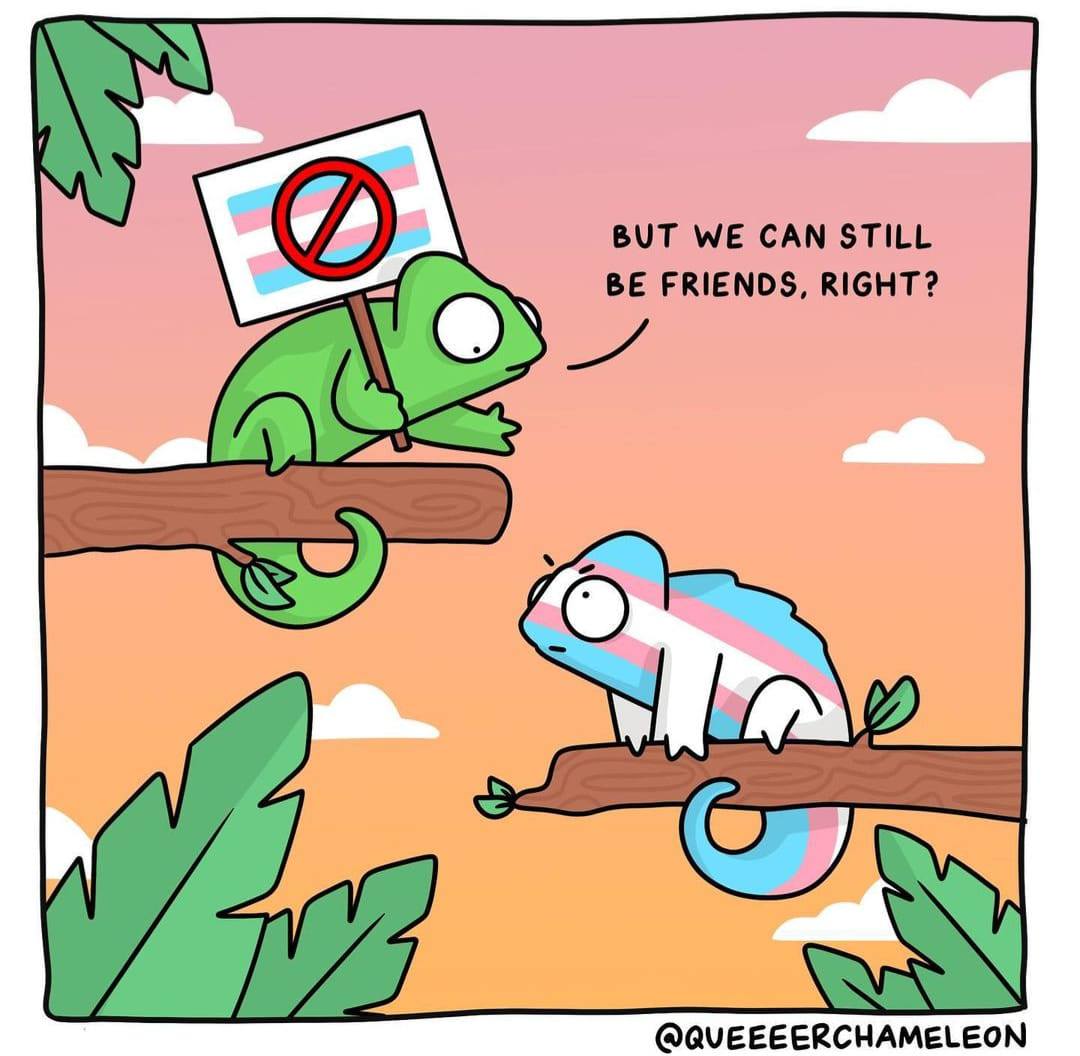
The image depicts two chameleons on a branch. The chameleon on the left is green and holding a flag with a transgender pride flag design crossed out with a red circle and slash (a symbol indicating prohibition). This chameleon asks, “But we can still be friends, right?” The chameleon on the right is displaying the colors of the transgender pride flag across its body. It appears to be somewhat recoiling, seemingly uncomfortable or distressed. The background is foliage and the artist's signature @QueeerChameleon is at the bottom.
Queer Feminist Intersectional Analysis
This is the most potent framework for analyzing this meme. At its core, the meme is a stark illustration of the fascist tactic of conditional acceptance—the demand for assimilation and the inherent violence of exclusion.
- Intersectionality: The meme directly addresses the intersection of gender identity (transgender) and political ideology (fascism). The green chameleon attempts to separate "friendship" from acceptance of transgender identity. This is exactly how oppressive ideologies work – trying to compartmentalize rights and personhood. It’s not simply about opposing transgender rights; it's about framing that opposition as separate from personal relationships, thereby justifying prejudice and discrimination within existing social bonds.
- Queer Theory & Deconstruction of Normativity: Queer theory challenges the fixed and binary categorizations of gender and sexuality. The meme exposes the underlying assumption that being transgender is somehow a political position that needs to be "tolerated" rather than simply a fact of existence. The demand for "friendship" contingent on denying or suppressing transgender identity underscores the attempt to enforce cisnormative expectations.
- Feminist Analysis: Fascism historically and consistently targets marginalized groups, including women and queer individuals, to enforce a patriarchal and heteronormative social order. The meme highlights the way that anti-trans sentiment is often intertwined with broader misogynistic and patriarchal structures. It's a tactic to reassert traditional gender roles and hierarchies.
- Violence of “Tolerance”: The seemingly innocent question ("But we can still be friends, right?") is a form of gaslighting. It normalizes the imposition of conditions on someone's existence. The implication is that to maintain the relationship, the trans chameleon must compromise their identity or tolerate bigotry. This is a subtle but insidious form of violence.
Foucauldian Genealogical Discourse Analysis
- Power/Knowledge: Michel Foucault's work emphasizes that power operates not simply through repression, but through the production of knowledge. The green chameleon's act of banning the trans flag isn’t merely an expression of opinion; it's an attempt to define what is considered "acceptable" knowledge about gender. By invalidating the trans identity, the chameleon is asserting a particular power dynamic – namely, the right to determine what is considered normal and valid.
- Discourse & Normalization: The meme exposes how discourses around "tolerance" and "respect" are often used to normalize discriminatory practices. The chameleon’s question attempts to create a discourse where anti-trans sentiment is framed as a matter of personal preference, rather than a form of oppression. This normalizes the idea that it’s okay to have conditions for accepting someone’s identity.
- Genealogy of Anti-Trans Sentiment: A Foucauldian genealogical approach would examine the historical emergence of anti-trans sentiment. It would trace how ideas about gender roles, biological essentialism, and the “naturalness” of heterosexuality have been constructed over time to justify discrimination against transgender people.
Marxist Conflict Theory
While less central than the queer feminist analysis, Marxist conflict theory provides a supporting framework:
- Ideology & False Consciousness: The meme can be seen as a representation of a hegemonic ideology – the dominant beliefs and values that serve the interests of the ruling class. The green chameleon is internalizing and reproducing an ideology that perpetuates the oppression of transgender people. The question about friendship reveals a "false consciousness," a lack of awareness of how power structures shape individual beliefs.
- Divide and Conquer: Fascism frequently employs a "divide and conquer" strategy to weaken opposition movements. By attempting to isolate the trans chameleon through conditional acceptance, the green chameleon is attempting to disrupt potential solidarity and maintain the existing power structure.
- Material Conditions: Underlying the ideological conflict is the material reality of inequality. Transgender individuals often face discrimination in areas like employment, housing, and healthcare, contributing to their economic and social marginalization. The meme, while focusing on the interpersonal level, implicitly points to these wider systemic issues.
Postmodernism
- Deconstruction of Binary Oppositions: Postmodernism challenges binary oppositions like “friend/enemy” and “acceptance/rejection.” The meme highlights the instability of these categories. The green chameleon’s question assumes that friendship and acceptance are mutually exclusive, when in reality, they can and should coexist.
- The Social Construction of Reality: The meme implicitly acknowledges that notions of gender and identity are socially constructed, not inherent or natural. The green chameleon’s attempt to control the expression of transgender identity underscores the arbitrary nature of these constructions.
Anti-Fascism - Overall
From an Anti-Fascist perspective, the meme isn't simply a humorous observation about a disagreement. It's a clear articulation of a fascist tactic – the attempt to control and erase marginalized identities while offering a superficial facade of acceptance. It’s a warning about the danger of conditional support and the necessity of unwavering solidarity with oppressed groups. The meme powerfully illustrates how seemingly innocuous questions can be deeply harmful and contribute to a broader system of oppression. The creator (@QueeerChameleon) is making visible the insidious nature of bigotry and challenging viewers to recognize and resist it.
Let me know if you would like me to expand on any of these points or explore additional angles!
simple-description (llama3.2-vision_11b)
The meme is a play on the popular phrase "can you smell what the rock is cooking?" but replaces "rock" with "trans rights". The image likely features a cartoon of a lizard (representing the "rock") holding a sign with the trans pride flag, while another lizard (representing the "trans rights") is shown in the background with a confused expression. The text "Can you smell what the trans rights is cooking?" is written above the lizard holding the sign, poking fun at the classic WWE phrase.
detailed-analysis (gemma3-27b-vision)
Okay, let's break down this image with the requested theoretical lenses.
Visual Description
The image is a colorful cartoon depicting two chameleons on a brown branch against a warm, sunset-toned background. One chameleon, predominantly green, stands erect and holds a flag bearing the transgender pride colors but with a red circle and slash over it (a symbol of prohibition). A speech bubble coming from this chameleon asks, “But we can still be friends, right?” The other chameleon, showcasing more of the transgender pride colors in its skin, is depicted in a more relaxed, almost slumped posture. There is a fallen leaf underneath the second chameleon. The artwork style is simple, flat, and cartoonish. The artist's handle "@queeeerchameleon" is in the bottom right corner.
---
Queer Feminist Intersectional Analysis
This image is strongly suited for a Queer Feminist Intersectional analysis.
- Trans Exclusion and Conditional Acceptance: The core message revolves around the problematic notion of "conditional friendship." One chameleon attempts to simultaneously reject transgender identity (represented by the defaced flag) and maintain a social relationship. This represents a common form of microaggression experienced by transgender individuals - the idea that one can disagree with or invalidate someone’s identity, but still “accept” them as a person. This acceptance is framed as a privilege the chameleon grants, not as a baseline expectation of respect.
- Internalized Transphobia & Performance of Neutrality: The visual dichotomy of the two chameleons speaks to the complex ways transphobia manifests. The chameleon with the defaced flag presents a more outwardly transphobic stance. However, the slumped posture of the second chameleon can be read as a representation of the emotional toll of enduring such rejection or conditional acceptance. The fallen leaf symbolizes loss and fragility.
- Performance of a "Neutral" Identity: The chameleon with the transgender pride colors in its skin does not seem to respond to the question, and its slumped posture communicates its exhaustion from encountering this level of microaggression.
- Intersectionality: The image points to the intersection of trans identity with social relationships. The issue is not merely about disagreeing with a political viewpoint; it's about the denial of a fundamental aspect of a person’s being and its impact on relational dynamics. This highlights how experiences of discrimination are often not singular but compounded by various intersecting identities.
- The Power Dynamic: The question “But we can still be friends, right?” implies that the person holding the flag is in a position to decide whether or not a friendship can continue, thereby asserting power over the other chameleon's identity and emotional wellbeing.
---
Foucauldian Genealogical Discourse Analysis
This image can be interpreted through a Foucauldian lens, focusing on the construction of identity and power.
- Discourse of "Acceptance" & Normativity: The exchange demonstrates how the discourse of "acceptance" is often employed to regulate and control trans identities. The question implies that friendship is contingent on conforming to certain norms of what is considered “acceptable.” Acceptance is not inherent but a power dynamic imposed by the dominant culture.
- Biopower and the Regulation of Gender: The defaced flag represents an attempt to regulate and control the expression of gender and sexuality. It’s not just about rejecting a flag; it’s about an attempt to impose a particular vision of what constitutes “appropriate” gender expression. The attempt to erase the flag signifies biopower at work – the ways in which power operates on bodies to define and control them.
- Genealogy of Transphobia: While the image is a snapshot, it gestures towards a genealogy of transphobic discourses – the historical and social forces that have constructed trans identities as “other” or deviant. The image highlights that transphobia isn't simply a matter of personal opinion but a product of deeply ingrained power structures and historical biases.
- The Construction of “Friendship”: The image questions the very definition of “friendship”. If friendship is contingent on suppressing or denying a core aspect of someone’s identity, can it truly be considered friendship?
---
Postmodernism
The image plays with themes central to postmodern thought:
- Deconstruction of “Authenticity”: The image questions the idea of a fixed or authentic gender identity. The chameleon’s changing colors symbolize the fluid and performative nature of identity.
- Relativism & Subjectivity: The assertion that friendship can continue despite disagreement suggests a relativistic view of truth and values. However, this relativism is problematized, as it risks erasing or devaluing the experiences of transgender individuals.
- Critique of Grand Narratives: The image challenges the grand narrative of “tolerance” by exposing the ways in which it can be used to justify conditional acceptance and erasure.
- Fragmentation of Identity: The colors of the chameleon are fractured across its body. This communicates that identity is not a singular form, but a spectrum of colors and experiences.
---
Marxist Conflict Theory (Applicable but Less Central)
While not the primary lens, Marxist theory can offer some insights:
- Power Dynamics & Social Stratification: The image reveals the power imbalance inherent in the exchange. The chameleon with the flag attempts to assert dominance by rejecting the other chameleon's identity. This can be seen as a micro-level manifestation of broader social stratification and the oppression of marginalized groups.
- Ideology & False Consciousness: The question “But we can still be friends, right?” could be interpreted as an attempt to mask the underlying conflict and maintain the status quo. It suggests a denial of the harm caused by transphobia and an attempt to normalize conditional acceptance.
---
Critical Theory
- Exposing Dominant Ideologies: The image is a critique of the dominant ideology that normalizes conditional acceptance of marginalized identities. It challenges the notion that disagreement on identity is compatible with genuine friendship.
- Social Justice: The image calls attention to the need for social justice and the dismantling of systems of oppression that marginalize transgender individuals. It encourages viewers to reflect on their own biases and to challenge transphobic attitudes.
Hopefully, this detailed breakdown provides a comprehensive analysis of the image through multiple theoretical frameworks. Let me know if you'd like me to elaborate on any specific aspect or theory!
simple-description (llama3.2-vision)
The meme features two chameleons on a branch. One chameleon holds a sign with a red circle and a line through it over a transgender flag, indicating that it's opposed to the transgender flag. The other chameleon asks if they can be friends, despite the first chameleon's opposition to the flag.