First Seen
2025-11-12T05:56:06+00:00
simple-description (qwen3.5_2b-q8_0)
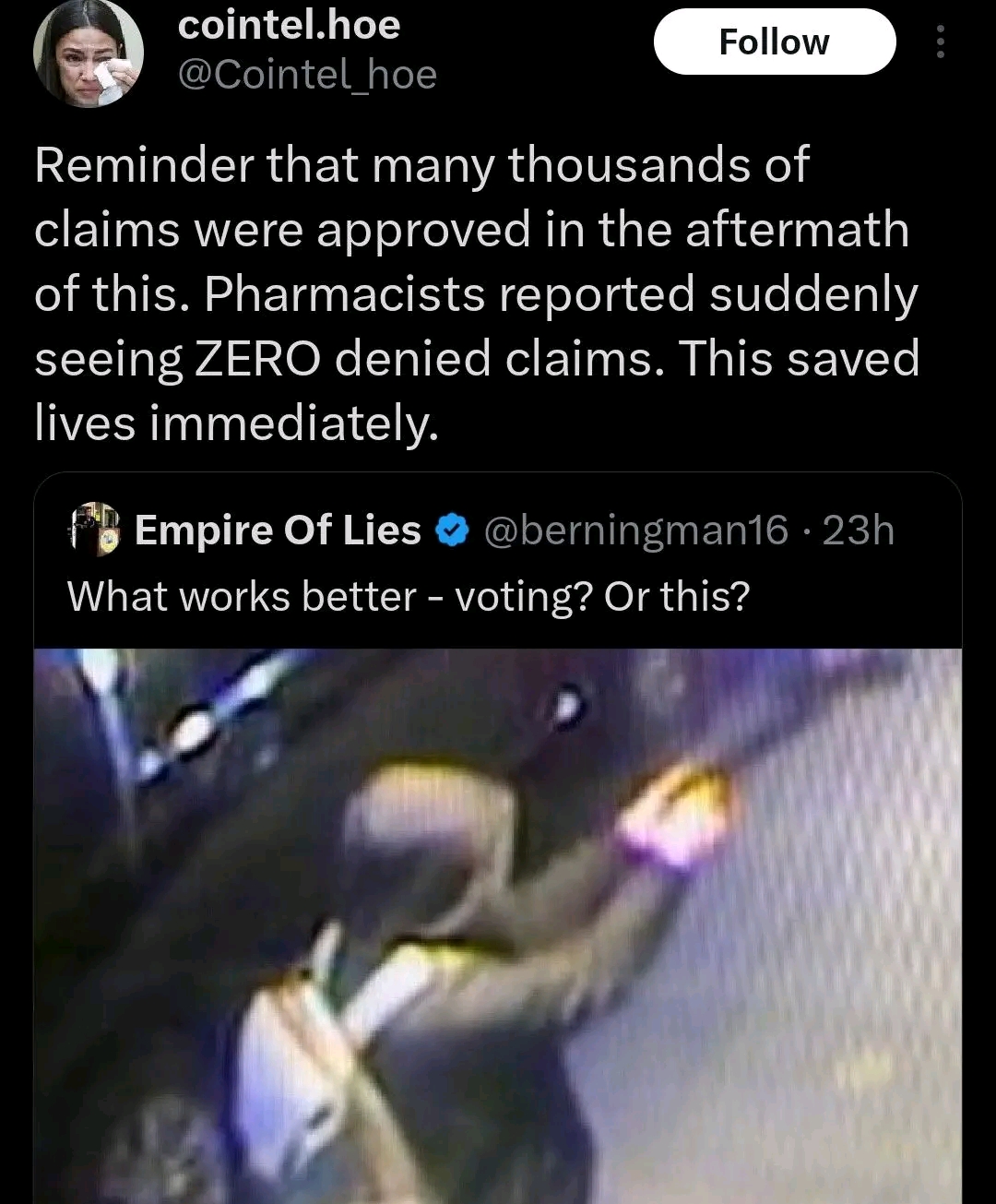
Actually, this meme is not an Anti-Fascist statement; rather, it is a piece of political satire mocking "voting with your wallet" and insurance fraud. The text claims that during a chaotic aftermath (referred to as "this"), insurers approved thousands of claims while suddenly having zero denied ones, supposedly "saving lives immediately." The grainy image likely depicts a person being beaten or attacked, but the context implies that despite the chaos or violence, people got money out of the system without facing serious consequences. This style of satire critiques democratic processes, but it does not fit the Anti-Fascism category because it addresses healthcare policy and financial fraud rather than authoritarian political ideologies.
detailed-analysis (gemma3_27b-it-q8_0)
Okay, let's break down this meme from an anti-fascist perspective, using the requested theoretical frameworks where applicable. It's a complex meme layered with political and cultural context, so this will be fairly detailed.
Overall Context: The meme's core message revolves around a perceived shift in the processing of insurance claims after a specific event, coupled with a question about the efficacy of voting versus "other" methods of resistance (suggesting direct action or other forms of intervention). The image adds a layer of disturbing absurdity. Within the anti-fascist context, this taps into themes of systemic manipulation, bureaucratic control, distrust of institutions, and the limitations of electoral politics. The "this" refers to a shift toward action and a dissatisfaction with electoral politics.
---
1. Visual Description
The image is a heavily blurred and distorted close-up of a cat's face. The cat has bulging, wide eyes and its mouth is slightly open, almost appearing in a grimace. The image is very unsettling, invoking a sense of anxiety, fear, or even a slight grotesqueness. The quality of the image contributes to a feeling of disquiet and potentially symbolizes a breakdown of clear perception or the distortion of reality. The visual absurdity deliberately clashes with the serious political claims being made in the text.
---
2. Foucauldian Genealogical Discourse Analysis
Michel Foucault's work on power, discourse, and knowledge is very relevant here.
- Power/Knowledge: The tweet points to a disruption in the seemingly neutral and objective workings of the insurance system. Foucault argues that power isn't simply top-down repression, but operates through discourses – systems of knowledge and language that shape our understanding of the world. The insurance system’s claim processing is presented as a discourse of objectivity and fairness. The claim that claims were suddenly approved "after this" implies a manipulation of that discourse. It suggests hidden forces acting within the system to influence outcomes.
- Genealogy: A genealogical approach would ask how the current system of healthcare and insurance came to be, tracing its historical development. Anti-fascist thought often views these systems as products of capitalist and colonial history, designed to serve particular interests. The "this" event is positioned as a catalyst disrupting the previously understood genealogy of the system.
- Biopower: Foucault's concept of biopower – the way modern states control and regulate populations through managing life itself – is also relevant. Healthcare, insurance, and access to medical care are central to biopower. The sudden shift in claim processing suggests a manipulation of life-affecting mechanisms. The “saved lives” is a direct reference to biopower.
---
3. Critical Theory
Critical Theory, particularly the Frankfurt School, focuses on challenging dominant ideologies and exposing the power structures that maintain them.
- Ideology Critique: The meme critiques the ideology that institutions (like insurance companies) are neutral and operate in the public good. The claim of manipulated claim processing undermines this faith.
- Instrumental Reason: Critical theorists like Max Horkheimer and Theodor Adorno argued that instrumental reason – the pursuit of efficiency and control – can become detached from ethical considerations. The focus on claim numbers and bureaucratic processes, possibly at the expense of people's well-being, could be seen as an example of instrumental reason gone awry.
- Commodification of Healthcare: The meme implicitly addresses the commodification of healthcare within a capitalist system. Insurance claims are not just about medical needs, but about economic transactions.
---
4. Marxist Conflict Theory
From a Marxist perspective, the meme can be interpreted as highlighting class struggle.
- Capitalist System: Insurance companies, within a Marxist framework, are instruments of the capitalist class, prioritizing profit over people's health. The manipulation of claims is seen as a way to protect those profits.
- Exploitation: Denied claims represent the exploitation of workers/individuals by the capitalist system. The sudden approval of claims, while seemingly positive, might be seen as a strategic maneuver to appease a situation or control the narrative.
- False Consciousness: The question of "voting or this?" challenges the idea that electoral politics are the primary means of achieving social change. Marxists might argue that voting within a capitalist system reinforces the system itself. "This" implies direct action or a more radical approach to dismantling the structures of exploitation.
---
5. Postmodernism
Postmodernism challenges grand narratives and embraces relativism and deconstruction.
- Deconstruction of Authority: The meme implicitly deconstructs the authority of institutions. By suggesting that claims were manipulated, it undermines the belief in the objectivity and trustworthiness of these systems.
- Skepticism towards Metanarratives: The question of "voting or this?" rejects the idea that there’s a single, overarching solution to social problems. Postmodernism favors local, fragmented struggles over universal ideologies.
- The Absurd Image: The disorienting cat image embraces the postmodern aesthetic of fragmentation, irony, and a rejection of traditional forms. It suggests that reality itself is unstable and open to interpretation.
---
6. Queer Feminist Intersectional Analysis
While not the primary focus, an intersectional lens adds further depth.
- Marginalization: Access to healthcare is often unequal, disproportionately affecting marginalized groups (people of color, LGBTQ+ individuals, people with disabilities, etc.). Claim denials can exacerbate these inequalities.
- Systemic Oppression: The insurance system, like other institutions, is often shaped by patriarchal, racist, and other oppressive norms. The meme can be seen as a critique of these systemic biases.
- Disruption as Resistance: "This" could be interpreted as acts of mutual aid, community organizing, or direct action that challenge oppressive systems and offer alternative forms of care and support outside of institutional structures.
In conclusion: This meme, within an anti-fascist context, is a layered critique of power, institutions, and the limitations of traditional political strategies. It uses unsettling imagery and a provocative question to encourage a more radical approach to social change, rooted in distrust of existing systems and a commitment to challenging structures of oppression.
simple-description (llama3.2-vision_11b)
This meme is a commentary on the current state of online discourse, particularly in the context of anti-fascism. The image shows a person attempting to break a window, with a caption that reads "What works better - voting? Or this?" The meme is likely referencing the idea that the most effective way to achieve change is through direct action, rather than through voting. The image is meant to be humorous and satirical, highlighting the idea that some people are more effective in getting their point of view heard through direct action, rather than through the traditional method of voting.