First Seen
2025-10-18T15:59:41+00:00
simple-description (qwen3.5_2b-q8_0)
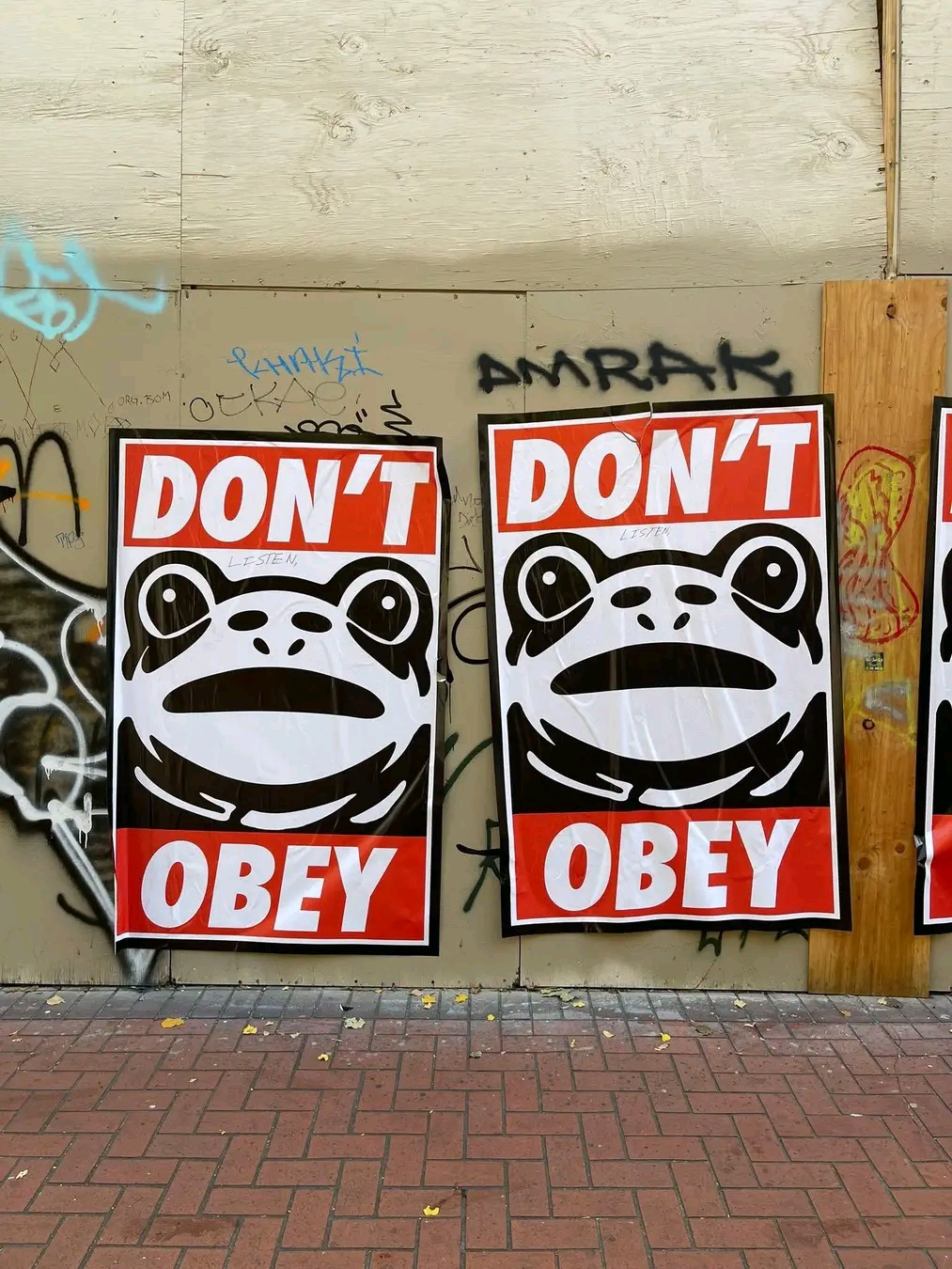
The image displays the iconic Anti-Nazi "Lernen Lest" poster (which translates to "Learn to Listen"), featuring a screaming frog in the text "DON'T OBEY." In an Anti-Fascist context, this meme criticizes blind submission to authority—the very core of fascist ideology—by advocating for open, direct communication and individual conscience over loyalty to governments or leaders. It emphasizes that the only way to speak the truth is to stop listening to orders and assert oneself against total control.
detailed-analysis (gemma3_27b-it-q8_0)
Here's an analysis of the Pepe the Frog “Don't Obey” meme in the context of Anti-Fascism, broken down into relevant theoretical frameworks. I’ll explain why each one is or isn’t particularly helpful in understanding the meme’s current usage and significance within that context.
Visual Description
The image features two repeating posters of Pepe the Frog, a character originating in the Boy’s Club comic. Pepe is depicted in a stark black and white with large, bulging eyes. Above the frog’s head, in large, bold red letters, is the word “DON’T.” Beneath the frog, also in large, bold red letters, is the word “OBEY.” The posters are displayed on a weathered, graffitied plywood wall, suggesting an urban, possibly neglected or contested space. The visual is deliberately graphic and high-contrast, creating a strong impact. The context suggests it is a street sticker or poster.
Foucauldian Genealogical Discourse Analysis
This framework is extremely useful here. Michel Foucault's work on power, knowledge, and discourse provides a strong lens to understand this meme.
- Power/Knowledge: The meme directly challenges the power structures that rely on unquestioning obedience. "Obey" evokes authoritarianism, and by negating it, the meme asserts a demand for critical thinking and resistance. The very act of placing the poster in public space is a disruption of the official discourse.
- Genealogy: The history of Pepe the Frog is key. Originally a harmless internet cartoon, it was co-opted by the alt-right and became a symbol of their movement, often associated with racist and antisemitic imagery. Its reclamation—transformed into an "anti-obey" symbol—is a genealogical shift in its meaning. The meme rewrites the history of the symbol, attempting to strip it of its hateful associations and repurpose it as a tool for resistance. This isn’t a simple reversal, however. The meme carries the weight of its past, which is part of its power. The act of reclaiming it acknowledges the prior hateful usage and actively attempts to subvert it.
- Discourse: The meme participates in a larger discourse about authority, control, and individual agency. The word “obey” resonates with historical and contemporary demands for conformity. The “don't” is a rejection of that demand.
Critical Theory
Critical Theory, particularly the Frankfurt School's focus on the "culture industry" and the manipulation of consciousness, is also relevant.
- Culture Industry: The original co-opting of Pepe by the alt-right is an example of how symbols can be manufactured and deployed to normalize harmful ideologies. This meme is a counter-response, an attempt to break the hold of this manufactured ideology.
- Enlightenment & Instrumental Reason: Critical Theory often critiques the dangers of unchecked reason used to control and dominate. The "obey" directive represents the imposition of a particular rational order. "Don't obey" suggests a rejection of that imposed order and a call for independent thought.
Marxist Conflict Theory
While not the primary framework, Marxist conflict theory provides a useful backdrop.
- Ideology and False Consciousness: The “obey” directive reinforces the ideological power of the dominant class. It encourages acceptance of the status quo. The meme challenges this by aiming to raise consciousness and encourage resistance.
- Class Struggle: Though not explicitly about class, the meme's critique of authority can be extrapolated to critiques of hierarchical power structures inherent in capitalism. "Obey" implies a power dynamic where some command and others submit.
- Hegemony: The meme challenges the hegemonic control of dominant ideologies by offering an alternative message.
Postmodernism
Postmodernism is somewhat less directly relevant, but offers some insight.
- Deconstruction: The meme deconstructs the simple command "obey" by negating it. It exposes the underlying assumptions and power relations embedded in the directive.
- Simulacra and Simulation: Pepe itself became a simulacrum – a copy without an original, its meaning constantly shifting and becoming detached from its origins. The meme utilizes this already destabilized symbol.
- Irony & Pastiche: The appropriation and recontextualization of Pepe often involves a degree of irony. The meme’s effectiveness relies on the audience understanding its layered history and the intent to subvert.
Queer Feminist Intersectional Analysis
This framework is less directly applicable, but can offer some supplementary perspective.
- Challenging Hierarchies: Anti-fascist thought inherently challenges oppressive hierarchies based on race, gender, sexuality, and other categories. The meme's call to "don't obey" is a general rejection of all forms of domination.
- Power Dynamics: A queer feminist lens would draw attention to how demands for obedience often disproportionately affect marginalized groups. The meme implicitly speaks to the need to resist oppressive systems that seek to control bodies and identities.
In summary:
The "Don't Obey" Pepe meme, within an Anti-Fascist context, is a powerful symbol of resistance. Its effectiveness stems from its genealogical journey—its deliberate reclamation from hateful usage. It leverages the image's loaded history to challenge authority, disrupt dominant narratives, and encourage critical thinking. The meme’s core message is a rejection of blind obedience to oppressive power structures, and a call for individual agency and resistance. The Foucauldian and Critical Theory frameworks provide the most robust analytical tools for understanding the meme’s complexities and its role within a broader struggle against fascism.
simple-description (llama3.2-vision_11b)
The "We Don't Need a Bigger Boat" meme is a humorous reference to the 1984 film "The ... (read more)