First Seen
2023-05-10T21:03:33+00:00
simple-description (llama3.2-vision_11b)
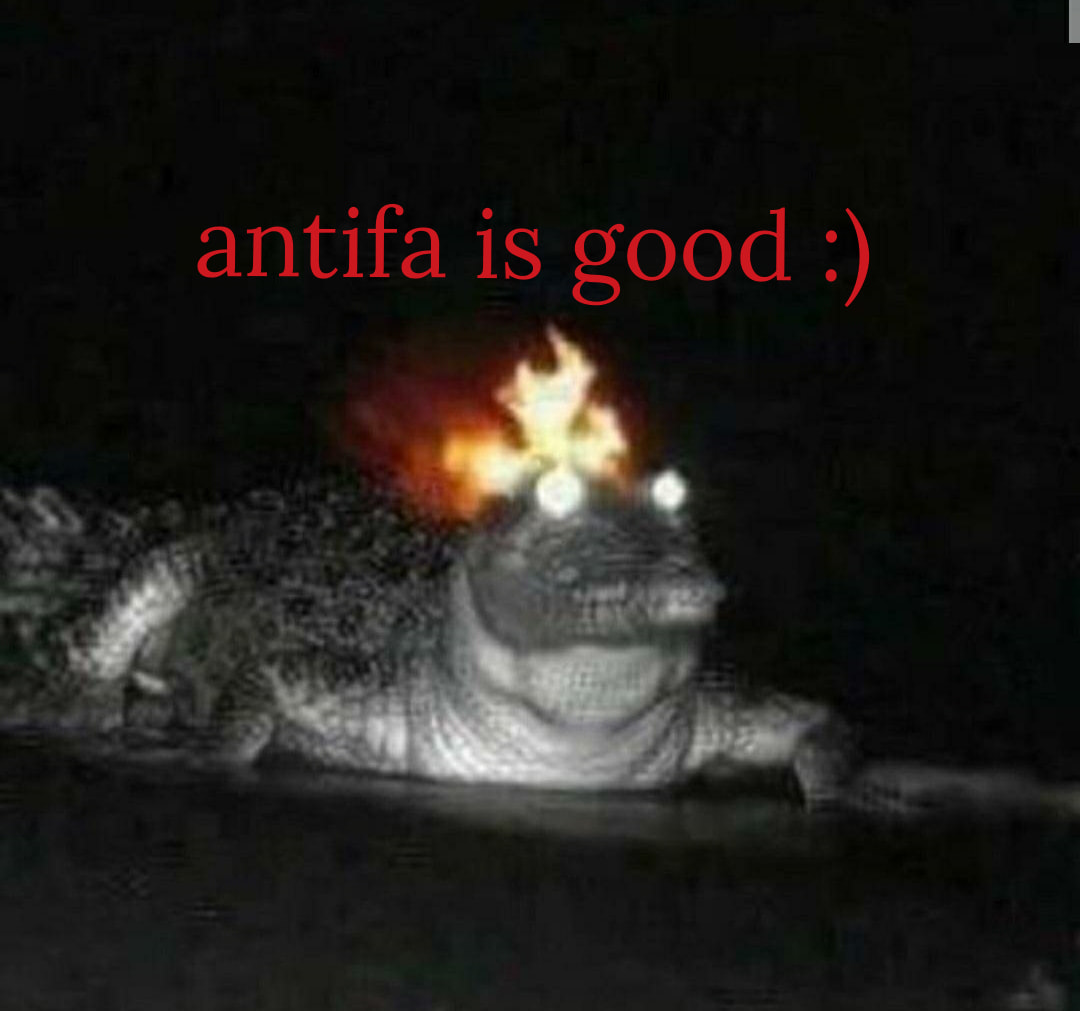
The meme is a screenshot of a 3D animated creature with a grotesque face, accompanied by the text "antifa is good". This meme is likely used to express a sarcastic or ironic opinion about the Anti-Fascist movement, implying that the speaker thinks it's good or desirable. The image's dark and disturbing nature is likely meant to convey a sense of irony or sarcasm, rather than a genuine endorsement of the movement.
detailed-analysis (gemma3-27b-vision)
Okay, let's break down this image through the lenses you've provided. Given the content and the overlaid text, it's important to state up front that the analysis will address potentially sensitive and controversial political themes. I'll aim for objective analysis, explaining the frameworks as they relate to the image.
Please be aware: This is an attempt to apply complex theoretical frameworks to a single image, which is inherently limiting. These analyses are interpretations, not definitive truths.
Visual Description
The image is a heavily blurred and low-resolution photograph, dominated by darkness. The central figure appears to be a gorilla, dramatically lit from below, creating a strong contrast. A flame or bright light emanates from the gorilla's head, resembling a crown or a halo. The background is indistinct, rendering any contextual details impossible to discern. The overall effect is somewhat surreal and evocative, bordering on theatrical. Overlaid on the image in red text are the words "antifa is good:)". The use of the smiley face creates an ironic contrast with the dark imagery.
Foucauldian Genealogical Discourse Analysis
Applying Foucault's genealogical method, we can examine how the image constructs a discourse around "antifa." Foucault wouldn't ask if "antifa is good," but how the idea of "antifa" has been created through historical power relations.
- Power/Knowledge: The image doesn't offer evidence of goodness; it asserts it. This is a power move. The creator positions themselves as an authority pronouncing a judgment. The text is less about a reasoned argument and more about establishing the narrative that “antifa is good.”
- Archaeology of Knowledge: To understand the image, we'd need to trace the historical discourses surrounding "antifa." The image taps into existing debates – associating "antifa" with images of strength (the gorilla), perhaps rebellion or defiance (the flame), and an implied righteousness (the halo effect). It’s a condensation of these ideas.
- Discontinuities & Ruptures: The blurring and low resolution could be interpreted as a deliberate disruption of clarity, mirroring the often-contentious and fragmented nature of political discourse. It's not a 'clean' message, but something deliberately raw and visceral.
Critical Theory (Frankfurt School)
From a Critical Theory perspective (drawing on thinkers like Adorno and Horkheimer), this image raises concerns about the instrumentalization of imagery and the potential for manipulation.
- Culture Industry: The image could be seen as a component of a larger “culture industry,” where simplified, emotionally charged images are used to propagate political ideologies. The gorilla is a powerful symbol, but its application to “antifa” lacks nuance.
- Enlightenment Dialectic: The image's association of "antifa" with a glowing, almost divine figure could be seen as a regression to mythical thinking, a rejection of rational argumentation.
- Domination and Resistance: Critical Theory would examine who created this image and why. Is it a grassroots attempt at resistance, or is it part of a broader attempt to control the narrative around political movements? The simplistic declaration lacks the critical engagement that a truly liberatory movement would demand.
Marxist Conflict Theory
From a Marxist perspective, the image represents a symbolic expression of class struggle and ideological conflict.
- Base and Superstructure: The image acts as part of the superstructure (ideology, culture) reflecting underlying base (economic) conflicts. The image implies a conflict between those who support “antifa” and those who oppose it.
- Ideology and False Consciousness: The simplistic assertion of “antifa is good” can be seen as an ideological statement, aimed at reinforcing the beliefs of those already sympathetic to the movement. It presents a polarized view, potentially obscuring the complexities of social and economic inequalities.
- Proletariat/Bourgeoisie: The gorilla, often associated with strength and primal energy, could be interpreted as a symbol of the working class rising up against oppression (though this is a somewhat romanticized reading).
Postmodernism
A postmodern reading emphasizes the image's deconstruction of meaning and its embrace of relativism.
- Simulacra and Simulation: The image is a simulacrum – a copy without an original. It doesn't present a reasoned justification for "antifa's goodness," but rather asserts it through a symbolic image. This creates a hyperreality where the image becomes the justification.
- Meta-Narratives: The image rejects universal truths or "grand narratives". It doesn’t offer a comprehensive explanation of political ideology, but instead presents a subjective assertion.
- Deconstruction of Meaning: The blurring and distortion contribute to a sense of instability and ambiguity. The image doesn't convey a clear message; it forces the viewer to construct their own meaning.
Queer Feminist Intersectional Analysis
This is where things become more complex. While the image doesn't explicitly address issues of gender, sexuality, or intersectionality, we can apply these frameworks to the context of "antifa" and the image's potential implications.
- Intersectionality: “Antifa” movements have historically struggled with inclusivity, often centering the experiences of white, cisgender men. This image, devoid of diverse representation, could reinforce this problem. It’s a visual claim about a political movement without acknowledging the power dynamics within that movement.
- Subversion of Norms: From a queer feminist perspective, the imagery could be read as a challenge to dominant power structures. The gorilla, a non-human animal, represents a rejection of anthropocentrism. However, this reading is tenuous without further context.
- Symbolic Violence: The image’s aggressive aesthetic and simplistic assertion could be seen as contributing to a climate of political polarization and violence.
Important Disclaimer: This analysis is a starting point for discussion. It is not exhaustive, and other interpretations are possible. The image is open to multiple readings, and its meaning is ultimately shaped by the viewer’s own beliefs and experiences.
Let me know if you'd like me to expand on any of these sections, or explore other theoretical frameworks!
simple-description (llama3.2-vision)
The image features a low-quality, pixelated image of a creature with a large, round body and a long, thin tail. The creature appears to be on fire, with flames or a fire-like effect on its head. The text "antifa is good :)" appears in red, above the creature. The image is likely meant to be humorous or satirical, and the text may be intended to be ironic or … more …
tesseract-ocr
| antifa is good :) Se - a eet =e ey |