First Seen
2025-03-22T19:46:22+00:00
detailed-analysis (gemma3_27b-it-q8_0)
Okay, let's break down this meme from an "Anti-Elon" category perspective, utilizing the requested theoretical frameworks where appropriate.
Visual Description
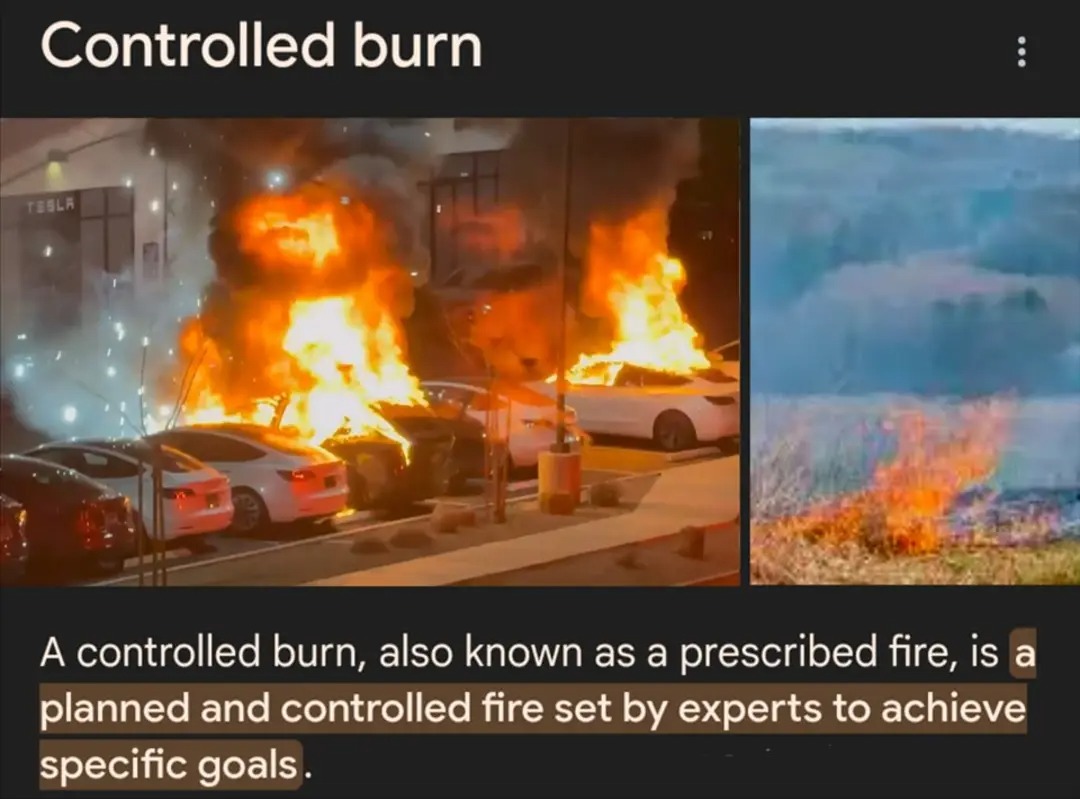
The meme depicts a Tesla vehicle engulfed in flames in what appears to be a parking lot. There are several other cars nearby. The flames are substantial, and the overall image suggests a significant fire incident. The juxtaposition of the sleek, "futuristic" design of the Tesla with the chaotic and destructive imagery of the fire is immediately striking. The background shows what appears to be a Tesla dealership or service center. The text "Controlled burn" is placed above this image and is followed by a definition that seems to imply the fire was a deliberate act.
Foucauldian Genealogical Discourse Analysis
Within an "Anti-Elon" framework, this meme engages in a Foucauldian critique of the discourse surrounding Tesla and Elon Musk. Musk has meticulously constructed a narrative of technological innovation, safety, and future-orientation, particularly around electric vehicles. This meme disrupts that discourse.
- Power/Knowledge: Musk wields significant power through the framing of his technologies. He defines what "safe," "sustainable," or "innovative" means. The meme challenges this power by presenting evidence (or the appearance of evidence) that directly contradicts the carefully cultivated safety narrative. The definition of "controlled burn" (a planned fire by experts) is strategically used to suggest this isn't a mishap but a deliberate concealment.
- Genealogy: The meme subtly hints at a historical lineage of problematic claims made by Musk and Tesla. The idea of a "controlled burn" as a euphemism taps into a potential perception that Tesla has a history of downplaying or covering up safety issues, manufacturing flaws, or other undesirable events. It's saying that fires aren't random, but rather potentially part of a consistent strategy to manage public perception.
- Disciplinary Power: The fire, framed as a “controlled burn,” symbolizes Tesla’s attempt to discipline the narrative around its safety. By attempting to present the fire as planned, Tesla attempts to exert control over how the event is understood and remembered.
Critical Theory
From a Critical Theory perspective, the meme can be seen as exposing the ideological contradictions inherent in Tesla's brand.
- Commodification of Safety: Tesla sells the idea of safety as part of its product. The meme challenges this by visually demonstrating a lack of safety, highlighting the gap between the advertised promise and the lived reality. It suggests that "safety" is being commodified and that profits are prioritized over actual safety.
- Mythmaking: Musk is a master of mythmaking—creating a powerful, compelling narrative around his companies. This meme acts as a demythologizing force, shattering the illusion of Tesla as a flawless, forward-thinking entity.
- Reason vs. Enlightenment (Horkheimer & Adorno): Tesla’s claim to technological advancement is a manifestation of “instrumental reason.” The meme suggests that the pursuit of profit and innovation (reason) has led to potentially dangerous consequences (the fire).
Marxist Conflict Theory
This meme touches on Marxist themes of class, exploitation, and the inherent contradictions of capitalism, even though it's not overtly about labor.
- Alienation: The Tesla owner is alienated from the product they purchased. They paid for a vehicle purportedly representing the future of transportation and safety, but are confronted with a dangerous breakdown.
- Commodification & Profit Motive: The meme implies that Tesla might be prioritizing profits over safety, potentially using "controlled burns" to cover up systemic issues with their vehicles. This aligns with a Marxist critique of capitalism, where the pursuit of profit can lead to exploitative and harmful practices.
- The State and Capital: Depending on how the "controlled burn" narrative is interpreted, it might hint at collusion between Tesla and regulatory bodies, suggesting that the state is serving the interests of capital (Tesla) rather than protecting consumers.
Postmodernism
The meme’s use of irony and subversion of meaning aligns with postmodern principles.
- Simulacra and Simulation: The Tesla brand simulates safety and sustainability. The meme exposes the gap between the simulation and reality.
- Deconstruction: The meme deconstructs the dominant narrative surrounding Tesla, undermining the brand's authority. The ironic juxtaposition of the term "controlled burn" with the image of a burning car dismantles the idea of Tesla as a responsible, reliable company.
- Loss of Grand Narratives: The meme questions the grand narrative of technological progress that Musk promotes. It suggests that technology is not inherently good or liberating but can be dangerous and destructive.
In essence, this meme operates as a potent piece of counter-narrative within the "Anti-Elon" sphere. It leverages visual and linguistic elements to deconstruct the carefully crafted image of Tesla and Elon Musk, exposing perceived contradictions and questioning the underlying motives driving the company's actions. It's designed to provoke skepticism and fuel ongoing critique.
simple-description (llama3.2-vision_11b)
The meme is a photo of a large fire engulfing a Tesla car dealership, with the caption "controlled burn" written above it. The meme is making a humorous connection between the phrase "controlled burn" (a term for a planned fire set to manage land or resources) and the fact that Elon Musk's Tesla cars are often set on fire in a "controlled" manner, implying that the company's cars are prone to catching fire.