First Seen
2025-03-13T20:35:49.267123+00:00
detailed-analysis (gemma3_27b-it-q8_0)
Okay, let's break down this meme from the perspective of the "Anti-Elon" category, utilizing the frameworks you've requested where applicable. It's important to note that memes often operate on multiple levels, so several frameworks might apply.
Visual Description
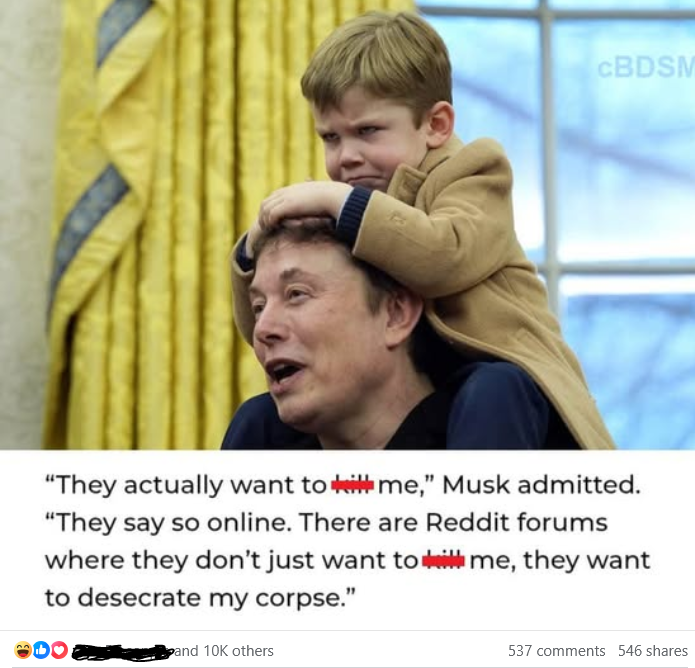
The meme depicts Elon Musk looking distressed and burdened, carrying a young boy on his shoulders. The background features opulent, heavy curtains and a bright, possibly institutional-looking window. The boy's expression is blank, almost uncaring, adding to the imbalance of the scene. The text overlaid quotes Musk lamenting online hostility, even referring to wishes for his death and desecration of his body. The choice to use a child here is particularly important, and we’ll explore that in subsequent sections.
Foucauldian Genealogical Discourse Analysis
From a Foucauldian perspective, this meme deconstructs the carefully curated discourse of Elon Musk as a visionary, genius, and even a somewhat tragic figure. Foucault emphasized how power operates through discourse – how language and ideas construct reality, and how certain truths become dominant.
Musk typically presents himself as a misunderstood, almost martyred figure, bravely fighting against ‘wokeness’ and ‘the haters’. This meme interrupts that discourse. It takes Musk’s own words (his claims of online hostility) and subverts them. Rather than eliciting sympathy, it frames him as a self-pitying figure.
The child on his shoulders is key. It presents Musk as carrying the weight of his own narrative, of his perceived persecution, and ironically, of a power structure he himself represents. It suggests he is a figure propped up by forces (perhaps the wealth and privilege that allows him to operate with impunity) that he simultaneously complains about. The meme questions the genealogy of this narrative – how did Musk come to construct himself as a victim? What historical and social factors enabled this positioning?
Critical Theory
Critical Theory focuses on challenging power structures and exposing ideologies that maintain those structures. This meme fits neatly into that framework. Musk, as a billionaire and owner of platforms like X (formerly Twitter), holds immense power. The “Anti-Elon” community often views him as a symbol of late-stage capitalism, tech-bro culture, and the erosion of democratic principles.
The meme deconstructs Musk’s power by presenting him as fragile, burdened, and even pathetic. It rejects the dominant narrative that he's a strong leader. It implies his complaints about being "attacked" are simply the grievances of someone accustomed to unchallenged power encountering resistance. The meme subtly points out the disparity between the real harm caused by his actions (e.g., worker exploitation, spread of misinformation) and his complaints about online negativity.
The use of the child is also critical. It subtly casts Musk as irresponsible or exploitative, highlighting his privilege and potentially implying a lack of moral compass.
Marxist Conflict Theory
From a Marxist perspective, the meme reflects a class struggle. Musk embodies the capitalist class – the owners of the means of production and wealth. The “Anti-Elon” community, often comprised of workers, activists, and those critical of economic inequality, represent the proletariat or those challenging the capitalist order.
The meme showcases a conflict between these classes. Musk’s complaints are seen as the whining of someone who benefits from a system that inherently exploits others. The meme doesn’t take his complaints seriously; instead, it highlights the absurdity of a billionaire lamenting online criticism while simultaneously wielding enormous economic and political power. It can be seen as a symbolic representation of the powerlessness experienced by many in the face of concentrated wealth and influence.
Postmodernism
Postmodernism rejects grand narratives and emphasizes the subjective nature of truth. This meme is very much a product of postmodernity. It parodies Musk’s self-presentation, using irony and exaggeration to dismantle his claims to authority.
The meme relies on intertextuality – it draws on the existing knowledge of Musk’s online persona and his frequent complaints about online criticism. It doesn’t present a singular, objective ‘truth’ about Musk; it presents a fragmented, ironic perspective. The meme’s effectiveness hinges on its audience’s understanding of these cultural codes and their recognition of the inherent contradictions in Musk’s public image. The child could represent the shifting, unstable nature of identity in the postmodern world.
Queer Feminist Intersectional Analysis
While not the primary lens, this framework can offer nuance. Musk’s behavior and policies have been criticized for being hostile to marginalized groups, and he often aligns with conservative ideologies. The meme's subversion of his perceived victimhood can be seen as a rejection of the narratives used to justify those behaviors.
The child could also symbolize innocence, vulnerability, and the future, implying that Musk’s actions threaten those values. The imbalance in the image could subtly critique patriarchal structures and the disproportionate power held by men like Musk.
In conclusion, this meme functions as a complex form of online resistance, leveraging irony, visual metaphor, and critical theory to challenge the power and narrative of Elon Musk. It's a distillation of the “Anti-Elon” sentiment into a potent, shareable format.
simple-description (llama3.2-vision_11b)
The meme is a screenshot of a Reddit post where a user is pretending to be Elon Musk and responding to a question about his plans for the future. The user claims to have a "crazy" idea to make a new AI that can do everything for you, including making your food, cleaning your house, and even making your children. The user says this AI would be able to make your life easier and more fun, and that it would be a "game changer" for humanity.