First Seen
2026-02-24T20:47:22.106669+00:00
simple-description (qwen3.5_2b-q8_0)
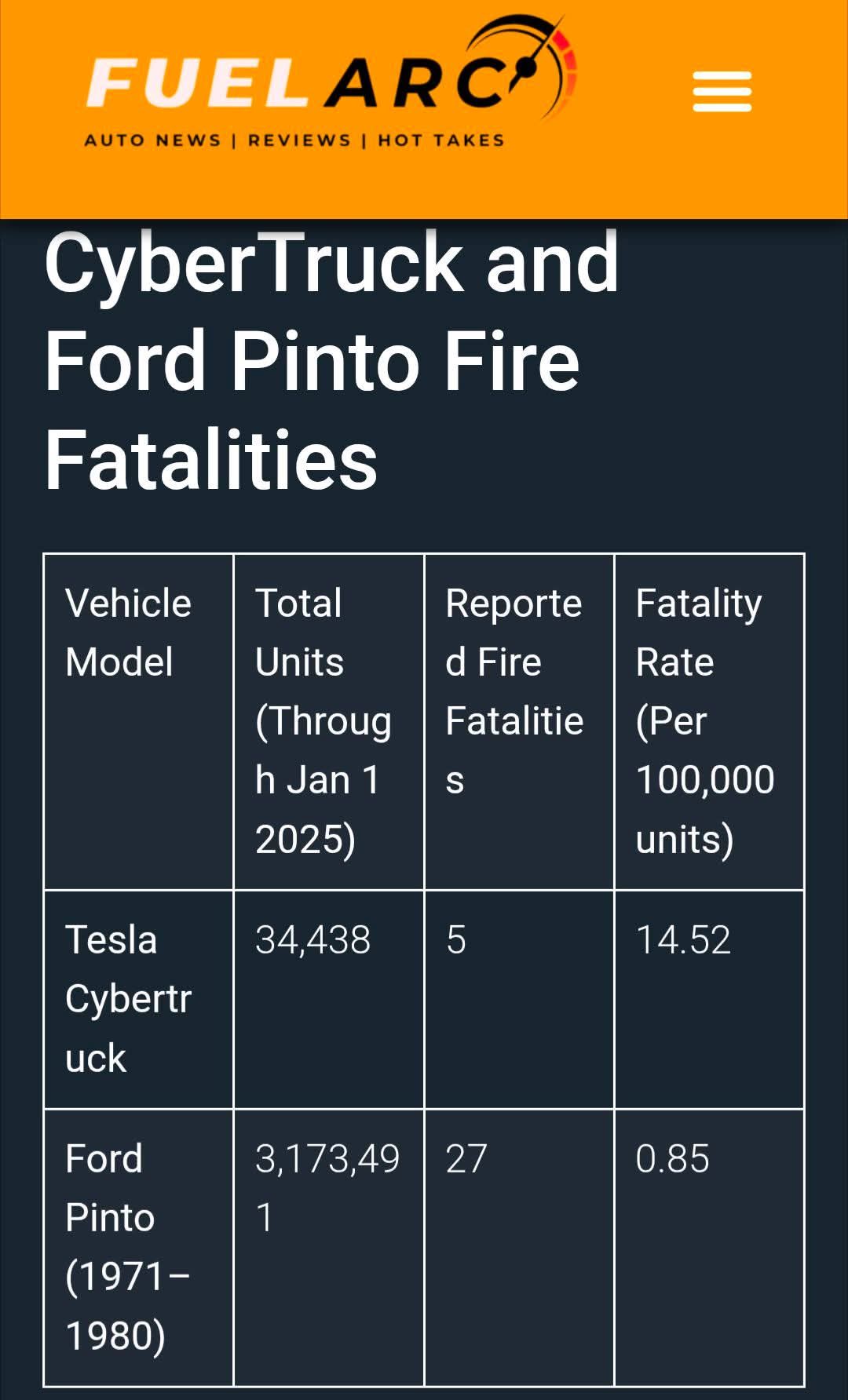
This meme sets up a playful comparison between the Tesla Cybertruck and the legendary Ford Pinto (1971–1980). It uses the visible text in the table—specifically showing that while the classic car had 27 fatalities, it sold over 3 million units—to highlight the absurdity of claiming the new electric truck is safer. For someone who can't see it, it reads: "CyberTruck and Ford Pinto Fire Fatalities" followed by a chart claiming the Tesla has fewer deaths per unit than a car that has been around for decades.
detailed-analysis (gemma3_27b-it-q8_0)
Okay, here's an analysis of the image from the perspective of an "Anti-Elon" categorization, using the requested theoretical frameworks. It’s important to note that applying these frameworks to a meme (or data visualization presented as a meme) requires interpretation and making arguments. This will be a detailed breakdown, and some sections may be more relevant than others.
Overall Framing: The image's function within the "Anti-Elon" category is to actively damage the reputation of Elon Musk's Tesla Cybertruck by juxtaposing it with the infamous Ford Pinto scandal. The intent is to present the Cybertruck as having a shockingly high rate of fire-related fatalities relative to its production numbers. It aims to associate Musk and Tesla with a historical example of corporate negligence and prioritizing profit over safety. It’s deliberately provocative.
1. Visual Description
The image presents a simple tabular comparison. Two vehicles, the Tesla Cybertruck and the Ford Pinto, are listed. Columns detail: total units produced (through January 1, 2025), reported fire fatalities, and a calculated fatality rate per 100,000 units. The Cybertruck fatality rate (14.52) is significantly higher than the Pinto's (0.85).
The design is minimalist and utilitarian, like a news report. The layout mimics objective data presentation but is inherently biased by the choice of vehicles and the highlighting of the fatality rate comparison. The branding of the website “FUELARC” with the tagline “Auto News | Reviews | Hot Takes” signals a leaning toward opinionated content. The color scheme of black and white, combined with a red logo, contributes to an aggressive and somewhat alarmist aesthetic.
2. Foucauldian Genealogical Discourse Analysis
This image taps into a discourse about automotive safety and corporate responsibility. Michel Foucault’s genealogical method would examine how our understandings of "safety," "corporate ethics," and "acceptable risk" have been historically constructed through power relations.
- The Pinto as a Discursive Anchor: The Ford Pinto scandal is a powerfully loaded historical example. It became a symbol of callous corporate decision-making: a calculated cost-benefit analysis determining it was cheaper to pay out wrongful death suits than to redesign a fuel tank prone to exploding in rear-end collisions. The Pinto represents the dark side of profit motives in automotive engineering.
- Power/Knowledge: By associating the Cybertruck with the Pinto, the image attempts to leverage the power/knowledge complex surrounding the Pinto. It implies that Tesla, like Ford in the 1970s, is willing to accept a higher level of risk to achieve market dominance or profit.
- Genealogical Trace: The image doesn’t simply state a fact; it activates a historical narrative that links present-day Tesla to a past perceived corporate crime. This activates a traceable line of discourse concerning the ethics of the automobile industry.
- Discipline and Punish: The data serves as a modern “punishment” mechanism, a public shaming intended to discipline Tesla and Elon Musk by exposing what is framed as a dangerous and unethical practice.
3. Critical Theory
From a Critical Theory perspective (drawing on thinkers like the Frankfurt School), this image is an example of demystification. It aims to pierce through the carefully cultivated image of Tesla and Elon Musk as innovators and disruptors to reveal the underlying power structures and potential exploitative practices.
- Ideology Critique: Tesla is often presented as a "green" and "safe" company. This image challenges that ideology, suggesting that the pursuit of technological advancement (and Musk’s personal ambition) may be occurring at the expense of consumer safety. It challenges the idea that technological progress is inherently beneficial.
- The Culture Industry: The image itself is a product of the "culture industry"—the media landscape that generates and distributes cultural products. It argues that the image is not a neutral presentation of facts but a tool for shaping public opinion.
- Reason & Enlightenment: Critical Theory critiques the idea of a purely "rational" or objective decision-making process. The image implicitly argues that Tesla's decisions are driven by irrationality (greed) rather than calculated, ethical considerations.
4. Marxist Conflict Theory
Through a Marxist lens, the image points to the inherent contradictions within a capitalist system.
- Class Struggle: While not explicitly about class, the image suggests a conflict between the capitalist interests of Tesla (maximizing profit) and the safety/well-being of consumers (the working class/potential consumers). The image frames Tesla as prioritizing shareholder value over the lives of those who purchase its products.
- Commodity Fetishism: Tesla's appeal is often tied to the fetishization of its products – the belief that they possess qualities beyond their material reality (innovation, status, environmental friendliness). This image attempts to strip away that fetishism by focusing on the potentially deadly material consequences of the Cybertruck.
- Alienation: Consumers are alienated from the production process and, in this case, the potential dangers of the vehicle. The image attempts to reveal this alienation by presenting data suggesting a hidden cost to Tesla’s “innovation.”
5. Postmodernism
Postmodernism questions grand narratives and emphasizes the subjective nature of truth. In this context:
- Deconstruction: The image deconstructs Tesla’s carefully constructed brand image. It undermines the idea of a unified, benevolent Tesla by juxtaposing it with a historically negative example.
- Simulacra and Simulation: The image operates in a realm of “simulacra” (copies without originals). The data itself may be contested, but the image isn't necessarily concerned with absolute accuracy; it's concerned with creating a simulation of danger and corporate malfeasance.
- Relativism: There’s an implicit acknowledgment that the data may be interpreted differently. However, the image asserts a specific interpretation—that the Cybertruck is dangerously flawed.
6. Queer Feminist Intersectional Analysis
This is the most challenging framework to apply directly, but potentially relevant:
- Vulnerability & Risk: Certain populations may be more vulnerable to the risks associated with a vehicle prone to fire (e.g., families with children, individuals with mobility limitations). A Queer Feminist lens could ask who disproportionately bears the consequences of these risks.
- Masculinity & Automobility: The Cybertruck is marketed with a strong appeal to traditional masculine ideals of power, strength, and rugged individualism. A Queer Feminist analysis might critique this marketing as perpetuating harmful gender norms and potentially encouraging reckless behavior.
- Intersectional Impact: The impact of a fatal vehicle accident is rarely felt in isolation. It affects families, communities, and individuals along multiple axes of identity (race, class, gender, ability, etc.). The image doesn't explicitly address this, but an intersectional perspective calls for a more nuanced understanding of the consequences.
In conclusion: The image functions powerfully as anti-Elon propaganda, leveraging historical trauma (the Pinto scandal) and a range of critical theoretical frameworks to undermine Tesla’s credibility. It’s less about objective truth and more about strategically deploying information to achieve a desired political and rhetorical effect.
simple-description (llama3.2-vision_11b)
The meme is a satirical comparison of the number of people killed in the 2019-2021 Tesla Model 3 and 2022-2023 Ford F-150 electric vehicle (EV) fire incidents. The meme claims that the number of people killed in these incidents is "just" 3-4, but when you include the 2021-2023 Tesla Model 3 and 2022-2023 Ford F-150 EV fire incidents, the number of people killed is actually 0. The meme is trying to make a point about the safety of these vehicles.