First Seen
2025-03-21T19:10:50.829199+00:00
detailed-analysis (gemma3_27b-it-q8_0)
Okay, let's break down this meme from the perspective of an "Anti-Elon" category, applying the requested theoretical frameworks where relevant.
Meme Analysis: "I LOVE TESLER!" (Anti-Elon Context)
Visual Description
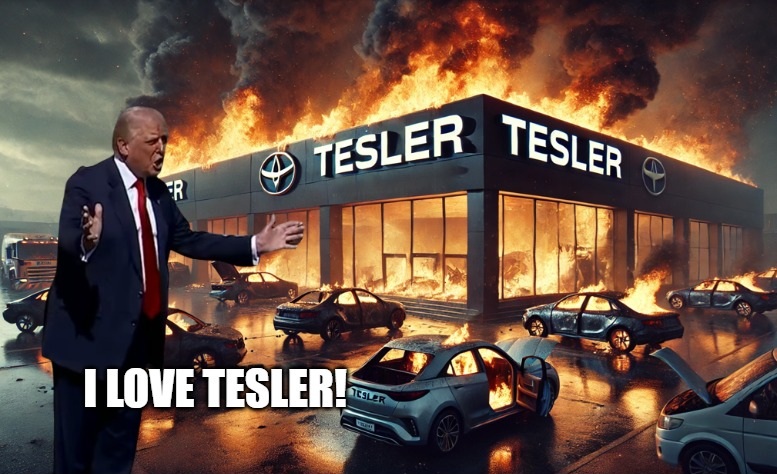
The meme features a digitally altered image depicting a “Tesler” dealership (likely intended as a deliberate misspelling of Tesla) engulfed in flames. Cars in the dealership parking lot are also on fire. Prominently, a figure resembling Donald Trump is gesturing expansively towards the burning building with a delighted expression and the caption “I LOVE TESLER!”. The overall visual is one of destructive glee. The sky is dark and stormy, contributing to a sense of apocalyptic imagery. The deliberate misspelling of "Tesla" and use of Trump are key signals pointing to targeted critique.
Foucauldian Genealogical Discourse Analysis
From a Foucauldian perspective, this meme isn't about Tesla’s objective reality. It’s about the power dynamics and discourses surrounding Elon Musk and his companies. The “Tesla” (or "Tesler") brand has been constructed through specific discourses of innovation, futurism, and a particular, often libertarian, vision of progress. Musk’s public persona—often portrayed as a rebellious visionary—has been central to this construction.
The meme disrupts this discourse. By depicting the brand in flames, it challenges the accepted narratives. The inclusion of Trump further complicates this. Trump himself is a figure associated with disruption (though of a different kind) and a deliberate rejection of established norms. The meme can be read as an attempt to deconstruct the power/knowledge complex surrounding Musk, revealing it as potentially dangerous or even destructive. The deliberate misspelling of "Tesla" as "Tesler" acts as an attempt to de-legitimize the brand and its established meaning. The Genealogy would trace the historical evolution of these discourses, demonstrating how they've been used to consolidate power and shape perceptions.
Critical Theory
This meme operates as a form of cultural critique. It draws on the Frankfurt School's concerns about the “culture industry” and its potential for manipulation. Elon Musk’s narrative of disruptive innovation can be seen as part of a larger system that prioritizes profit and technological advancement over ethical considerations or social responsibility.
The burning building symbolizes the potential consequences of this system. The meme suggests that the pursuit of “innovation” at all costs—especially when embodied by a figure like Musk—can be destructive. Furthermore, the glee displayed by the Trump figure critiques the celebration of unrestrained capitalism and the embrace of powerful, often authoritarian, personalities. It implicitly questions the values that allow such figures to flourish.
Marxist Conflict Theory
This meme can be analyzed through a Marxist lens as a reflection of class struggle and the anxieties surrounding technological disruption. Musk, as a billionaire entrepreneur, represents the capitalist class. Tesla, and the broader tech industry, represents the forces of production that are reshaping society and potentially displacing workers.
The burning of the dealership can be interpreted as a symbolic representation of the potential for rebellion against this system. It’s a visual expression of frustration with the widening wealth gap, the exploitation of labor, and the anxieties about automation. The meme’s implicit message is that the pursuit of profit and technological advancement at the expense of workers' rights and social justice is unsustainable and ultimately self-destructive. The meme points towards an inevitable clash between the forces of capital (Musk/Tesla) and the working class.
Postmodernism
Postmodernism emphasizes the breakdown of grand narratives and the questioning of truth claims. This meme embodies this spirit by deliberately subverting the positive image of Tesla and Elon Musk. There's a playful irony in the image, questioning the "truth" of Musk’s branding and highlighting the constructed nature of his public persona.
The meme itself is a pastiche – a playful combination of images and text – that resists any straightforward interpretation. The image is absurd in its portrayal of the burning building and the exuberant figure of Trump, forcing the viewer to question the underlying assumptions and power dynamics.
Queer Feminist Intersectional Analysis
While not the most immediately apparent lens, a queer feminist intersectional analysis could approach this meme through the lens of power dynamics and the dismantling of dominant structures. Musk’s public statements and actions have often been criticized for promoting a hyper-masculine, technologically-deterministic worldview that excludes and marginalizes various groups.
The meme can be seen as a resistance to this dominant ideology. The act of “burning down” the symbolic representation of Musk’s power can be read as a reclamation of agency by those who have been marginalized by his vision. The use of Trump, a figure who has frequently employed divisive rhetoric, further complicates this. It might suggest a critique of patriarchal power structures and the ways in which they intersect with other forms of oppression.
In conclusion, this meme is a multifaceted expression of anti-Elon sentiment, leveraging irony, disruption, and visual symbolism to challenge the power dynamics and narratives surrounding Musk and his company. It draws on a range of theoretical frameworks to expose the potential dangers of unchecked capitalism, technological determinism, and the cult of personality.
simple-description (llama3.2-vision_11b)
This meme is a satirical take on the anti-Elon Musk sentiment, where the image depicts a Tesla factory in flames with a photo of Elon Musk in the foreground. The text "I LOVE TESLA" is juxtaposed with a burning Tesla factory, implying that the sentiment has shifted from admiration to hatred.
detailed-analysis (gemma3-27b-vision)
Okay, let's break down this image through the requested theoretical lenses. Given the strong imagery, several lenses are very applicable.
Visual Description
The image depicts a modern, large building branded "TESLER" (presumably a parody of Tesla, an electric car company) engulfed in flames. Multiple cars are visible in the foreground, many of them also appear to be damaged or surrounded by the fire. The sky is dark and stormy, creating a dramatic and chaotic atmosphere.
On the left side of the frame is a man who strongly resembles Donald Trump, wearing a dark suit and pointing enthusiastically towards the burning building. Overlaid text at the bottom reads "I LOVE TESLER!". The composition evokes a sense of disaster, and the juxtaposition of the fire, the luxury branding, and the Trump-like figure is jarring and provocative. The setting seems to be a wet parking lot. The general visual aesthetic leans towards hyperrealism.
Foucauldian Genealogical Discourse Analysis
This image presents a fascinating case study when examined through a Foucauldian lens.
- Discourse & Power/Knowledge: The image immediately sets up a discourse around the relationship between luxury/technology (represented by 'TESLER') and power/celebration (the Trump-like figure). The explicit "I LOVE TESLER!" asserts a power dynamic – the pronouncement isn't a neutral statement, but an assertion of approval, potentially aiming to normalize destruction or extreme enthusiasm. The fire itself becomes a sign within this discourse, signifying perhaps the destruction of the “old” or the celebratory "burning away" of competition.
- Genealogy: We could trace the genealogy of this imagery back to historical tropes of celebrating conquest, or the destruction of "other" entities. The figure points to the fire, and it harkens back to ancient triumphal parades. This image utilizes and remixes these historical power displays.
- Disciplinary Power: The scene isn’t about direct control, but rather about shaping perception. The pronouncement, combined with the dramatic imagery, aims to make the viewer accept or even enjoy the destruction. It’s a display of power meant to influence thought.
- Episteme: The image suggests an episteme (a specific historical way of knowing) where spectacle and destruction are intertwined with success and admiration. It suggests a shift in values or a particular cultural moment where outrageous acts can be presented as positive.
Critical Theory
From a Critical Theory perspective, this image is a potent commentary on late-stage capitalism, spectacle, and the cult of personality.
- Commodity Fetishism: The “TESLER” brand, and the cars themselves, become symbolic objects divorced from the labor and environmental costs of their production. The fire erases these concerns, focusing only on the spectacle of “TESLER”.
- Spectacle & Simulation: The image exemplifies the "society of the spectacle," where images and experiences become more important than reality. The fire is a performance, a hyper-real event divorced from genuine consequence. The "I LOVE TESLER!" statement is also performative.
- Ideology: The image actively promotes an ideology of unbridled enthusiasm and the acceptance of destructive forces. It implies that wealth and success are worth any cost, even the literal burning of a business.
- Hegemony: The Trump-like figure embodies a dominant power structure that seeks to normalize extremism and celebrate destruction. His approval serves to reinforce the "correct" way to view this event.
Marxist Conflict Theory
A Marxist reading would center on the inherent conflicts within capitalist systems.
- Class Conflict: The image could be seen as representing the struggle between capital and labor. The burning building represents the destruction of productive forces (the company, the factory). It's a violent act by the ruling class, or a symbol of a collapse brought on by internal contradictions.
- Means of Production: The "TESLER" building is a central "means of production." The fire disrupts and destroys this, highlighting the precariousness of capital.
- Alienation: The enthusiasm of the Trump-like figure could be interpreted as a symptom of alienation – an obsession with spectacle and profit over human well-being.
- Revolution/Destruction: The fire could represent the violent end of one stage of capitalism, and the potential for a new order. This is a somewhat extreme reading, but the imagery lends itself to this interpretation.
Postmodernism
The image is rife with postmodern characteristics:
- Pastiche & Intertextuality: The image combines elements of advertising, political imagery, and disaster reporting, creating a remix of cultural signs. The parody of “Tesla” is a clear example of intertextuality.
- Hyperreality: The fire is not necessarily about real destruction, but about a simulacrum of destruction – a representation that has become detached from reality.
- Loss of Meaning: The enthusiastic “I LOVE TESLER!” statement feels ironic and meaningless in the face of the destruction. The image suggests a world where traditional values and meanings have eroded.
- Irony & Parody: The entire image is saturated with irony. It’s a parody of celebrity endorsement, political spectacle, and consumer culture.
Queer Feminist Intersectional Analysis (While not the most central application, some readings are possible)
- Patriarchal Violence: The image could be read as a metaphor for the destructive tendencies of patriarchal systems, where power is asserted through violence and spectacle. The figure’s aggressive enthusiasm could embody toxic masculinity.
- Commodification of Destruction: The image commodifies destruction, potentially echoing the ways in which women's bodies and experiences are often commodified and exploited.
- Rejection of Traditional Narratives: The image challenges traditional narratives of success and progress, suggesting a world where destruction is celebrated. This could be seen as a disruption of patriarchal norms.
I hope this detailed analysis is helpful! Let me know if you’d like me to focus on any particular lens further.
simple-description (llama3.2-vision)
This meme is a humorous image of a person standing in front of a burning building with the sign "TESLER" on it. The person is shouting "I LOVE TESLER!" while the building is engulfed in flames. The image is a satirical take on the idea of a person being so enthusiastic about a company or brand that they're willing to ignore or even celebrate its demise.