First Seen
2025-03-21T19:10:42.616191+00:00
detailed-analysis (gemma3_27b-it-q8_0)
Okay, let's break down this meme from an "Anti-Elon" perspective, using the requested theoretical frameworks where applicable.
Visual Description
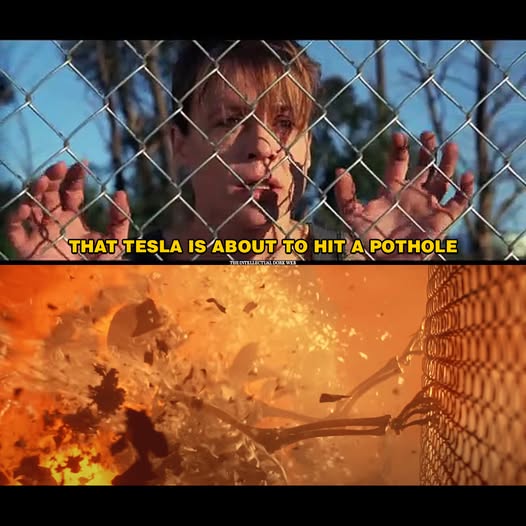
The meme features a still from a dramatic scene, likely a disaster or action movie. A woman, appearing distressed, is positioned in front of a chain-link fence, arms outstretched in a gesture that can be interpreted as both protection and helpless witnessing. Behind her, there’s a large, fiery explosion, looking somewhat cartoonish. Superimposed over the image in bold yellow text is the phrase: "THAT TESLA IS ABOUT TO HIT A POTHOLE". The visual juxtaposition of the woman's seemingly personal, immediate distress with the large-scale (but ultimately contained) explosion creates a darkly humorous, ironic effect. The meme is captioned “The Intellectual Dark Web” at the bottom.
Foucauldian Genealogical Discourse Analysis
From a Foucauldian perspective, this meme dismantles the discourse surrounding Elon Musk and Tesla as a revolutionary, futuristic, and ultimately safe technology. Elon Musk presents Tesla as an advancement in power and progress. The 'pothole' is not merely a road imperfection but represents the inherent failures and limitations within the techno-utopian vision. The image presents the illusion of technological infallibility in a disaster setting, showing that disaster, even in the age of technological advancement, is inevitable.
The "Intellectual Dark Web" caption is particularly significant. Foucault would be interested in the power dynamics inherent in that label itself. The intellectual dark web is a term used to describe a group of conservative thinkers who often present themselves as outside of mainstream academic or political discourse, often framing themselves as free thinkers combating "political correctness." By framing the meme’s creator as part of this group, it is an assertion of critical thinking against the perceived cult of personality around Elon Musk.
Critical Theory
This meme engages with Critical Theory by challenging the hegemonic narratives around technological progress and entrepreneurial "genius." Tesla, and Elon Musk personally, are consistently presented in mainstream media as innovative and forward-thinking. The meme subverts this image by reducing the technological marvel to a very mundane, and potentially damaging, encounter with a "pothole."
The woman’s reaction, captured in the image, functions as a metaphor for the anxieties that arise from entrusting our futures to unchecked technological advancement. The explosion is not of catastrophic proportions, but it is disruptive. It suggests that even the most sophisticated systems are susceptible to basic failures – those potholes that reveal the fragility of a seemingly perfect system. This is a critique of the instrumental rationality that often underlies technological development, where systems are built for efficiency and profit without considering potential consequences.
Marxist Conflict Theory
From a Marxist lens, the meme speaks to the inherent contradictions within capitalist systems of production. Tesla, while marketed as a green technology, is also a commodity produced for profit. The "pothole" becomes a symbol of the systemic issues—poor infrastructure, unequal resource allocation, the inherent instability of capitalist markets—that undermine even the most ambitious attempts at technological innovation.
The image highlights the social costs of prioritising individual wealth and technological advancement over collective well-being. The woman's distress can be interpreted as representative of those impacted by the flaws inherent in such systems.
Postmodernism
The meme embodies postmodern characteristics, specifically through its use of irony, pastiche, and a disruption of grand narratives. The juxtaposition of the dramatic imagery with the absurdly mundane "pothole" is fundamentally ironic. It mocks the inflated hype surrounding Tesla and Elon Musk. The meme doesn’t argue against Tesla’s technology directly; it deconstructs the narrative around it, revealing the inherent absurdity of viewing it as a flawless solution.
It also questions the idea of a singular, overarching narrative of progress. Instead, the meme suggests a fragmented and uncertain future where even the most advanced technologies are vulnerable to the most basic failures.
In summary:
The meme functions as a pointed critique of Elon Musk's image and the promises associated with Tesla. It uses visual and textual irony to deconstruct the narratives of technological progress and expose the inherent limitations and potential failures within such systems. Its power lies in its ability to convey complex critiques through a readily shareable and humorous format.
simple-description (llama3.2-vision_11b)
The meme is a humorous comparison between Elon Musk's SpaceX and the 1997 film "The Rock" starring Nicolas Cage. The image depicts a scene from the movie where Nicolas Cage's character, Sean Connery's son, is about to be eaten by a giant lizard. The meme juxtaposes this scene with Elon Musk's SpaceX, implying that the company's rocket is about to crash and burn, much like the lizard in the movie. The text "That Tesla is about to hit a pothole" is a humorous commentary on the potential failure of the SpaceX rocket, implying that even a high-tech company like SpaceX can still make mistakes.
detailed-analysis (gemma3-27b-vision)
Okay, here's an analysis of the image, broken down into sections relevant to the requested theoretical frameworks. It's important to note that applying these theories to a seemingly simple meme image requires a degree of interpretive stretching – it's about potential readings rather than obvious answers.
Visual Description
The image is a digitally manipulated, high-contrast screenshot likely from a film or video. It shows a young boy, seemingly pressing his hands against a chain-link fence. The boy has a concerned or anxious expression. The background appears to be a field, but is largely obscured by a dramatic, fiery explosion – possibly digitally overlaid. Bold yellow text is superimposed over the image: "THAT TESLA IS ABOUT TO HIT A POTHOLE". The phrase is layered over a dark rectangular band. The meme uses hyperbole, and a juxtaposition of childish anxiety and a futuristic, luxury car with a common, mundane issue (a pothole). The overall aesthetic is striking due to the color palette and dynamic composition.
Foucauldian Genealogical Discourse Analysis
This image could be interpreted through a Foucauldian lens by examining the "discourse" surrounding Tesla cars and infrastructure. The phrase "THAT TESLA IS ABOUT TO HIT A POTHOLE" isn’t just about a literal event; it’s a commentary on the expectation of smoothness associated with advanced technology and luxury vehicles.
- Power/Knowledge: The discourse around Tesla constructs the car as embodying technological progress, environmental responsibility, and status. The meme disrupts this established discourse by grounding this 'future' in the very mundane issue of potholes. The expectation of a flawless experience is challenged. The power dynamic exists within the way Tesla markets itself and the public's perception of technological solutions versus real-world issues.
- Genealogy: Tracing the 'genealogy' of the pothole as a recurring problem, it reveals a history of inadequate infrastructure maintenance, public works neglect, and the prioritization of certain kinds of development over others. The Tesla, in this frame, becomes symbolic of a disconnect between utopian visions and material realities.
- Disciplinary Power: The implied anxiety of the boy against the fence could be read as a metaphor for the anxieties surrounding technological disruption. Are we ‘fenced in’ by technological advancements and a system that prioritizes innovation over everyday needs? The boy's position against the fence is suggestive of being contained or regulated.
Critical Theory
From a Critical Theory perspective (drawing on Frankfurt School thinkers like Adorno and Horkheimer), the image can be seen as a critique of the “culture industry”.
- Commodification of Angst: The image appropriates a natural expression of concern (the boy's face) and places it in a context of consumer culture (the Tesla). This could be seen as a further commodification of emotions, turning anxiety into a spectacle linked to the purchase of a luxury item.
- False Consciousness: The meme could be interpreted as highlighting a "false consciousness" – a distraction from real societal problems. The image directs attention toward a trivial issue ("a Tesla hitting a pothole") while obscuring deeper structural inequalities related to infrastructure, economic disparities, and the environmental impact of consumption.
- The spectacle: The bright colors, digital manipulation, and hyperbolic text contribute to the image as a spectacle. The "event" of a car hitting a pothole is elevated to something worthy of dramatic attention, reinforcing a culture of spectacle over substance.
Marxist Conflict Theory
Through a Marxist lens, the image reveals class-based tensions and contradictions.
- Symbolic Capital and Infrastructure: The Tesla represents symbolic capital – wealth, status, and social standing. The pothole, conversely, represents the decaying infrastructure disproportionately impacting working-class communities. The meme highlights this contradiction: a symbol of privilege confronting a symptom of systemic neglect.
- Exploitation & Maintenance: The pothole can be seen as a material manifestation of the exploitation of labor. Lack of infrastructure maintenance indicates a prioritization of profit over the well-being of the working class. The Tesla driver (implied) benefits from a system that neglects essential public services.
- Alienation: The boy against the fence could represent alienation from the fruits of technological progress. While the Tesla embodies progress, it exists within a system that generates inequality and leaves many behind.
Postmodernism
The image embodies several key Postmodern characteristics:
- Hyperreality: The digitally manipulated imagery creates a hyperreal effect, blurring the lines between reality and simulation. The explosion and dramatic colors exaggerate the mundane event.
- Pastiche/Irony: The juxtaposition of a childish expression of anxiety and a luxury car is inherently ironic. It's a playful mixing of disparate elements.
- Deconstruction of Grand Narratives: The meme challenges the 'grand narrative' of technological progress. It suggests that even the most advanced technology is vulnerable to basic, real-world problems.
- Fragmentation: The image itself is fragmented - a screencap, digitally altered, with superimposed text. This reflects the postmodern tendency toward fragmented narratives and the rejection of unified meaning.
Queer Feminist Intersectional Analysis
This analysis is a bit more challenging, as the image doesn't immediately lend itself to queer or feminist readings. However:
- Disruption of Expectation (Queer Theory): The unexpected pairing of a luxury vehicle and a simple, everyday issue disrupts conventional expectations and logical flow, which aligns with the queer aesthetic of challenging norms. The unexpectedness is a form of "camp."
- Infrastructure & Care (Feminist Theory): The pothole can be interpreted as a symbol of the neglected "care work" (feminist concept) needed to maintain essential infrastructure. The underfunding of public services disproportionately affects marginalized communities, who are often tasked with filling the gaps in social care. The image highlights a system that prioritizes consumer goods (Tesla) over basic needs (road maintenance).
- Intersectionality: A fully intersectional analysis would need to consider how access to reliable transportation (like a Tesla) is often linked to privilege, while poor infrastructure disproportionately affects marginalized communities (based on race, class, gender, etc.). The meme, while superficial, hints at this uneven distribution of resources.
Important Note: These interpretations are not definitive. Art and media are open to multiple readings, and the goal here is to demonstrate how different theoretical frameworks can be applied to unpack potential meanings embedded within the image.
simple-description (llama3.2-vision)
This meme is a play on the 2013 film "The Lone Ranger" and the 2015 film "Mad Max: Fury Road." The image shows a still from "The Lone Ranger" with the text "That's how you know you're in the wrong universe" overlaid, followed by a still from "Mad Max: Fury Road" with the text "That's how you know you're in the wrong universe" overlaid, and finally a still from "The Lone Ranger" with the text "That's how you know you're in the wrong universe" overlaid.