First Seen
2025-03-27T23:02:28.688803+00:00
detailed-analysis (gemma3_27b-it-q8_0)
Okay, let's break down this meme, situated within the context of "Anti-DNC" sentiment, through a variety of critical theory lenses. This is going to be a nuanced analysis because the meme's power relies on fairly subtle coding and shared understanding within that online subculture. I'll cover the sections relevant to the image's meaning, skipping those that don't particularly apply.
Image Source & Basic Premise:
The image is of Lin, the boiler man from Hayao Miyazaki's Spirited Away. He’s often used in online political spaces, especially those leaning towards anti-establishment/leftist viewpoints, as a figure representing quiet, diligent labor, a 'regular guy' who's just doing his job, and a bit of understated competence. The Anti-DNC use leans hard into this archetype to represent ordinary people increasingly disillusioned with mainstream Democratic Party politics.
Visual Description
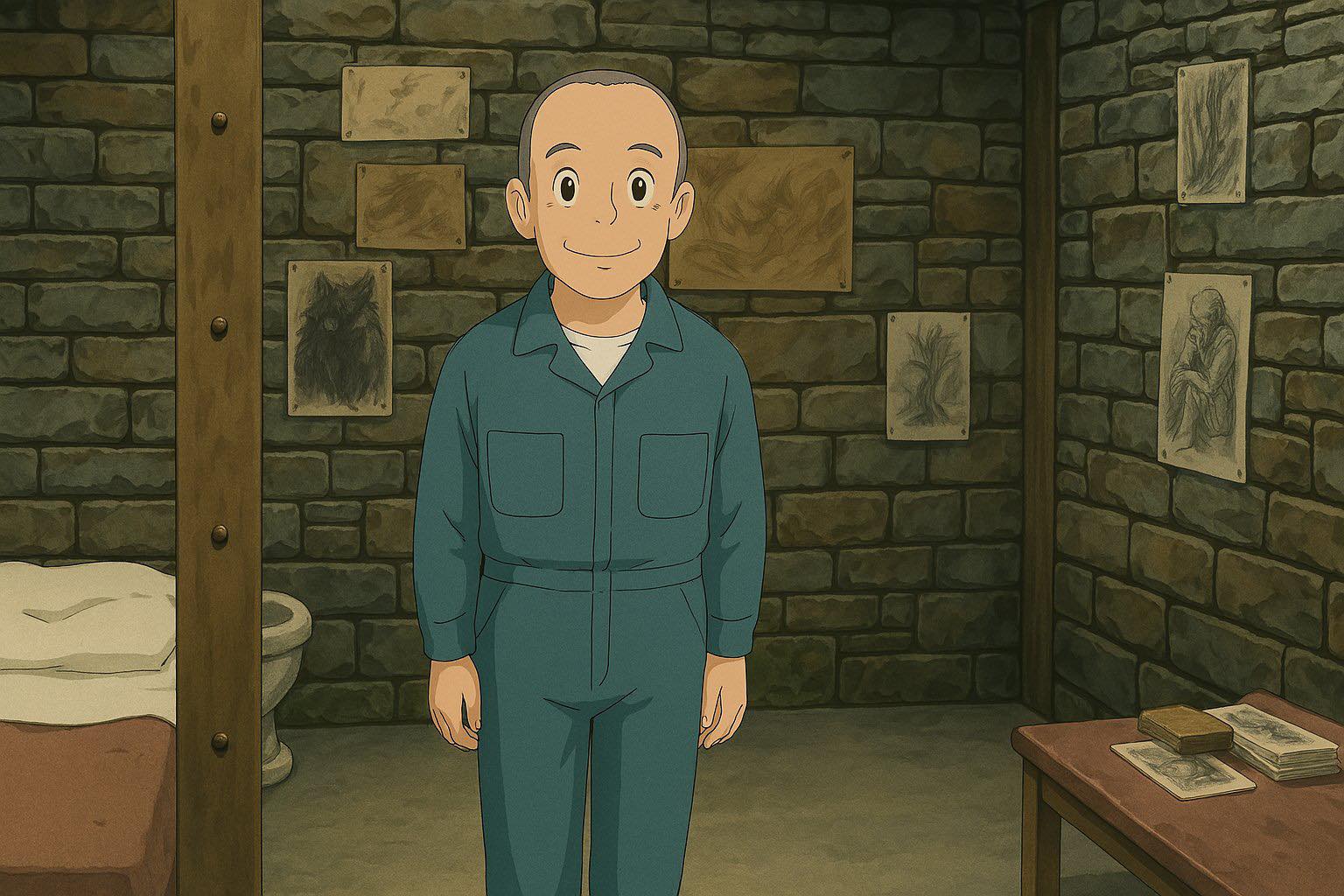
The scene depicts Lin standing in his boiler room workplace, constructed of stone. He is wearing a teal boiler suit and is depicted in a straightforward, slightly stooped pose. His expression is amiable but somewhat reserved. The room itself is functional, bordering on austere. Around him are sketches – depicting various spirits and creatures from the film – giving a sense of a hidden, unseen world of complexity beneath the surface. A folded pile of linens, a chamber pot, and a small table with books add to the sense of a lived-in, working-class space.
The visual tone is notably unflashy. It's a deliberate contrast with the often performative, polished image of Democratic politicians. The stone walls evoke a sense of solidity and grounding, representing the 'real' people as opposed to the 'establishment.'
Foucauldian Genealogical Discourse Analysis
This is where the meme really hits its stride in the Anti-DNC context. Foucault's work emphasizes how power operates not through top-down repression, but through the construction of discourses – systems of thought, language, and practice – that shape our understanding of the world and our positions within it.
- Discipline & Normalization: Lin, as a boiler man, embodies disciplined labor. He exists within a specific "regime of truth" - the expectation that someone must maintain the machinery that enables the bathhouse (a metaphor for society) to function. The DNC, in this analysis, performs discipline by demanding unwavering loyalty and conformity to its platform, thereby normalizing certain viewpoints and silencing others.
- Genealogy of Power: The meme challenges the genealogy of power represented by the DNC. It suggests that the DNC has historically presented itself as a champion of the working class, but has increasingly become disconnected from the needs of ordinary people. Lin represents the 'authentic' working class, unaffected by the ideological manipulations of the political elite. The sketches on the walls subtly point to an alternate, unseen reality outside the sanctioned narrative.
- The “Normal” as Controlling: The DNC presents a vision of "normal" politics. Lin, in his unassuming role, disrupts that notion of normality. He isn't a charismatic leader; he's just a guy doing a job. His very existence questions the necessity of the elaborate political theater the DNC engages in.
Marxist Conflict Theory
From a Marxist perspective, the meme highlights the inherent class conflict within society, and specifically, within the Democratic Party.
- Proletariat vs. Bourgeoisie: Lin embodies the proletariat – the working class. The Anti-DNC sentiment views the DNC leadership as increasingly aligned with the bourgeoisie (the ruling class), more focused on donor interests and maintaining the status quo than on representing the needs of the working class.
- False Consciousness: The meme implicitly accuses the DNC of perpetuating "false consciousness" – preventing the proletariat from recognizing their own exploitation and class interests. The perceived disconnect between the DNC's rhetoric and its actions is seen as evidence of this manipulation.
- Alienation: The boiler room environment (and Lin's solitary work) can be seen as a metaphor for the alienation of labor under capitalism. The Anti-DNC perspective argues that the DNC offers no real solution to this alienation, instead simply reinforcing the system that creates it.
Postmodernism
While not the primary focus, postmodern ideas underpin the meme's effectiveness.
- Deconstruction of Grand Narratives: The DNC, traditionally, presented a “grand narrative” of progress and opportunity. The meme deconstructs this narrative, questioning the very idea of a single, overarching story. Lin, with his quiet dignity, is an example of a lived experience that doesn’t fit neatly into the DNC’s narrative.
- Simulation & Hyperreality: The Anti-DNC viewpoint sees the DNC as increasingly engaged in "simulation" – creating a spectacle of politics that is disconnected from reality. Lin represents a return to the “real,” a grounding force in a world of manufactured images and narratives.
In summary:
In the context of "Anti-DNC," the Lin meme is a potent symbol of disillusionment, a rejection of political performance, and a call for a return to authentic representation. It uses the visual and narrative elements of Spirited Away to critique the power structures of the Democratic Party, highlighting issues of class, labor, and the manipulation of narratives. The meme’s success stems from its ability to tap into a deep-seated feeling of frustration and alienation felt by those who believe the DNC has abandoned its core principles.
simple-description (llama3.2-vision_11b)
The meme features a character from the movie "The Silence of the Lambs" with a caption that implies the person is against the Democratic National Committee (DNC). The image is likely a humorous take on the character's iconic persona, with the caption suggesting a tongue-in-cheek critique of the DNC.
detailed-analysis (gemma3-27b-vision)
Okay, here's an analysis of the image, broken down into relevant sections. Given the image's context (likely from Mononoke, a Japanese animated series), several of these frameworks do apply, while others are less central.
---
Visual Description
The image is a still from a 2D animated series, utilizing a distinct and somewhat muted color palette with strong outlines. The scene takes place in a rustic, likely interior space constructed from roughly-hewn stone bricks. The overall atmosphere is somewhat somber and suggestive of age or decay.
A man stands centered in the frame. He is depicted as balding with a relatively unremarkable face and a friendly expression. He is dressed in a dark teal/green jumpsuit over a white undershirt. To the left, a wooden doorframe is visible with bedding partially visible behind it. To the right is a small wooden table with a few objects (appearing to be paper or manuscripts) on top.
The walls are decorated with what appear to be framed drawings or sketches – shadowy and somewhat unsettling. The lighting is dim, creating strong shadows and emphasizing the texture of the stone walls. The artistic style leans towards a minimalist yet detailed aesthetic, with strong, deliberate lines.
---
Foucauldian Genealogical Discourse Analysis
This scene is rich with potential Foucauldian interpretation, given the series Mononoke's core themes of spirits, curses, and the underlying psychology of human suffering.
- Discourse & Power/Knowledge: The room itself is a significant space of discourse. The stone construction, the drawings, the objects on the table – all contribute to a discourse around memory, history, and potentially, the supernatural. This space doesn’t simply contain events; it produces them, shaping the understanding of the events unfolding.
- Genealogy of the Curse: Within Mononoke, curses aren’t magical anomalies; they are the result of "formlessness" manifesting through a specific shape. The room likely represents the physical manifestation of a particular history of trauma or sorrow – a genealogy of suffering. The drawings could be visual records of the events leading to the formlessness, the shapes of the curse, or the suffering that birthed it.
- Panopticism & Surveillance: While not immediately apparent, the arrangement of the room, the drawings acting as "eyes," and the implied presence of a narrator/observer could be linked to a form of panoptic surveillance. The man, and potentially any viewer, is positioned within a space of observation and control, even if the source of that control is ambiguous. This ties into the idea of "internalizing" the gaze.
- The Expert/Shaman: The man’s appearance suggests a role as an intermediary - a shaman, investigator, or expert in dealing with the supernatural. He is positioned within the discourse of the supernatural, not above it. His power is derived from understanding the genealogy of suffering embodied by the space.
---
Critical Theory
This image can be analyzed through the lens of Critical Theory, particularly focusing on the themes of alienation and the historical construction of reality.
- Alienation: The stone room, with its rough texture and somber atmosphere, suggests a space of isolation and disconnection. The man’s neutral expression could be interpreted as a manifestation of this alienation. The drawings represent a past that haunts the present, creating a sense of estrangement from authentic experience.
- Historical Materialism (implied): The room's existence implies a history, a set of material conditions that have shaped the present. Mononoke consistently ties spirits and curses to specific historical events and social injustices. The drawings aren’t merely artistic representations; they are material traces of past suffering.
- Ideology: The room can be seen as a site where dominant ideologies (e.g., beliefs about spirits, folklore, societal norms) are both reinforced and challenged. The man, as a figure who engages with the supernatural, is potentially positioned as either an agent of that ideology or a critical voice questioning its foundations.
---
Postmodernism
While Mononoke doesn’t overtly present a radical postmodern aesthetic, certain elements resonate with postmodern thought:
- Fragmentation & Deconstruction: The drawings on the wall are fragmented images, hinting at a disrupted narrative. This fragmentation reflects a postmodern rejection of grand narratives and an emphasis on local, subjective experiences.
- Ambiguity & Simulation: The nature of the supernatural in Mononoke often blurs the lines between reality and illusion. The room itself could be a simulated space, a construct of the mind, or a representation of a fragmented memory.
- The Death of the Author (to a degree): The meaning of the drawings isn’t fixed; it is open to interpretation. The "author" of the curse (the individual or events that created it) is often obscured or ambiguous.
---
Other Sections:
- Marxist Conflict Theory: While present in the broader context of Mononoke (the series often explores social injustices and the exploitation of people), it isn't immediately apparent in this single image. One could argue the man represents a class that attempts to intervene in conflict.
- Queer Feminist Intersectional Analysis: Not directly applicable given the imagery in this scene; although the series explores themes of societal marginalization and the internal struggles of individuals, these aren't prominent in this particular image.
I hope this detailed analysis is helpful! Let me know if you'd like me to elaborate on any particular point.
simple-description (llama3.2-vision)
The meme is an image of a character from the movie "Hannibal" (played by Anthony Hopkins) in a cartoonish, exaggerated manner, with a wide, toothy grin. The image is captioned "I love Hannibal" and is likely being used to express enthusiasm or admiration for the character. The meme is likely being used in a humorous or ironic way to poke fun at the character's sinister and unsettling nature.