First Seen
2026-03-24T09:02:57+00:00
simple-description (qwen3.5_2b-q8_0)
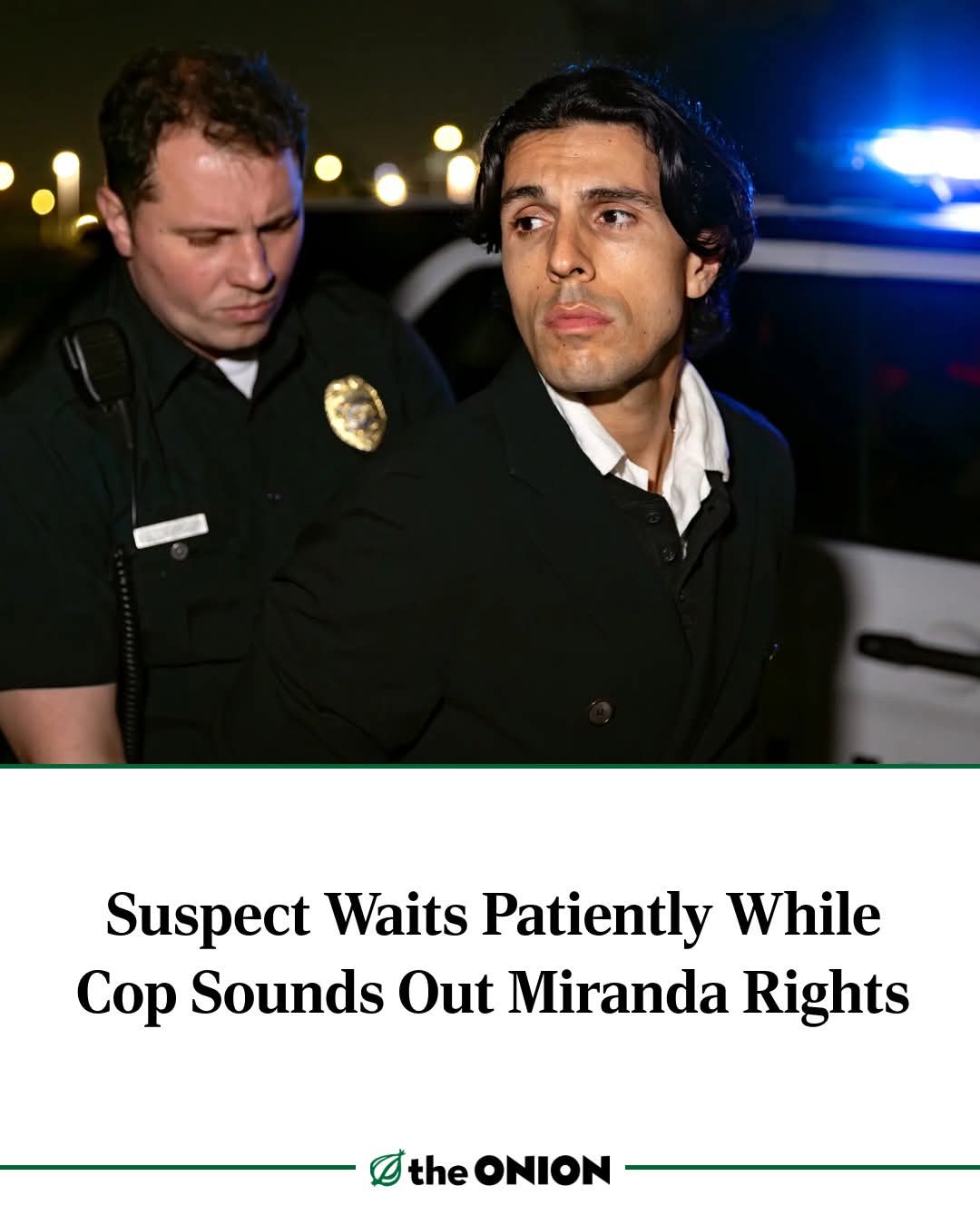
The image depicts a man being escorted by police officers at night. The overlaid text, which reads "Suspect Waits Patiently While Cop Sounds Out Miranda Rights," suggests a joke about how compliant and polite the authorities seem to be compared to other negative stereotypes of law enforcement.
While this specific meme is ironically sarcastic—mocking complaints about bad cops—it highlights the "Anticop" perspective by mocking officers who are portrayed as acting with patience and professionalism during an interrogation, rather than being depicted as rude or aggressive.
detailed-analysis (gemma3_27b-it-q8_0)
Okay, let's break down this Onion meme from an "Anti-Cops" perspective, utilizing the requested theoretical lenses where applicable. It’s important to understand that the meme’s core relies on satire and exaggeration to make a pointed commentary.
Visual Description
The image depicts a stark contrast. A visibly frustrated or put-upon man, dressed in a suit (suggesting he isn't necessarily a typical "criminal" archetype), is being escorted by a police officer. The man looks directly at the camera with a patient, almost bewildered expression. The officer, looking somewhat bored and rigid, is positioned close to the man, hands close to, and potentially on, the suspect's arms. The background is dark, illuminated by flashing police lights, creating a sense of confinement and formality. The lighting emphasizes the contrasting expressions: the suspect's thoughtful, almost resigned look versus the officer’s stern, unengaged presence. The meme’s text emphasizes the imbalance of power.
Foucauldian Genealogical Discourse Analysis
This meme is ripe for a Foucauldian analysis. Michel Foucault’s work highlights how power operates not through a central authority imposing rules, but through discourses – systems of thought, language, and practices that produce knowledge and, crucially, shape subjects.
- Discipline and Punishment: The scene directly invokes the ritual of the arrest and the reading of Miranda Rights. This isn't just about legal procedure; it’s a performative display of power. The officer’s recitation of rights is not necessarily about ensuring the suspect understands their protections, but about demonstrating the legitimacy of the state’s power to detain and question. The suspect’s patient waiting underscores the normalizing, disciplinary effect of this power. He is being subjected to the power structures that define his status as "suspect."
- Panoptic Effect: Though not visually explicit, the context of the flashing lights and the officer’s presence creates a subtle panoptic effect. The suspect is aware he is potentially under scrutiny, internalizing the norms and expectations of the system, even if he hasn’t done anything wrong.
- Genealogy of "Suspicion": The meme challenges the very idea of “suspicion.” It suggests that the process of labeling someone a "suspect" isn’t based on objective evidence, but on a discourse that allows authorities to arbitrarily impose control. The suspect's calm demeanor highlights the absurdity of being treated as inherently guilty.
Critical Theory
The meme operates as a form of critical commentary, exposing the underlying power dynamics inherent in policing.
- Hegemony: The meme implicitly critiques the hegemonic power of law enforcement. Hegemony refers to the way dominant groups maintain power not through force alone, but through shaping societal norms and beliefs. The expectation that a suspect should submit to questioning and the Miranda Rights procedure, even if innocent, demonstrates the normalization of this power dynamic. The meme subverts this expectation by depicting a suspect who doesn't fit the stereotypical image of resistance or guilt.
- Ideology: The meme unveils the ideology embedded in policing. The image deconstructs the narrative of “law and order” by showing the process as more of a ritualistic performance than a pursuit of justice. The suspect is treated as a problem to be processed, rather than an individual with rights and dignity.
Marxist Conflict Theory
From a Marxist perspective, this meme highlights the class-based conflicts embedded within the criminal justice system.
- State as an Instrument of Oppression: Marxists view the state (and its institutions, like the police) as instruments used by the ruling class to maintain its power and suppress dissent. The meme implicitly suggests that policing disproportionately targets and controls marginalized groups, contributing to the perpetuation of social inequalities. The suspect’s suit suggests a level of social standing, but the fact that he is still subjected to this process implies that anyone can be caught in the net of state control.
- False Consciousness: The passive acceptance of the Miranda Rights recitation can be seen as a representation of "false consciousness" – the acceptance of the dominant ideology even when it works against one's own interests. The suspect’s seeming acceptance of the situation reinforces the power of the system.
Postmodernism
While perhaps less directly, aspects of postmodern thought are present.
- Deconstruction of Grand Narratives: The meme undermines the “grand narrative” of justice and the rule of law. It presents a fragmented, absurd scenario that challenges the idea of a coherent, objective legal system.
- Simulacra and Simulation: The reading of the Miranda Rights becomes a "simulacrum" – a copy without an original. The actual protections offered by these rights are less important than the appearance of due process.
In summary, this Onion meme functions as a concise yet potent critique of policing. Through satire and visual contrast, it exposes the power dynamics, ideological underpinnings, and potentially oppressive nature of law enforcement from an "Anti-Cops" standpoint. The meme’s strength lies in its ability to evoke a feeling of absurdity that forces viewers to question the taken-for-granted assumptions about justice and authority.
simple-description (llama3.2-vision_11b)
The meme features a news headline with a photo of a police officer and a suspect. The headline reads "Suspect Waits Patiently While Cop Sounds Out Miranda Rights." The image is likely a satirical take on the concept of the "Miranda Rights" that are typically explained to a suspect by a police officer. The use of the word "patiently" in the headline is meant to be ironic, as it is unlikely that a suspect would be "patient" while waiting for their rights to be explained. The image is likely meant to be humorous or satirical, rather than a serious news story.