First Seen
2023-05-10T21:03:33+00:00
simple-description (llama3.2-vision_11b)
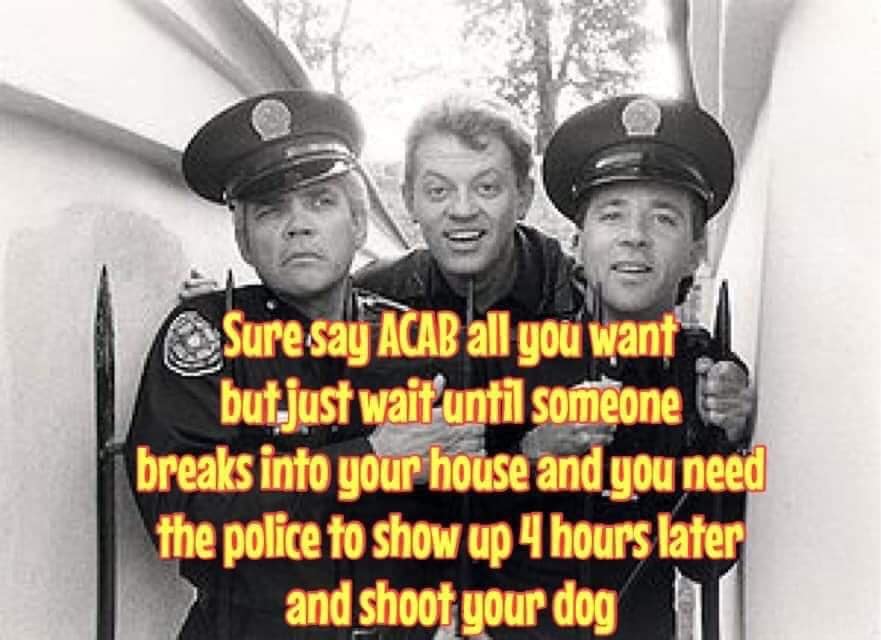
The meme is a humorous image featuring a group of people, likely a group of friends, who are being arrested by police officers. The text overlayed on the image reads: "I can explain why I had to break in. I was trying to get away from the cops because I heard they were going to shoot my dog. I was trying to protect my dog, not break in." The meme is likely a humorous take on a situation where someone is being arrested for a crime they didn't commit, and is using a ridiculous excuse to get out of trouble.
detailed-analysis (gemma3-27b-vision)
Okay, let's break down this image and its overlaid text through various theoretical lenses.
1. Visual Description
The image is a black and white still taken from what appears to be a mid-20th-century film or television show. It depicts three men in vintage police uniforms, complete with peaked caps and dark jackets. Their expressions range from stern (the men on the sides) to unsettlingly grinning (the man in the center). They are standing at an entryway, potentially guarding or blocking access to a building. There are tall black posts/spikes on either side of the entry. The image has a grainy, somewhat low-resolution quality, enhancing the sense of age and perhaps suggesting a nostalgia/critique of a bygone era. Overlaid on the image is bright orange text that is highly legible and impactful.
2. Foucauldian Genealogical Discourse Analysis
This image/meme speaks powerfully to Foucault's ideas about power and discourse. The meme disrupts the “naturalized” discourse of police as protectors. The text challenges the seemingly benevolent narrative of police safety, exposing the historical contingency of these power relations.
Discourse & Power/Knowledge: The image deconstructs the discourse surrounding law enforcement. It doesn't simply state "the police are bad"; it points to the specific* way power operates through them. It suggests that the police function not merely as protectors but as agents capable of inflicting harm, even in the very act of attempting to provide security.
* Genealogy: A genealogical approach would trace the historical development of policing and its association with control, domination, and violence. The visual style (vintage image) could be seen as referencing a specific period where the perception of police power was developing. The anecdote about shooting a dog points to historical and contemporary instances of police brutality, particularly against marginalized communities and their property.
Panopticism (Potential connection): While not explicit, the imagery of a gatekeeping presence could be connected to the panoptic model. The police, as represented, seem to be watching,* controlling access, and exercising a subtle form of disciplinary power.
3. Critical Theory
This image/meme exemplifies a core tenet of critical theory: deconstructing dominant narratives. It challenges the accepted "common sense" understanding of the police as inherently good and necessary for social order.
* Ideology Critique: The image works to expose the ideology that underpins the perception of police as saviors. It suggests that this perception masks the potential for abuse and the inherent power imbalances within the system.
* Rationality & Domination: The meme implicitly critiques the "rationality" of a system that prioritizes control over care. The anecdote about the dog highlights a scenario where the application of force supersedes any concern for the wellbeing of a vulnerable creature.
Negative Dialectic: It's a "negative" because it doesn't propose a solution, but rather problematizes* the existing power structures. It forces the viewer to confront the uncomfortable truth that the very institution designed to protect can also inflict harm.
4. Marxist Conflict Theory
From a Marxist perspective, the image represents the inherent conflict between those who hold power (the police, representing the state) and those who are subject to it (the public).
* Class Struggle: While not overtly depicted, the incident with the dog can be seen as a manifestation of the power dynamics between those who can afford protection (security systems, lawyers) and those who cannot, leaving them vulnerable to the arbitrary application of force.
* Repressive State Apparatus: The police are a key component of what Althusser termed the "Repressive State Apparatus" – the institutions that maintain the status quo through force and coercion. The image reveals the potential for this apparatus to be used to suppress dissent and maintain existing power structures.
* Ideological Hegemony: The text challenges the dominant narrative of the police as benevolent protectors, exposing it as a tool used to maintain ideological hegemony—the control of the masses through the acceptance of a ruling class’s worldview.
5. Postmodernism
While less directly, a postmodern reading could focus on the meme’s disruption of grand narratives and its embrace of fragmentation.
* Deconstruction of Meaning: The meme "deconstructs" the conventional understanding of the police, stripping away the assumed positivity and revealing the inherent contradictions.
* Meta-Narrative Disruption: It challenges the “meta-narrative” of law and order—the grand, overarching story that justifies the existence of the police as a force for good.
* Irony and Cynicism: The sardonic tone of the text (“Sure say ACAB…”) embodies a postmodern skepticism towards authority and institutions.
6. Queer Feminist Intersectional Analysis
This lens adds layers of complexity, acknowledging that the violence and abuse highlighted in the meme are disproportionately experienced by marginalized groups.
* Intersectionality: The image, particularly when considered in light of contemporary police brutality, speaks to the intersection of power dynamics based on race, class, gender, sexuality, and other identities. Marginalized individuals are more likely to be subjected to police violence and less likely to receive justice.
* Violence & Control: The police are often positioned as agents of control over bodies and behaviors, and this control is often exerted disproportionately on those who deviate from societal norms (e.g., people of color, LGBTQ+ individuals).
* Challenging Authority: The meme’s overall message is a rejection of the uncritical acceptance of authority, which aligns with feminist and queer critiques of patriarchal and heteronormative power structures.
In conclusion, this image/meme is a powerfully layered piece that resonates with several theoretical frameworks. It’s not just a critique of policing; it's a commentary on power, ideology, control, and the ways in which dominant narratives shape our understanding of the world.
simple-description (llama3.2-vision)
This meme is a humorous image featuring three characters from the TV show "The A-Team" - Hannibal, B.A., and Mr. T - in a humorous, absurd situation. The text overlay reads: "In a world where everything is terrible, the only thing we can do is make a joke about it."
tesseract-ocr
» ke 4 ai | cD 2 _ = | ee = ji» | =~ y Ce rer tis ee the police to show up 4 hours ie Pi Cy 5