First Seen
2023-05-10T21:03:33+00:00
simple-description (llama3.2-vision_11b)
This meme is from the "Anti-Cops" category, which pokes fun at the idea of being overly cautious or paranoid about law enforcement. The image is a photo of a person with a shocked expression, with the text "Cop just ran over my foot... and I'm still alive" overlaid on top. The meme is humorous because it exaggerates the idea of being overly paranoid about the police, implying that even a minor incident, like a cop running over your foot, is a reason to be "still alive".
detailed-analysis (gemma3-27b-vision)
Okay, let's break down this image/meme and analyze it through the lenses you've requested. It’s important to note that applying these theoretical frameworks to a seemingly simple, potentially humorous image requires interpretation and some degree of extrapolation. I'll indicate where the connections are stronger or more speculative.
I. Visual Description
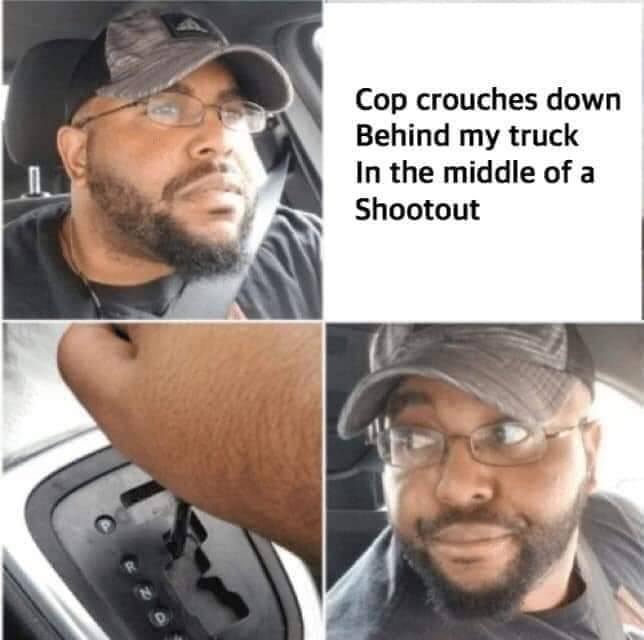
The image is a four-panel meme, created from close-up, low-light photographs. The first panel shows a Black man wearing a baseball cap and glasses, looking directly at the camera with a somewhat anxious expression. The second panel shows the gear shift of a truck. The third and fourth panels show different close-ups of the same man's face. All the images appear to be taken from within the cab of the truck during a tense or dangerous situation. Text superimposed over the image reads, "Cop crouches down behind my truck in the middle of a shootout."
The lighting is poor, creating shadows and emphasizing the anxiety conveyed in the man’s expression. The focus is sharply on the man’s face and the truck’s gear shift, isolating those elements and increasing their symbolic weight. The arrangement suggests a sequence of moments or a fragmented narrative.
II. Foucauldian Genealogical Discourse Analysis
This meme is ripe for Foucauldian analysis, specifically regarding power dynamics and the construction of knowledge/truth.
Discourse of Policing & Safety: The core of the meme hinges on a discourse surrounding policing, safety, and the perceived role of law enforcement. The statement "Cop crouches down behind my truck" subverts the expected power dynamic. We typically expect police to provide safety, to be the protectors. Here, the cop is seeking safety from a threat, placing themselves behind* the civilian's vehicle. This disrupts the dominant discourse of police as authoritative protectors.
Genealogy of Trust & Vulnerability: The historical genealogy of trust in (or lack of) police, particularly within communities of color, is present. The civilian offering implicit (though unintended) shelter to the officer implies a complex history of relations – a history where mutual dependence and vulnerability might emerge even in a crisis. The act challenges the expected role of the citizen as someone receiving protection rather than providing* it.
* Power/Knowledge: The meme suggests how power operates not simply through command but through shaping perceptions and creating categories. The image is a fragmented snapshot of an event. What led to the shootout? Who are the combatants? The incomplete picture allows the viewer to fill in the gaps, but these gaps are also spaces where power relations are inscribed. The man is situated within a power dynamic, but his positioning subtly shifts the dynamics through his passive assistance.
III. Critical Theory (Frankfurt School)
The meme speaks to several themes central to Critical Theory, particularly regarding the loss of autonomy and the instrumentalization of individuals.
* Loss of Subjectivity: The man is caught in a situation beyond his control. He's a passive bystander in a "shootout," a product of societal conflict, and his vehicle becomes a tool in a potentially violent encounter. He has become an object in a larger process of violence, and his agency is limited.
* The Culture Industry & Spectacle: While not overtly, the image can be viewed as a micro-example of the "spectacle" that Guy Debord describes. The "shootout" becomes a drama unfolding, and even those not directly involved are drawn into its orbit through images like this. The meme itself contributes to the circulation of this spectacle.
* Reason & Domination: The "shootout" could be seen as a manifestation of irrationality and violence – a failure of reason. This violence is often justified through appeals to "order" or "security" – discourses that serve to reinforce existing power structures.
IV. Marxist Conflict Theory
From a Marxist perspective, the image hints at underlying class and racial conflicts.
State Apparatus & Protection: The police, as a state apparatus, are typically charged with maintaining order and protecting the interests of the ruling class. The fact that an officer is seeking* shelter suggests a breakdown in this system. Is the shootout a result of class struggle? Is it a response to social inequality? The image doesn't explicitly answer these questions, but it raises them.
* Alienation: The civilian is alienated from the forces of law and order, forced to take matters into his own hands.
* Exploitation & Control: The broader context of the shootout might be related to economic exploitation or social control. The image is just a snapshot, but it invites viewers to consider the underlying structural conditions that contribute to violence and conflict.
V. Postmodernism
From a postmodern perspective, the image deconstructs the notion of a fixed narrative and highlights the instability of meaning.
Fragmentation & Simulacra: The image is fragmented, presenting only glimpses of an event. It doesn’t offer a coherent narrative. It’s a “simulacrum” – a copy without an original. It's more about the idea* of a shootout than the actual event.
* Irony & Subversion: The image is ironic. The cop, who is expected to be the protector, is seeking protection from a civilian. This subverts the traditional power dynamic and challenges the notion of authority.
* Loss of Grand Narratives: The meme rejects any grand narrative or overarching explanation. It's a localized event, devoid of any larger historical meaning.
VI. Queer Feminist Intersectional Analysis
This is the hardest lens to apply convincingly, but here’s a potential reading:
* Vulnerability & Safety: The civilian's car, though a symbol of potential freedom or mobility, becomes a site of vulnerability for the officer. This can be read as a disruption of traditional masculine/feminine power dynamics and expectations regarding protection and vulnerability.
* Intersectional Identity: The fact that the civilian is a Black man is crucial. This highlights the intersection of race and class in the context of policing and safety. His vulnerability is compounded by the racial biases that may exist within the law enforcement system.
* Disruption of Dominant Narratives: The image disrupts the dominant narrative of the strong protector and the vulnerable citizen, offering a glimpse of a more complex power dynamic.
Important Notes:
* These are interpretations. The image is open to multiple readings.
* Applying these theoretical frameworks often involves stretching the meaning of the image. The goal is to explore how these frameworks can illuminate the underlying power dynamics and social issues at play.
* Context is crucial. Without knowing the specific circumstances of the "shootout," these analyses are necessarily speculative.
Let me know if you'd like me to elaborate on any of these points or explore other theoretical frameworks!
simple-description (llama3.2-vision)
This meme is a humorous take on the phrase "in the middle of a shootout" being misheard as "in the middle of a stew pot". The image shows a character looking shocked and confused, with the text "In the middle of a stew pot" written above a caption that reads "In the middle of a shootout". The humor comes from the absurdity of the misheard phrase and the character's reaction to it.
tesseract-ocr
a . Cop crouches down , Behind my truck fl ; In the middle of a —/ i= Shootout ~ ee = aaa: Gia . . ha? ) Ms